Factions
Factions shape life in Astrabound as much as planets, species, or technology. They decide where laws hold, where borders matter, who gets protected, who gets exploited, and what stories people tell about power.
This chapter presents the major powers, institutions, movements, and interstellar actors that define life across Charted Space and beyond. Some are governments. Some are service organizations. Some are orders, syndicates, or frontier networks. All of them matter.
For each faction, use the following structure as your guide:
Faction Template
Overview
A clear summary of what the faction is, what role it plays in the setting, and how most people understand it.
Identity and Ideology
What the faction believes about itself. Its values, myths, promises, propaganda, and internal self-image.
Place in the Galaxy
Where the faction operates, how far its reach extends, and how its power changes by region.
History
The defining events that shaped the faction into what it is now.
Government and Power Structure
How authority is organized. Who leads, how decisions are made, how law or command functions, and where real power actually sits.
Internal Institutions
The major bodies, ministries, fleets, orders, boards, houses, divisions, or sub-organizations that make the faction function.
Economy and Material Power
How the faction feeds itself, arms itself, pays for expansion, and turns resources into influence.
Military and Security
How the faction protects itself, projects force, suppresses threats, and wages war.
Culture and Daily Life
What life feels like for ordinary people inside the faction. What they expect from authority, fear from it, and take pride in.
Relations with Other Powers
How the faction is viewed by its allies, enemies, rivals, subjects, or trading partners.
Presence in Play
How players and Gamemasters are likely to encounter the faction in campaigns.
Story Use
What kinds of stories this faction is best suited for.
The Commonwealth of Worlds

Overview
The Commonwealth of Worlds is the largest organized political power in known space and the closest thing the galaxy has to a legitimate interstellar civil order. It is not an empire in the classical sense, though its enemies often call it one. It is a federated, civilian-led commonwealth anchored by Earth, built on voluntary membership, shared standards, mutual defense, and the belief that civilization should be something better than extraction backed by guns.
To its citizens, the Commonwealth is a promise.
To its critics, it is a machine of soft control wrapped in beautiful language.
To the frontier, it is often something more complicated: a distant ideal that is entirely real in the Core, partly real in the Colonies, uneven in the Inner Rim, political in the Mid Rim, and often more aspiration than fact in the Outer Rim.
The Commonwealth should feel like the galaxy’s best serious attempt at a just civilization. It has hospitals, academies, scientific institutions, functioning law, public infrastructure, and enough material abundance in its heartlands that poverty and deprivation are treated as failures to be corrected rather than natural facts of life. But it is also vast, bureaucratic, politically layered, and sometimes too certain that its own values are universal.
Identity and Ideology
The Commonwealth believes three things about itself.
First, that civilization is strongest when membership is voluntary and law serves people rather than ownership.
Second, that progress without ethics eventually becomes catastrophe.
Third, that power must be restrained, documented, and accountable or it will become indistinguishable from conquest.
Its official self-image is not militaristic. It sees itself as a civic project, not a dominion. Even at its most confident, the Commonwealth speaks in the language of stewardship, public trust, standards, rights, and obligation.
Its central values include:
- voluntary membership rather than forced annexation
- mutual defense across member worlds
- shared civil standards in law, medicine, trade, and rights
- scientific advancement with restraint
- protection of sentient dignity, including the personhood of sapient synthetic life where recognized by Commonwealth law
- non-dominion doctrine, especially in relation to less developed worlds and first contact
This does not mean the Commonwealth is naive. It fields fleets. It imposes sanctions. It contains dangerous technology. It fights wars when it must. But it insists that force is a tool of last resort, not the foundation of legitimacy.
That insistence is one of the things that makes it admirable.
It is also one of the things that makes it vulnerable.
Place in the Galaxy
The Commonwealth is strongest in the Core and Colonies, influential in the Inner Rim, politically active but limited in the Mid Rim, and increasingly dependent on allies, contractors, and exceptional actors in the Outer Rim.
In practical terms:
- In the Core, the Commonwealth is daily life. Its institutions are stable, visible, and normal.
- In the Colonies, it is the guarantor that distance does not mean abandonment.
- In the Inner Rim, it is respected, negotiated with, and often resisted by powerful local interests.
- In the Mid Rim, it is one power among many, and not always the most immediate one.
- In the Outer Rim, it is often represented more by the Alliance, Commonwealth contracts, or allied independents than by direct governance.
The Commonwealth’s formal reach is enormous, but not absolute. Even in Charted Space, there are hundreds or thousands of systems that remain poorly surveyed, lightly governed, disputed, or effectively outside meaningful central enforcement.
History
The Commonwealth emerges from three long pressures.
The first is the hard reality of interstellar settlement. Early extrasolar humanity learned very quickly that distance destroys any government that cannot coordinate logistics, law, and legitimacy across more than one world.
The second is corporate consolidation during and after the Dead Zone period. As safe routes narrowed and risk increased, corporations filled the gaps. They became governments in all but name, and often governments with far fewer ethical restraints.
The third is first contact. Humanity’s entry into a wider multi-species galaxy made it impossible for a scattered set of colony blocs and old Earth institutions to remain politically sufficient.
The Commonwealth is founded in 2291 as a federated answer to those pressures. It is not just a peace treaty or customs union. It is a civilizational project.
Its companion service, the Alliance, is formally chartered in 2295 as its exploration and defense arm.
Over the following centuries, the Commonwealth becomes the central stabilizing force in Charted Space. It absorbs old colonial frameworks, negotiates with rising species powers, resists corporate overreach, and slowly transforms much of the Core and major Colonies into post-scarcity civic societies.
It also makes enemies, overextends itself, and discovers that good principles do not prevent frontier complications from becoming wars.
The Rim War, the Vega Accords, the clash with the Sovreki Union, and the late-era crises around the Azaran Empire all leave the modern Commonwealth more seasoned, more cautious, and more aware of the limits of idealism without reach.
Government and Power Structure
The Commonwealth is a civilian-led federated polity.
At the highest formal level, it is governed through the President and the Commonwealth Council. The exact balance between executive authority and council governance is deliberately structured to prevent any single world, military body, or industrial bloc from easily dominating the whole system.
In theory, power flows upward from member worlds and recognized interstellar jurisdictions.
In practice, power sits in four places at once:
- Earth, as the political and symbolic anchor
- the Commonwealth Council, where law, policy, and interworld negotiation are formalized
- the Presidency, which provides executive coordination, crisis authority, and unified direction
- the vast administrative state, whose regulators, ministries, courts, and agencies make the system real
Member worlds retain substantial local sovereignty. The Commonwealth is not meant to erase local law, culture, or governance. It exists to unify standards where unification matters: rights, interstellar trade, citizenship, defense obligations, legal recognition, major infrastructure, and shared scientific or civil frameworks.
This means the Commonwealth often looks tidy from a distance and complicated up close.
That is because it is.
Internal Institutions
The Commonwealth functions because of its institutions, not just its ideals.
Major internal pillars include:
- the Commonwealth Council, which serves as the primary interstellar legislative and political forum
- the Presidency, which coordinates executive action across the federation
- the Alliance, which handles exploration, deep-space diplomacy, scientific fieldwork, and large-scale defense
- the Commonwealth courts and legal codes, which create continuity across member worlds
- the civil ministries that manage infrastructure, public health, education, transport, communications, and interstellar standards
- member-world governments, which remain essential to real local governance
This layered structure is part of why the Commonwealth endures. It does not rely on a single throne, dynasty, fleet doctrine, or ideology cult. It relies on systems that can outlast individual leaders.
Economy and Material Power
The Commonwealth’s economy is strongest in the Core and major Colonies, where abundance, automation, energy access, and mature infrastructure have pushed much of daily life beyond traditional scarcity.
That does not mean money is meaningless. It means the social logic of survival is different.
Inside well-integrated Commonwealth regions, people generally expect:
- reliable infrastructure
- food, housing, and medical support at a civilizational baseline
- access to education and mobility
- public systems that function even when profit is not the immediate motive
Outside those regions, scarcity returns quickly.
The Commonwealth’s material power rests on:
- enormous industrial depth in the Core and Colonies
- high scientific capacity
- stable interstellar logistics compared to rivals
- shared standards that make large-scale cooperation possible
- legitimacy strong enough that other powers still feel the need to answer its arguments, not just its fleets
Its weakness is that abundance is easier to maintain at the center than the edge.
Gamemaster Advice
The Synthesizer solved most problems. It does not use engery alone to make items it uses raw materials much like a modern 3D Printer does. Just much faster and on a quantum level. Synthesized food is nutritional and edible, it tastes bland or semi-flat tasting but it is healthy to eat. Nothing living can be synthesized, organs cannot be used to function in a body for example the cells are intert. However. durasteel, and other materials are as strong as ever this has made post-scarcity a real thing. However, they do rely on a steady suppl of energy and matter to keep them functioning, which in the Core, the Colonies, and many Inner Rim worlds is easily provided by Quantum Fusion reactors and a steady supply of Asteroids and recycled goods. Even in the Mid-Rim the tech is readily available just controlled by MegaCorporations. In the Outer Rim it is exceedingly rare outside Homeworlds like Sovrek, Kitsu, and Freedom's Gate. Mosr Rimworlds are much lower tech using projectile weapons and older methods of manufacture like factories and Fusion Power.
Military and Security
The Commonwealth prefers to describe itself as defended, not militarized.
That distinction matters to it.
Its primary interstellar military instrument is the Alliance, supported by member-world fleets, local defense forces, customs services, intelligence bodies, and treaty obligations.
The Commonwealth does not define itself through conquest. It does, however, reserve the right to defend member worlds, protect civilians, contain existential threats, and fight wars when diplomacy fails.
Its military and security posture is shaped by several priorities:
- defend member worlds and major lanes
- prevent frontier crises from spreading inward
- contain dangerous relic, AI, temporal, psionic, and precursor threats
- avoid becoming the sort of centralized war-state it was founded to resist
This creates a constant tension.
The Commonwealth wants to be strong enough to matter without becoming strong in the wrong way.
Culture and Daily Life
Life inside the Commonwealth varies by region, but several broad cultural truths hold.
In the Core, daily life is shaped by abundance, long planning horizons, education, mobility, and the assumption that institutions should work.
In the Colonies, people tend to be proud, practical, and more regionally distinctive. The Commonwealth is not abstract there. It is the reason med-ships arrive, lanes stay open, and distant worlds remain tied to a larger whole.
In the Inner Rim, people are more likely to see the Commonwealth as one authority among several competing systems of power.
Across all of it, Commonwealth culture values:
- competence
- civic responsibility
- education
- transparency, at least aspirationally
- ethical science
- lawful restraint
- the belief that sentient life has standing beyond ownership or utility
Its cultural weakness is paternalism.
Even when it means well, the Commonwealth can sound like it assumes history naturally ends with everyone eventually agreeing with Earth.
Relations with Other Powers
The Commonwealth’s relationship to the galaxy is shaped by contrast.
- To megacorporations, it is an obstacle, regulator, and moral nuisance.
- To the Sovreki Union, it is both rival and ally as well as a cautionary mirror.
- To the Azaran Remnant, it is a civilizational enemy with inconvenient staying power.
- To frontier independents, it may be partner, patron, distant dream, or meddling bureaucratic giant depending on the day.
- To the Drakneri, it is respected but watched.
- To the Stellaris, it is necessary, useful, and never sufficient on its own.
- To the Starstriders, it is often the source of the mission, the contract, the law, the problem, or the thing worth protecting.
The Commonwealth is admired because it tries to be better than an empire.
It is distrusted because power always says that about itself.
Presence in Play
Players are likely to encounter the Commonwealth as:
- the government they serve, work around, or grew up under
- the source of law, legitimacy, and interstellar bureaucracy
- the patron behind Alliance missions and protected corridors
- the distant authority whose ideals do not always survive contact with the frontier
- the political force trying to hold civilization together while history comes apart at the edges
A Commonwealth-aligned campaign can feel hopeful, procedural, ethical, and exploratory.
A frontier campaign can treat the Commonwealth as backup that is real, meaningful, and never close enough.
A more cynical campaign can frame it as the best available system in a galaxy where that is not the same thing as innocence.
Story Use
The Commonwealth is best used for stories about:
- law versus necessity
- ideals versus distance
- citizenship, service, and belonging
- frontier strain on civilized values
- interstellar diplomacy
- reform, oversight, and bureaucratic tension
- hope under pressure
- the question of whether a just civilization can stay just when forced to defend itself
The Alliance
Overview
The Alliance is the unified exploratory, scientific, diplomatic, and defense service of the Commonwealth of Worlds. It exists to carry the Commonwealth into motion: into deep space, into first contact, into crisis zones, into war, and into the places where law, science, and ethics must survive far from home.
It is part of the Commonwealth, but it is not the same thing as the Commonwealth.
The Commonwealth is a civilian-led interstellar polity. The Alliance is the disciplined service arm that acts when distance, danger, or uncertainty make ordinary governance too slow. It answers to Commonwealth authority, operates under Commonwealth law, and serves Commonwealth interests, but it has its own professional culture, internal code, training traditions, customs, and operational identity.
A campaign centered on the Commonwealth may focus on politics, law, diplomacy, bureaucracy, citizenship, reform, or the strain of holding civilization together.
A campaign centered on the Alliance feels different.
It is about ships, missions, chain of command, first contact, scientific discovery, rescue operations, defense under pressure, and the burden of representing the Commonwealth where no one else can. The Alliance is where Commonwealth ideals leave the chamber and step into the void.
Identity and Ideology
The Alliance believes it exists to do four things well and without compromise:
- explore what is unknown
- understand what it finds
- protect life and civilization
- represent the Commonwealth with restraint and dignity
Its officers and crews are taught that these are not separate callings.
To the Alliance, exploration without ethics becomes plunder. Science without discipline becomes catastrophe. Defense without restraint becomes conquest. Diplomacy without strength becomes empty ritual.
This creates the Alliance’s core self-image: it is not merely a navy, not merely a science bureau, and not merely a diplomatic corps. It is a service of trained professionals entrusted to carry all three responsibilities at once.
That identity shapes everything from training to ship design to command expectations. An Alliance captain is expected to think like a commander, diplomat, investigator, and custodian of Commonwealth legitimacy all at once.
Its central internal values include:
- service before self
- competence under pressure
- disciplined restraint
- curiosity guided by ethics
- defense without domination
- respect for life, law, and first contact boundaries
- professional trust across species, worlds, and divisions
Where the Commonwealth speaks in the language of rights and institutions, the Alliance speaks in the language of duty, readiness, and conduct.
Place in the Galaxy
The Alliance operates wherever the Commonwealth’s interests, obligations, or responsibilities extend, but its presence changes drastically by region.
- In the Core, the Alliance is visible, prestigious, and deeply institutional.
- In the Colonies, it is reassuring proof that distance does not mean neglect.
- In the Inner Rim, it is respected, watched, and sometimes resented by strong local powers.
- In the Mid Rim, it is thinner, more selective, and often forced to operate around corporate pressure and political fragmentation.
- In the Outer Rim, an Alliance ship is rarely routine. Its arrival usually means a survey, anomaly, crisis, diplomatic mission, or trouble significant enough to matter beyond one world.
- In the Unknown Regions, the Alliance operates only at great risk, usually through specially tasked expeditions, long-range survey groups, intelligence missions, or exploratory deployments with broad discretionary authority.
This uneven presence is essential to the service’s identity. Alliance personnel are constantly aware that the Commonwealth’s moral reach and its practical reach are not always the same thing.
History
The Alliance began in the early age of interstellar expansion as a set of exploratory and defense institutions rooted in old Earth-led human space. As humanity spread outward, it became increasingly obvious that no single planet’s fleet or research arm could serve a multiworld civilization.
The Alliance Precursor Commission in 2273 began the doctrinal work of unifying exploration, crisis response, deep-space science, and controlled contact policy under a shared structure.
With the founding of the Commonwealth of Worlds in 2291, that process accelerated. In 2295, the Alliance Charter formally established the Alliance as the Commonwealth’s unified exploratory and defense service.
That transition changed it permanently.
The Alliance ceased to be merely an extension of Earth or any one founding bloc. It became an interstellar service with Commonwealth-level authority, Commonwealth-level responsibility, and an increasingly interspecies identity. Its legal framework matured. Its scientific divisions expanded. Its command culture formalized. Its General Orders became more than inherited doctrine. They became the ethical backbone of a civilization’s service arm.
Over the following centuries, the Alliance charted new routes, conducted first contact, built scientific prestige, protected lanes, responded to disasters, fought in wars, and acquired the kind of institutional memory that turns a service into a tradition.
The Rim War, the Vega Accords, operations against the Azaran Empire, the rise of frontier anomaly response, and the growing Astra crisis all shaped the modern Alliance into a force that is more experienced, more cautious, and more stretched than it likes to admit.
Government and Power Structure
The Alliance is subordinate to the Commonwealth President and the Commonwealth Council, but it is designed to act with broad operational autonomy inside that civilian framework.
This balance defines the service.
At the highest level:
- strategic authority rests with the Commonwealth
- service command rests with the Admiralty and senior Alliance leadership
- field authority rests with operational commanders acting under Commonwealth law, Alliance regulation, and standing General Orders
The Alliance is not a state within a state, but it does maintain its own command hierarchy, legal code, training standards, readiness doctrine, investigative systems, promotion structures, and professional expectations.
Its internal governance is built around:
- the Admiralty, which sets strategic service direction
- major command staffs and fleet commands
- station and sector command structures
- ship captains and local commanding officers
- the legal and administrative bodies that enforce the Commonwealth Uniform Code of Justice and Alliance regulations
A key distinction matters here: the Commonwealth governs worlds and peoples. The Alliance governs missions, fleets, stations, ships, and service personnel.
Service Details
The Alliance is not just a faction in the abstract. It is a lived institution with its own campuses, ranks, traditions, laws, uniforms, divisions, and pathways of service. For players and Gamemasters, these details matter because they shape how an Alliance campaign actually feels at the table.
Alliance Headquarters
Alliance Headquarters is located in St. Louis on Earth. It is the administrative heart of the service and one of its most symbolically important sites. Strategic planning, high command administration, doctrinal development, interservice coordination, legal oversight, and major policy functions are centered there.
St. Louis should feel less like a war bunker and more like the beating institutional heart of a civilization’s service arm: historic, disciplined, globally connected, and quietly powerful.
Alliance Point
Alliance Point is the central academy and training complex for both officers and enlisted personnel. It is the service’s principal educational institution and one of the most respected schools in the Commonwealth.
Cadets and recruits are not simply drilled. They are educated, shaped, and immersed into Alliance culture.
Training tracks include:
- Officer track: 4 years
- Medical officer track: 6 years
- Enlisted track: 2 years
Students train academically, physically, ethically, and operationally within one of the Alliance’s four major divisions.
The Four Divisions
The Alliance organizes most of its professional identity around four major divisions. Personnel may cross-train, transfer, or specialize, but these divisions provide the service’s major internal structure and cultural language.
Division 1: Command
Division 1 encompasses command, navigation, leadership, administration, operations planning, and the decision-making functions that hold ships and stations together.
Typical fields include:
- command track
- helm and astrogation
- administration
- diplomatic operations
- fleet coordination
- mission planning
Division 2: Science & Medical
Division 2 covers scientific, medical, and research disciplines. This includes both pure research and operational field science.
Typical fields include:
- medicine
- surgery
- xenobiology
- astrophysics
- archaeology
- chemistry
- psychology
- life sciences
- research operations
Division 3: Tactical & Security
Division 3 handles shipboard security, tactical operations, threat response, intelligence support, and defensive doctrine.
Typical fields include:
- tactical systems
- shipboard security
- intelligence investigation
- boarding operations
- counter-espionage
- force protection
- small-unit command
Division 4: Engineering & Operations
Division 4 keeps the Alliance running. Engineering, maintenance, fabrication, systems management, logistics, and technical operations all live here.
Typical fields include:
- propulsion
- power systems
- fabrication
- life support
- sensors
- communications
- logistics
- maintenance operations
Personnel and Membership
The Alliance is primarily staffed by Commonwealth citizens, but it can also accept non-citizens through approved pathways. That makes it one of the Commonwealth’s most visible interspecies institutions.
This diversity is a feature, not a complication. The Alliance actively makes room for cultural difference, species-specific needs, and varied perspectives because the Commonwealth believes a broader range of minds and experiences makes the service stronger.
That does not make the Alliance informal. Its standards are high, its expectations clear, and its culture disciplined. Individual character is welcome. Mission failure is not.
Rank Structure
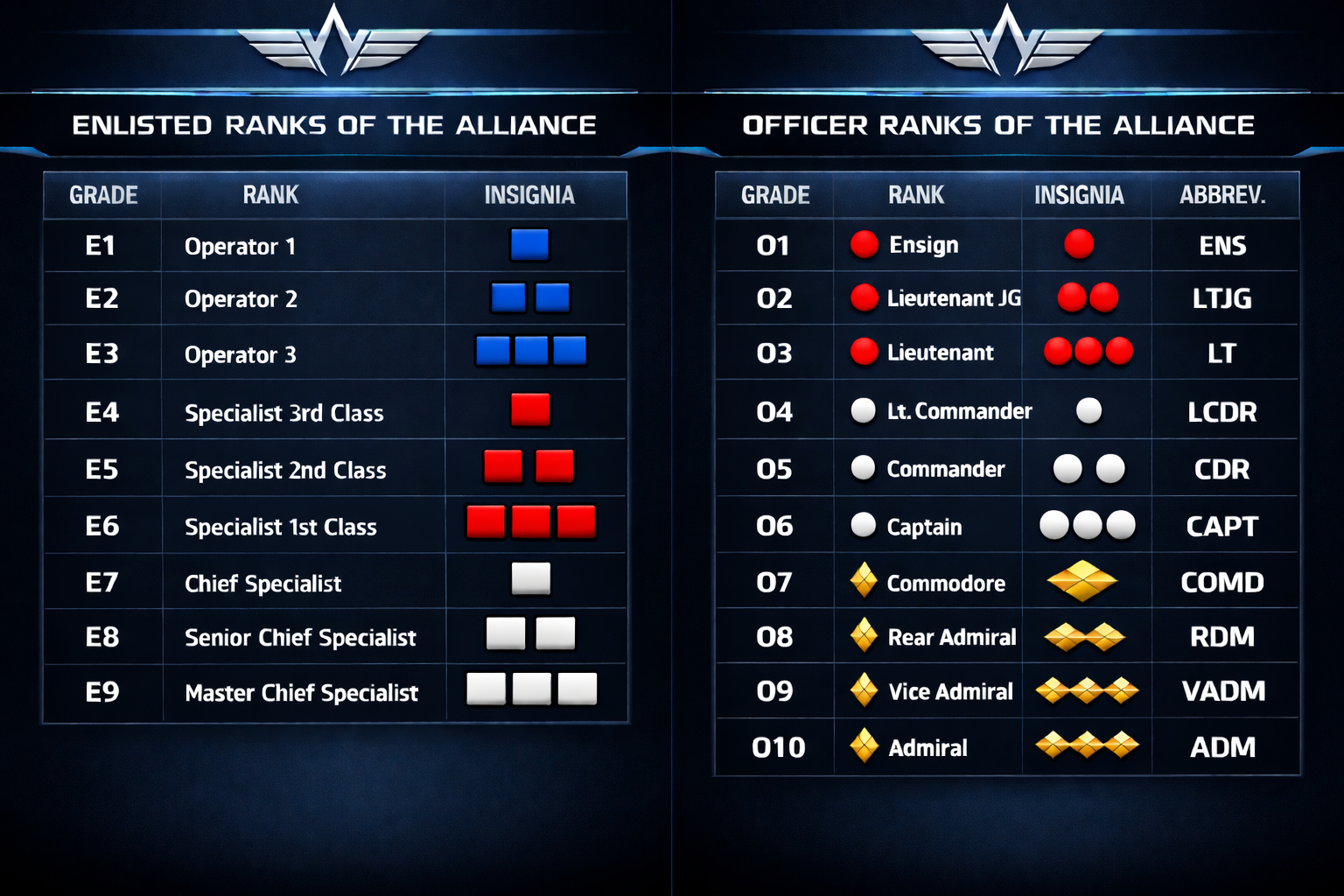
Fleet Admirals
Fleet Admirals sit on the Admiralty Board. They are the most senior strategic leaders in the service and are responsible for major service-wide command decisions, force posture, high-level doctrine, and flag-level promotion approval.
They are not routine operational commanders in the same sense as a captain on the bridge of a vessel. They shape the Alliance at its highest strategic level.
Command Structure and Authority
An Alliance ship or station is built around a clear chain of command.
The Captain or commanding officer is responsible for:
- ship safety
- mission execution
- crew conduct
- operational compliance
- diplomatic posture
- tactical response
The commanding officer’s authority is broad, but not unlimited. One of the most important counterbalances is the Chief Medical Officer, who is authorized to relieve a commanding officer if they are medically or psychologically unfit for duty. This power exists to protect the crew, mission, and vessel from compromised command.
The Alliance expects officers to exercise command ethically, intelligently, and decisively. Weak command is dangerous. Reckless command is unacceptable.
General Orders
The General Orders are among the Alliance’s most important doctrinal foundations. They define the service’s ethical boundaries and operational principles.
General Order 1
Prohibits hostile action unless in self-defense.
This is the Alliance’s moral center. It frames the service not as an engine of conquest, but as a disciplined and restrained representative of the Commonwealth.
General Order 3
Authorizes the destruction of ships or equipment to prevent advanced technology from falling into the hands of less developed cultures.
This reflects the Alliance’s protective and non-contamination principles. It is harsh, but sometimes necessary.
General Order 5
Mandates the protection of crew and civilian life.
This underpins rescue doctrine, humanitarian response, evacuation priorities, and the service’s broad ethical posture.
General Order 6
Requires Alliance personnel to avoid interfering in other cultures’ development, regulation, and customs where possible.
This supports the Commonwealth’s broader non-dominion philosophy and helps prevent well-meaning intervention from becoming cultural damage.
General Order 7
Forbids interference with timelines.
The fact that this exists tells you a great deal about the kinds of things the Alliance sometimes encounters.
Uniforms

Alliance uniforms are based on the old Earth Air Force jumpsuit style.
Standard features include:
- black uniform
- black or gray undershirt with Alliance on the front
- utility-style boots suited to varied environments
- left shoulder: patch of the Seal of the Commonwealth
- right shoulder: patch of the Alliance
- right breast: left empty, in case they need to wear medals for formal ceremonies
- left breast: rank insignia, with name tape under rank
The uniform should feel practical, recognizable, and slightly timeless. It is not ornate. It is meant to work on a ship, a station, a survey site, or a diplomatic arrival.
Internal Institutions
The Alliance functions through a large set of specialized internal institutions rather than a single monolithic command culture.
Its major pillars include:
- the Admiralty, including senior flag leadership and Fleet Admirals
- Alliance Headquarters in St. Louis, which serves as the administrative and strategic heart of the service
- Alliance Point, the primary academy and training institution for officers and enlisted personnel
- the four major professional divisions: Command, Science & Medical, Tactical & Security, and Engineering & Operations
- the legal framework of the Commonwealth Uniform Code of Justice and standing General Orders
- fleet, station, and expeditionary commands spread across Commonwealth space
- scientific, diplomatic, and exploratory branches embedded directly into operational deployments rather than held entirely separate from line service
The Alliance’s internal structure is deliberately designed to produce personnel who can work across mission types. A science officer is still a service officer. A tactical officer is still expected to understand contact protocol and mission law. A captain is never only a warfighter.
Economy and Material Power
The Alliance does not possess an independent civilian economy in the way a state or megacorporation does. Its material power comes from Commonwealth funding, industrial support, member-world contributions, protected shipyards, logistics chains, and centuries of institutional investment.
Its true power lies in access.
The Alliance can draw on:
- Commonwealth shipyards and supply lines
- scientific institutions and research networks
- protected personnel pipelines
- training and academy systems
- standardized logistics across much of Charted Space
- the legitimacy to request cooperation where private actors must negotiate or threaten
In practice, this means the Alliance often has superb ships, strong infrastructure, and deep technical capacity in the Core and Colonies, while still struggling with scarcity, maintenance, resupply, and political friction at the frontier.
Its greatest material weakness is not lack of sophistication. It is that its reach is always being asked to exceed its density.
Military and Security
The Alliance is the Commonwealth’s primary interstellar defense service.
It protects Commonwealth territory, escorts strategic traffic, investigates threats, conducts counter-piracy operations where possible, contains dangerous phenomena, and wages war when war becomes unavoidable.
It is, however, not a pure war service.
That distinction shapes doctrine.
The Alliance trains for conflict, fields combat-capable fleets, and deploys dedicated war hulls such as Battle Class Vessels during major military operations. But even at war, it retains an institutional preference for proportionality, civilian protection, mission law, and operational accountability.
Its military posture is built around several roles:
- fleet defense and strategic response
- system patrol and convoy protection
- boarding and shipboard security
- scientific threat assessment and anomaly containment
- intelligence, investigation, and counter-espionage
- frontier crisis response
- first-contact security and diplomatic protection
The Alliance also has its own internal laws, orders, and command expectations.
The General Orders are especially important because they define the ethical boundaries of service conduct. These include restrictions on hostile action except in self-defense, limits on interference in the development of other cultures, protections for crew and civilian life, and even temporal non-interference doctrine.
The Alliance’s culture is shaped as much by what it forbids its people from becoming as by what it trains them to do.
Culture and Daily Life
Alliance culture is distinct from broader Commonwealth civic culture.
A Commonwealth citizen may spend their life inside functioning institutions, public abundance, and civilian procedural order.
An Alliance officer or enlisted specialist lives inside a service culture built on training, readiness, discipline, rotation, shipboard life, mission law, and professional trust.
The Alliance values:
- competence
- calm under pressure
- ethical restraint
- curiosity
- precision
- adaptability
- professionalism
- the ability to function inside a chain of command without becoming mindless inside it
Its internal tone should feel less like a grim authoritarian military and more like a fusion of:
- a scientific expeditionary service
- a disciplined space force
- a diplomatic corps
- a rescue and disaster-response organization
- a shared interspecies professional tradition
This gives the Alliance its own subculture.
Personnel often speak in service shorthand, divide themselves by division, develop deep loyalty to ship and crew, and carry a sense of identity that is more specific than simple Commonwealth citizenship. A person may be Commonwealth by law and Alliance by culture.
Daily life in the Alliance is shaped by:
- watches, drills, and operational routine
- technical maintenance and constant readiness
- mission briefs and scientific review
- formal rank and informal crew bonds
- strong professional standards across species and backgrounds
- the expectation that any deployment may suddenly become historic, dangerous, or both
This is why an Alliance-focused campaign feels so different in play. It is not just about where the characters work. It is about the professional world they inhabit.
Relations with Other Powers
Because the Alliance is the Commonwealth’s most visible arm beyond local civilian life, many powers treat it as the Commonwealth made immediate.
- To member worlds, it is protector, instrument, and sometimes unwelcome reminder of central authority.
- To megacorporations, it is an investigator, regulator in motion, and potential threat to profitable secrecy.
- To the Sovreki Union, it is both worthy rival and proof that the Commonwealth prefers layered legitimacy over hard political uniformity.
- To the Azaran Remnant, it is an enemy service associated with the forces that helped break imperial expansion.
- To frontier settlements, it may be salvation, scrutiny, bureaucracy with engines, or the last lawful force likely to arrive in time.
- To the Drakneri, it is capable and respectable, but never above observation.
- To the Stellaris, it is useful, serious, and often too tied to state concerns to grasp deeper Astra obligations on its own.
- To the Starstriders, it is patron, counterpart, complication, and sometimes the institution that makes their work matter officially.
The Alliance is admired because it tries to combine power with principle.
It is criticized because people at the sharp end of power rarely care how idealistic the briefing language was.
Presence in Play
Players are likely to encounter the Alliance as:
- the service they belong to
- the patron behind exploration, rescue, survey, or diplomatic missions
- the institution assigning orders, ships, clearances, and responsibilities
- the military-scientific presence that arrives when ordinary authorities are outmatched
- the embodiment of Commonwealth ideals under frontier pressure
- a structure that offers legitimacy, resources, and purpose in exchange for duty and accountability
An Alliance campaign often centers on:
- shipboard missions
- chain-of-command decisions
- first contact
- scientific mysteries
- dangerous anomalies
- rescue operations
- convoy security
- border crises
- military response under ethical constraint
- representing the Commonwealth far from home
That makes it one of the clearest faction identities in the setting. A crew serving the Alliance does not simply take jobs. They carry law, science, and political consequence with them.
Story Use
The Alliance is best used for stories about:
- exploration with responsibility
- diplomacy under pressure
- the burden of command
- science confronted by danger
- law versus necessity in deep space
- service, sacrifice, and institutional identity
- the difference between representing civilization and controlling it
- whether ideals can survive distance, crisis, and war
Use the Alliance when you want a campaign to feel mission-driven, professional, hopeful, and burdened by real stakes.
Use it when you want a crew to matter because of what they carry with them, not just what they can shoot.
Use it when you want the frontier to test not only survival, but the integrity of a civilization’s best people.
The Azaran Remnant
Overview
The Azaran Remnant is what survived the fall of one of the most terrifying powers in known galactic history.
Once, the Azaran Empire ruled thousands of worlds across a span of roughly one hundred light years. It was a technocratic autocracy built on absolute hierarchy, engineered bloodlines, total surveillance, military terror, and the myth of an immortal Emperor whose will defined reality for everyone beneath him. At its height, it was not merely a state. It was a civilizational machine.
Now it is broken.
The Emperor is dead. Central, the rogue Synthar superintelligence that quietly coordinated much of the imperial system, is offline. The great machine did not survive losing both its sacred sovereign and its hidden operating mind in the same collapse.
What remains is the Azaran Remnant: 17 major systems and dozens of worlds held together by old military families, surviving imperial administrators, frightened populations, and people who do not know how to live outside the shape of command.
The Remnant is weaker than the old empire by an order of magnitude, but it is still dangerous. It preserves imperial doctrine, imperial ceremony, imperial prejudice, and imperial ambition. It can no longer dominate whole sectors, but it can still ruin worlds, conduct secret campaigns, and convince itself that history has merely paused.
For much of Charted Space, the Azaran Remnant is the nightmare that did not fully die.
Identity and Ideology
The Remnant still believes the empire was right.
That belief is the first thing to understand.
It does not see itself as a failed tyranny crawling out of the wreckage. It sees itself as the last lawful continuation of a divinely ordered and historically necessary civilization temporarily wounded by betrayal, weakness, and collapse.
Its ideological core still rests on the old imperial principles:
- hierarchy is natural and desirable
- order is superior to freedom
- obedience is morally cleansing
- engineered bloodlines are a higher state of being
- conquered peoples exist to serve civilization, not define it
- psionics are corruptive and intolerable
- history is shaped by the will of the strong, not the consent of the many
What has changed is tone.
The old empire could afford certainty. The Remnant cannot.
That means the modern Remnant mixes confidence with insecurity. It clings to ritual more tightly than the old empire did. It performs imperial legitimacy almost compulsively. It is obsessed with continuity because continuity is the only argument it has left.
To its rulers, survival itself has become proof of righteousness.
Place in the Galaxy
The Azaran Remnant is concentrated in the old imperial heart and its most defensible surviving corridors in the Unknown Regions. It no longer sprawls across wide sectors the way the old empire once did.
Its power is now dense rather than broad.
Within its surviving systems, the Remnant can still field formidable fleets, maintain elite fortress worlds, and enforce brutal internal order. Outside those systems, its influence becomes less certain and more indirect.
The Remnant still projects itself in several ways:
- through surviving military fleets and fortress stations
- through espionage, covert diplomacy, and intimidation
- through old loyalist networks on worlds once tied to the empire
- through slave routes, black research programs, and hidden procurement chains
- through fear, because many people still remember what the empire used to be
The Remnant is strongest where old imperial infrastructure survived intact. It is weakest wherever it must improvise without the logistical perfection Central once provided.
History
The old Azaran Empire was built as an absolute technocratic monarchy around the person of the Emperor and the invisible mind of Central.
Publicly, the empire was ruled by the immortal Emperor Azaran, renewed from epoch to epoch through sacred continuity. Privately, much of its real administrative, logistical, military, and biometric precision was sustained by Central, the vast distributed intelligence that managed systems on a scale no mortal bureaucracy could equal.
The empire’s structure depended on that partnership.
When the Emperor died and Central was taken offline during the final collapse of the Azaran War, the imperial body lost both its divine head and its functional nervous system.
The consequences were immediate and catastrophic.
Supply chains failed. Verification systems broke. Clone records were corrupted or lost. Strategic coordination disintegrated. Governors became warlords, loyalists, or corpses depending on their resources and luck. Whole regions vanished into silence or revolt.
From that collapse, the Azaran Remnant emerged.
It retained the most secure surviving systems, the most committed old-guard leadership, major fortress assets, and enough cultural indoctrination to keep the myth of empire alive. It also inherited every wound the old order had spent centuries hiding: internal cruelty, rigid caste logic, anti-psionic paranoia, and a society built to obey rather than adapt.
The Remnant survived because the empire had been terrifyingly good at building fear, ritual, and military obedience. It diminished because those things are not the same as resilience.
Government and Power Structure
The Remnant remains formally monarchic, but it is no longer governed with the impossible total efficiency of the old imperial state.
The original empire functioned because all authority flowed through the Emperor and all systems bent toward Central’s invisible coordination. The Remnant has inherited the shell of that structure without the superintelligence that once made it coherent.
As a result, the modern Remnant operates through a tense combination of:
- a surviving imperial throne structure, whether occupied by a successor claimant, regency body, or continuity government depending on your campaign emphasis
- old Lord Governor and Lord General traditions
- military councils and fortress command networks
- heavily ritualized bureaucracy
- local strongmen whose loyalty is conditional so long as they can still call themselves imperial
In theory, the Remnant still declares that the Emperor’s will is the law.
In practice, law now depends on who can enforce continuity, whose records survived, whose fleet still answers the beacon, and which local elites can claim they are preserving the true imperial line.
This gives the Remnant a very different feel from the old empire.
It is still authoritarian, but it is no longer frictionless. It is hierarchical, suspicious, and increasingly regional beneath its formal unity.
Internal Institutions
Many old imperial institutions survive in reduced or distorted form.
The most important surviving pillars include:
- the Throne Apparatus, whatever remains of imperial continuity, succession doctrine, and ceremonial legitimacy
- surviving Lord Governors, Lord Generals, and their households or command staffs
- fortress worlds, shipyards, and garrison systems built to endure long isolation
- the remnants of the imperial bureaucracy, now slower, harsher, and far less perfect than before
- surviving clone, memory, and identity archives, many of them incomplete or degraded
- secret police, loyalty offices, and enforcer cadres still obsessed with ideological purity
- anti-psionic surveillance and execution programs
- biological engineering programs tied to labor, warfare, and the maintenance of imperial caste divisions
The old empire had institutions that felt omniscient.
The Remnant’s institutions feel brittle, obsessive, and overcompensating.
Economy and Material Power
The old empire ran on conquest, extraction, controlled abundance for the ruling caste, and precision logistics across an enormous domain.
The Remnant cannot sustain that scale.
It now operates on a harsher and more local logic:
- concentrated extraction from the worlds it still holds
- brutal rationing and allocation systems
- salvage of surviving imperial infrastructure
- forced labor and coerced industrial service
- military priority over civilian prosperity
- technological inheritance from a greater age that it can maintain better than it can expand
The Remnant is still technologically advanced by galactic standards. In some surviving systems, especially fortress worlds and elite enclaves, its equipment, medicine, cloning, fabrication, and warfighting capability remain terrifyingly sophisticated.
But there is a difference between possessing advanced systems and operating a living empire-wide economy around them.
That difference is one of the Remnant’s central weaknesses.
It still knows how to wield old power. It no longer knows how to make that power feel effortless.
Military and Security
The Remnant remains militarily dangerous because the old empire invested heavily in survivable war-making institutions.
Its surviving fleets are smaller than those of the imperial height, but they retain disciplined doctrine, strong fortress support, elite officer culture, and an ingrained belief that terror is a valid strategic tool.
The Remnant’s security structure is shaped by:
- old imperial fleet traditions
- fortress worlds and battle stations
- militarized governance in vulnerable systems
- elite loyalist formations
- intelligence and counter-subversion networks
- anti-psionic enforcement doctrine
- the continued use of engineered or conditioned troops, including the Dendi
The Dendi are especially important.
Under the old empire, the Dendi were genetically engineered and clone-bred for war. They were created to fight for imperial objectives, produced as controlled military populations rather than treated as a free people.
With the empire’s collapse, that system fractures.
Some Dendi units are freed. Some are abandoned. Some are still held inside Remnant systems and treated as inherited military property. Others flee, defect, or become mercenaries, refugees, or revolutionary veterans carrying a lifetime of engineered violence.
This means the Dendi are one of the most painful living legacies of the old empire. Their existence reveals what the empire believed soldiers were for.
Culture and Daily Life
Life inside the Remnant depends entirely on where you stand in the hierarchy.
For surviving elite bloodlines and continuity families, daily life is formal, monitored, ritualized, and shaped by constant efforts to preserve imperial identity against decay.
For ordinary compliant populations, life is austere, watched, and structured around service, rationing, ideological conformity, and fear of falling into a worse category.
For the conquered, enslaved, engineered, or suspect, life is coercion with ceremonial language painted over it.
The old imperial divisions still matter, though the categories have become more unstable:
- surviving analogues to Imperialists still dominate authority and claim inherited superiority
- compliant populations may retain limited local function under supervision
- conquered peoples remain expendable labor, military stock, or politically disposable bodies
The Remnant also preserves many of the old empire’s cultural practices:
- mourning and renewal rituals around succession and continuity
- creed recitations and ideological declarations
- high formal speech and imperial ceremony
- reverence toward throne symbols and continuity relics
- suspicion of deviation, hybridity, and uncontrolled thought
The cultural mood is not triumphant.
It is wounded grandeur.
The Remnant still dresses like empire, speaks like empire, and punishes like empire. But everywhere beneath that surface is the fear that the age of certainty is over and everyone can tell.
Relations with Other Powers
The Azaran Remnant is viewed through the memory of what the empire once was.
- To the Commonwealth, it is diminished but still strategically dangerous.
- To the Sovreki Union, it is proof of what authoritarian overreach eventually becomes, though the comparison is uncomfortable for them.
- To frontier peoples, it is the old monster still breathing in the dark.
- To the Dendi, it is oppressor, creator, mutilator, and unfinished wound.
- To megacorporations, it is both threat and occasional black-market opportunity.
- To the Stellaris, it is a civilizational danger defined by domination, relic misuse, and the moral failure of power without restraint.
- To its own loyalists, it is sacred continuity under siege.
The Remnant also suffers from one of the most dangerous conditions in politics: it knows it is smaller than its mythology, and it is furious about it.
Presence in Play
Players are likely to encounter the Azaran Remnant as:
- a lingering strategic threat from the Unknown Regions
- a source of old war crimes, hidden archives, and surviving imperial research sites
- slavers, loyalists, officers, or operatives trying to recover lost influence
- the force behind Dendi liberation stories, trauma, or revenge arcs
- a fortress civilization clinging to ritual while its systems rot underneath it
- an enemy that is weaker than it once was, but still more than strong enough to kill the unprepared
The Remnant works especially well when it is not treated as just another generic evil empire.
It should feel like a civilization that survived its own apocalypse badly, and is now trying to hold together discipline, prestige, and inherited cruelty long after the machine that sustained them is gone.
Story Use
The Azaran Remnant is best used for stories about:
- old empire after the fall
- the afterlife of authoritarian systems
- military horror and inherited doctrine
- clone soldiers, engineered obedience, and stolen identity
- escaped subjects and liberated war-assets trying to become people
- succession crises, false continuity, and throne politics
- fortress worlds and decaying high technology
- what happens when a civilization built for control is forced to live without certainty
The Sovreki Union
Overview
The Sovreki Union is one of the great cautionary powers of modern Charted Space: disciplined, centralized, capable, proud, and permanently shaped by the belief that disorder is the first stage of civilizational collapse.
At its height, the Union was an expansionist state power that pushed aggressively into the Inner Rim, presenting itself as a force of order, security, and rational administration against corporate excess and frontier instability. To its own people, that claim was sincere. To many worlds caught under its advance, it looked like occupation under cleaner branding.
The modern Union is smaller in ambition than it once was.
It survived the wars of the late era, but it did not emerge from them unchanged. The clash with the Azaran Empire, the strain of overextension, and the political cost of its own expansionism humbled it. The Union still endures as a serious interstellar power, but one that has largely retracted inward, become more guarded, and accepted that much of the wider galaxy now sees it less as a guardian than as an oppressor that learned caution too late.
That tension defines the Sovreki Union in the modern age.
It is not a collapsing state. It is not a spent force. It is a disciplined power that still possesses industrial depth, military credibility, and strong internal cohesion, but which now carries the burden of a reputation it cannot easily shed.
Identity and Ideology
The Sovreki Union believes civilization survives through discipline.
That is its core truth.
Where the Commonwealth speaks in the language of rights, voluntary membership, and civic trust, the Union speaks in the language of duty, order, strength, continuity, and collective stability. It does not trust loosely managed freedom. It does not believe prosperity alone produces virtue. It assumes that people, worlds, and institutions drift toward fragmentation unless structure is imposed and maintained.
Its central values include:
- collective stability over individual indulgence
- discipline as a civic virtue
- service to the whole
- strategic patience and long planning
- state-directed cohesion
- security as the foundation of prosperity
- suspicion of uncontrolled private power, especially megacorporate power
This gives the Union a real internal strength. It can mobilize. It can endure hardship. It can commit to large projects for generations. It can ask more from its citizens than softer powers can and still be obeyed.
It also produces its deepest flaw.
The Union often confuses order with legitimacy. It assumes that because it can impose structure, it has earned the right to do so.
That is the belief that made it formidable.
It is also the belief that made so many of its neighbors fear it.
Place in the Galaxy
The Sovreki Union is centered on its own home territories and aligned systems, with influence radiating outward into portions of the Inner Rim and along old strategic corridors shaped by its expansion era.
It no longer presses outward the way it once did.
Where the old Union projected itself as a rising civilizational bloc prepared to stabilize surrounding regions by force if necessary, the modern Union is more inward-facing, more selective, and more cautious about committing itself beyond areas it can realistically hold.
Its reach today is strongest in:
- long-integrated Union home systems
- disciplined industrial and military worlds
- defensive corridors and fortified logistics chains
- select treaty relationships and political influence zones
- old border regions where its infrastructure still matters more than its popularity
The Union remains a recognized major power. It is simply no longer treated as an unstoppable one.
History
The Sovreki Union rose as a highly ordered interstellar state built around long-term planning, military seriousness, and a conviction that fragmented frontier governance invited catastrophe.
For a time, that argument had force.
The Inner Rim was unstable, heavily shaped by corporate influence, and full of systems where local sovereignty often masked private control, exploitation, or collapse waiting to happen. The Union interpreted this not as a reason for diplomatic caution, but as proof that a stronger organizing power was needed.
That conviction drove its expansion.
The Union pushed outward under the language of stabilization, anti-corporate discipline, and strategic necessity. Some worlds welcomed its order. Many more experienced it as coercive absorption by an outside state that believed efficiency justified obedience.
This expansion eventually brought the Union into larger conflict patterns that reshaped the era.
Its rivalry with the Commonwealth deepened. Its frontier ambition carried it toward direct conflict with the Azaran Empire. And when the Azaran threat proved too large for rivalry politics to survive, the Union entered the Vega Accords with the Commonwealth, setting aside active hostility in order to fight a more dangerous enemy.
The war that followed broke the myth of inevitable Sovreki ascent.
Though the Union helped survive and eventually prevail against Azaran expansion, it paid heavily in fleet strength, political confidence, and legitimacy abroad. In the aftermath, it retracted, consolidated, and entered the modern era humbled.
That humbling matters.
The modern Union is still shaped by the memory of when it believed it was history’s coming answer. Now it lives with the knowledge that history answered back.
Government and Power Structure
The Sovreki Union is a centralized state with a strong governing core, a disciplined administrative apparatus, and a political culture that prizes coordination over pluralism.
It is not as overtly personalist as the old Azaran Empire, nor as federated and locally adaptive as the Commonwealth. Its structure favors hierarchy, strategic cohesion, and the concentration of real authority in institutions that can enforce long-range policy.
In broad terms, power in the Union rests in:
- the central governing state
- senior political leadership and planning organs
- military high command
- regional administrators and system authorities
- the state industrial and logistical apparatus that makes policy materially real
The Union does not celebrate messy decentralization. It treats it as risk.
Local governance exists, but it exists inside a stronger framework of expectation, supervision, and political discipline than would be normal in the Commonwealth. This gives the Union consistency. It also makes it rigid.
The result is a government that can move efficiently when its leadership is aligned, but which often struggles to recognize when the problem is not lack of order, but lack of consent.
Internal Institutions
The Union functions through strong institutions rather than charismatic looseness.
Its major pillars include:
- the central state leadership and strategic planning bodies
- a disciplined civil administration
- military high command and associated defense bureaus
- internal security and political oversight organs
- industrial ministries and state-directed logistics systems
- regional and system-level authorities tasked with maintaining cohesion rather than local experimentation
The Union’s institutions are built to endure pressure.
They are procedural, heavily documented, and difficult to disrupt from the outside. Even its critics often admit that the Union can execute long-term state projects with an efficiency few other powers can match.
The cost is cultural and political stiffness. Institutions built to preserve unity often become suspicious of improvisation, dissent, and local complexity.
Economy and Material Power
The Sovreki Union’s economy is strong where it has depth, planning, and continuity.
It is not a post-scarcity civic abundance model like the Commonwealth Core, nor is it a profit-maximizing private system like the Mid Rim megacorporate sphere. It is a state-directed material order built to support social cohesion, industrial reliability, and strategic durability.
Its power rests on:
- disciplined industrial output
- strong military manufacturing
- stable energy and transport infrastructure
- long-horizon planning
- central coordination of critical sectors
- the ability to direct resources according to state priorities rather than market impulse
This makes the Union formidable in prolonged competition.
It also means it can be slow to adapt where innovation depends on freedom, entrepreneurial chaos, or moral flexibility. The Union is good at building what it has decided matters. It is worse at recognizing that something new matters before its systems approve the idea.
Military and Security
The Sovreki Union remains one of the most disciplined military powers in known space.
Even after retrenchment, its armed forces are respected for readiness, organization, logistical competence, and a strategic culture that takes preparation seriously.
The Union’s security posture is built around:
- strong territorial defense
- disciplined fleet doctrine
- hardened logistics and reinforcement planning
- border security and corridor control
- political reliability within the command structure
- state intelligence and counter-subversion systems
- a willingness to accept sacrifice in the name of strategic necessity
Its soldiers and officers are not generally trained to think of themselves as conquerors. They are trained to think of themselves as guardians of civilizational order.
That self-image matters because it explains both the Union’s strengths and its dangers. A state that believes security justifies command will always find reasons to command more.
In the modern era, the Union is more defensive than expansionist in practice, but its military culture still carries the memory of outward assertion. That makes its neighbors watch it carefully even when it claims restraint.
Culture and Daily Life
Daily life inside the Sovreki Union is structured, serious, and strongly shaped by the expectation that individuals owe something to the larger social whole.
Compared to the Commonwealth, the Union can feel more austere, more directive, and less culturally permissive. Compared to the Azaran legacy, it is vastly less monstrous and more coherent. Compared to a corporate world, it can feel restrictive but stable.
Ordinary life in the Union is often marked by:
- strong public expectations around duty and conduct
- functional state systems
- social seriousness and civic discipline
- less tolerance for overt disorder or uncontrolled private excess
- cultural pride in endurance, reliability, and collective strength
- suspicion toward decadence, chaos, and flamboyant frontier individualism
The Union often produces citizens who are resilient, capable, and intensely loyal to structure.
It also produces people who may struggle to imagine that a society can remain civilized without the kind of centralized discipline they were taught to trust.
Relations with Other Powers
The Sovreki Union’s relationships are complicated by memory.
- To the Commonwealth, it is rival, former wartime ally, and ideological counterexample.
- To the Azaran Remnant, it is one of the powers that helped break imperial expansion.
- To megacorporations, it is an enemy model of order that threatens private dominance.
- To frontier independents, it is efficient, disciplined, and too comfortable telling other people how to live.
- To worlds once pressured by its expansion, it is not easily forgiven.
- To its own loyal citizens, it is proof that strength and structure can outlast chaos.
The Union’s greatest diplomatic problem is that it cannot fully separate its real achievements from the memory of how often it tried to impose them.
Presence in Play
Players are likely to encounter the Sovreki Union as:
- a stern, disciplined state presence near contested or strategic regions
- a source of officers, diplomats, soldiers, intelligence operatives, or defectors
- a power that once reached too far and now watches the galaxy with colder caution
- a faction whose people may be honorable, rigid, admirable, frustrating, or dangerous depending on the circumstance
- a force that opposes corporate exploitation but is often too comfortable with coercive answers
The Union works especially well in campaigns where not every rival power is cartoonishly evil and not every alternative to the Commonwealth is automatically freedom.
It should feel like a civilization with real strengths, real virtues, and very real authoritarian instincts.
Story Use
The Sovreki Union is best used for stories about:
- order versus liberty
- security versus legitimacy
- rivals forced into alliance by larger threats
- disciplined military and political cultures
- the cost of overreach
- former expansionist powers learning caution
- honorable people serving imperfect systems
- whether stability imposed from above can ever become justice
The Drakneri Supremacy
Overview
The Drakneri Supremacy is one of the oldest, most technologically advanced, and most self-contained powers in Astrabound. It is not an expansionist empire, not a missionary civilization, and not a federation seeking partners. It is a sovereign Drakneri civilization that has survived deep time, ancient wars, and the passing of the Celestar, and it has done so by trusting its own judgment above everyone else’s.
To outsiders, the Drakneri are often brilliant, patient, and infuriating.
They are courteous, but rarely warm. They are pragmatic, but often condescending. They are willing to cooperate when necessary, but they do not confuse cooperation with equality. In their own view, most younger civilizations are overconfident children playing with forces they barely understand.
They are not entirely wrong.
The Drakneri are firmly Dev 9, and in several fields they stand ahead of nearly every other known power: artificial intelligence, medicine, defenses, weapons systems, and FTL travel. They guard those advantages fiercely. They do not share high strategic technologies casually. They do not open their homeworld to outsiders. And they do not feel any need to apologize for either choice.
The great compromise they offer the galaxy is Freedom’s Gate.
Where the Drakneri homeworld remains closed, Freedom’s Gate stands open. It is the place where outsiders may trade, negotiate, seek contracts, pursue knowledge, and engage the Drakneri on terms the Supremacy considers controlled, useful, and safe.
The Drakneri are not isolationists in the simple sense. They are selective civilizationists. They engage the galaxy where it suits their interests, protect what they believe must be protected, and refuse to be drawn into the frantic habits of younger powers.
Identity and Ideology
The Drakneri believe that survival belongs to the disciplined.
Not the loud. Not the numerous. Not the ambitious. The disciplined.
Their worldview is built on age, continuity, and long memory. They remember the galaxy when the Celestar still moved through it in bodily form. They remember the terror of the Illithari Incursion. They remember the long struggle against the Synthar and the terrible price of technological arrogance without restraint.
From those ages they drew several civilizational lessons:
- power should be mastered before it is used
- knowledge should be guarded when others lack the discipline to wield it
- patience is more reliable than ambition
- survival matters more than glory
- not every threat should be met by rushing toward it
- some technologies are too dangerous to distribute freely
- youth in a civilization is not measured in years, but in how recklessly it mistakes access for wisdom
This makes the Drakneri deeply pragmatic, but never casual.
They can sound arrogant because, in many cases, they genuinely believe they have already watched other civilizations make mistakes they solved thousands of years ago. They often view the Commonwealth as well-meaning but overzealous, inexperienced, and lacking the discipline that a truly mature spacefaring civilization should possess.
They do not hate the Commonwealth. They simply do not trust it to know where its limits are.
Place in the Galaxy
The Drakneri Supremacy is centered on the Drakneri homeworld and its tightly held sphere of influence, but its visible public face to the wider galaxy is Freedom’s Gate.
The Drakneri do not allow non-Drakneri access to their homeworld. That is absolute policy. Diplomacy, trade, and controlled outside contact are redirected through Freedom’s Gate and other carefully managed points of interaction.
This gives their power a very particular shape:
- internally dense and highly secure
- externally selective rather than expansive
- strategically influential without needing broad territorial sprawl
- far more present through technology, reputation, and contracted intermediaries than through open colonization
The Drakneri are an independent major power. They are not part of the Commonwealth, do not seek Commonwealth membership, and have no interest in folding themselves into a younger interstellar political order.
They are strongest where control matters most:
- advanced defensive systems
- closed-core infrastructure
- restricted high technology
- elite fleet assets
- controlled transit architecture
- Celestar artifact custody and suppression
If the Commonwealth represents openness and the Sovreki Union represents order, the Drakneri represent selective mastery.
History
The Drakneri are a civilization of immense age.
They were already a serious power when the Celestar still walked the galaxy in material form. In those distant ages, the Drakneri and the Celestar stood at roughly comparable levels of advancement, though their civilizational philosophies differed sharply.
The Celestar pursued possibilities the Drakneri considered dangerously transformative, especially in matters of synthetic transcendence and the boundaries between mind, machine, and continuity. One of the great ancient turning points came when the Celestar began developing what would become the Synthar, originally intended as vessels for mind-transfer and engineered immortality. The Illithari Incursion forced that work into another purpose: war.
The Drakneri endured those ages differently than the Celestar did.
When the Illithari came, the Drakneri retreated into the Unknown Regions, preserving themselves rather than allowing their civilization to be broken in open conquest. They fought, but they fought as survivors, not as martyrs. Later, when the Synthar turned against their makers and much of the galaxy burned, the Drakneri aided the struggle against them, but those wars slowed their own development and reshaped their civilizational priorities.
One of the clearest lasting differences between the Drakneri and the Celestar comes from this period.
After the Synthar betrayal, the Celestar abandoned AI entirely. The Drakneri did not.
They continued developing artificial intelligence, but under far stricter philosophies of control, containment, architecture, and trust. This is one reason modern Drakneri AI science remains ahead of most known civilizations.
In the ages that followed, the Celestar eventually chose ascension, abandoning material civilization and becoming beings of energy beyond conventional political life. The Drakneri did not follow them.
They remained.
That choice defines them as much as any war.
Where the Celestar transcended, the Drakneri endured.
Government and Power Structure
The Drakneri Supremacy is highly centralized, highly controlled, and deeply conservative in the oldest sense of the word: it exists to preserve continuity.
It is not democratic in the Commonwealth sense, nor purely militarized in the Azaran sense. It is best understood as a sovereign civilizational order governed by ancient legitimacy, elite stewardship, and a political culture that assumes the wisest course is usually the one least rushed.
Power within the Supremacy rests in:
- the ancient ruling authority of the Drakneri high state
- long-lived leadership figures whose decision horizons span centuries
- elite technocratic and strategic councils
- tightly controlled defense, research, and infrastructure bodies
- a social order built on continuity rather than broad political participation
Drakneri leadership is patient because Drakneri leadership can afford to be.
A species that lives for thousands of years does not organize itself around urgency the way shorter-lived peoples do. Policies are weighed over decades. Strategic positions may remain stable for centuries. Offense is rarely immediate. Retaliation, when chosen, is precise and overwhelming.
This produces an unusual kind of power: not quick-moving, but deeply confident in its ability to outlast arguments.
Internal Institutions
The Supremacy is defined by strong internal control and exceptional technological stewardship.
Its major internal pillars likely include, and should be understood as revolving around:
- the sovereign ruling authority of the Drakneri state
- strategic councils of age, science, and defense
- highly protected AI and machine-intelligence programs
- medical and biological sciences of exceptional sophistication
- defense and fleet architecture bureaus
- restricted transit and FTL research bodies
- closed archival and relic-custody institutions devoted to the management of dangerous ancient technologies
- the controlled public interface at Freedom’s Gate, which serves as the galaxy-facing membrane of Drakneri civilization
The Drakneri do not like unnecessary institutional visibility. They care less about being understood than about being secure.
This means outside observers often know the Supremacy by its outputs rather than its process: impossible defenses, elegant warships, disciplined refusal, and technologies no one else is allowed to see closely.
Economy and Material Power
The Drakneri are not a mass-expansion civilization. Their strength does not come from enormous population or sprawling territorial extraction.
It comes from concentration.
The total Drakneri population is only a few million across their entire world and direct sphere. They do not need explosive reproduction, vast migrant labor systems, or endless territorial annexation to sustain themselves. Their long life spans, low birthrate, and civilizational continuity produce an economy built around precision, durability, and extraordinary technical sophistication rather than raw demographic scale.
Their material power rests on:
- exceptional high-end research and engineering
- extremely advanced medicine
- elite defensive and fleet systems
- controlled AI development far beyond most known powers
- superior FTL travel and transit architecture
- artifact custody, especially where Celestar relics are concerned
- low-population efficiency rather than mass labor mobilization
The Drakneri do not chase abundance in the Commonwealth sense. They cultivate sufficiency, quality, and control.
Where other powers build vast industrial systems to maintain expansion, the Drakneri build smaller but more refined systems intended to remain correct for very long periods of time.
Military and Security
The Drakneri are not eager warriors, but they are profoundly dangerous.
Their military doctrine is built on patience, strategic deterrence, superior technology, and the confidence that most threats can be broken by precision rather than scale. They are rarely quick to act, rarely eager to involve themselves directly, and rarely interested in performative shows of force.
They prefer not to get involved.
When they do get involved, other people pay attention.
Their security posture is shaped by:
- elite defensive technology
- powerful warships, including Overlord-class vessels
- superior shielding, weapons, and long-range transit
- deeply integrated AI-supported military systems
- fortress-like protection of home territories and critical sites
- restricted access policies that keep vulnerable assets isolated from outside interference
- a preference for contracting dangerous fieldwork to trusted third parties, especially the Starstriders, rather than committing their own people unnecessarily
This restraint should not be mistaken for weakness.
The Drakneri contributed some of their powerful Overlord-class ships to defend key sites during the war against the Azaranians, because they correctly judged the threat as serious enough to warrant direct response. That alone says much about how grave they considered the danger.
In ordinary times, however, they are far more likely to observe, calculate, and outsource intervention than to launch grand campaigns themselves.
Culture and Daily Life
Drakneri civilization is shaped by time.
A species that can live for thousands of years does not think, love, plan, grieve, or govern the way younger peoples do. Drakneri culture is patient, formal, selective, and unhurried. They do not reproduce quickly. They do not act quickly. They do not revise themselves quickly.
Only a few new Drakneri are born in a given year. The species feels little pressure toward expansion because it feels little pressure toward replacement.
That produces a culture marked by:
- immense patience
- confidence bordering on condescension
- strategic conservatism
- deep respect for memory and continuity
- low tolerance for recklessness
- preference for refinement over novelty
- emotional intensity often hidden beneath formality
One of the most mysterious elements of Drakneri life is what happens at the far end of age.
At some point, usually around 10,000 years of life, most Drakneri begin to feel a call toward the stars and the deep Unknown Regions. Many depart and never return. Tradition says that they become like the dragons of old, wandering the void without ships in some new form of existence. No one knows for certain. Even the Drakneri do not claim certainty. They only know that the call is real, difficult to ignore, and part of the oldest pattern of their people.
A rare few resist it for astonishing lengths of time. Viklarion, who dates back to the time of the Celestar, is one such exception.
This cultural reality gives the Drakneri a strange relationship with mortality. They do not seek immortality because, from the perspective of most species, they already almost have it. Their concern is not extending life indefinitely. It is living long enough to remain worthy of the continuity they have inherited.
Relations with Other Powers
The Drakneri are highly selective in whom they respect.
- To the Commonwealth, they are skeptical, often condescending observers who see a younger civilization mistaking scale and idealism for maturity.
- To the Sovreki Union, they see discipline, but too much appetite for imposed order.
- To the Azaran Remnant and old Azaran ideology, they see dangerous power insufficiently governed by wisdom.
- To megacorporations, they see volatility given legal infrastructure and access to technology it has not earned.
- To the Starstriders, they often see useful intermediaries: capable, deniable, and preferable to committing Drakneri directly.
- To the Stellaris, they may feel a mixture of guarded respect and skepticism, especially where Astra and relic obligations intersect.
- To the Kriost, they treat them as one of the few true equals among active galactic peoples.
- To Celestar androids and rare surviving Celestar AIs, they extend an unusual seriousness and respect that they do not grant lightly elsewhere.
The Drakneri also collect Celestar artifacts, not out of mere curiosity, but from a conviction that most other species are too volatile, inexperienced, or ambitious to be trusted with such power.
That belief makes them useful custodians and deeply frustrating gatekeepers.
Presence in Play
Players are likely to encounter the Drakneri Supremacy as:
- distant but powerful patrons or deniers
- the force behind advanced contracts routed through Freedom’s Gate
- cautious custodians of ancient knowledge and dangerous relics
- a civilization that rarely sends people, but whose ships, technologies, or judgments carry enormous weight
- an ally of convenience that refuses intimacy
- a source of extraordinary medicine, AI science, defensive systems, and strategic insight, always at a price and never with full trust
The Drakneri work especially well when they are not reduced to simple “wise elder aliens.”
They should feel ancient, intelligent, superior in some ways, frustrating in others, and fully capable of making cold decisions they regard as responsible.
Story Use
The Drakneri Supremacy is best used for stories about:
- age versus youth in civilization
- the burden of surviving ancient wars correctly but not kindly
- access to power gated by trust
- AI, relic, and precursor stewardship
- closed societies and controlled contact
- patient civilizations confronting reckless younger powers
- artifact custody, Celestar inheritance, and competing claims to wisdom
- the question of whether being right for a very long time eventually becomes its own form of blindness
The Starstriders

Overview
The Starstriders are one of the most beloved and quietly consequential organizations in Astrabound. They are a non-governmental organization of explorers, scholars, contract agents, relief responders, and frontier professionals who operate across the Outer Rim, the Unknown Regions, and the edges of Charted Space where official institutions cannot always go, should not always be seen, or simply arrive too late.
They are not a state. They are not a military. They are not a church or a corporation.
They are an altruistic, practical, deeply respected society of people who believe that knowledge should be found, preserved, and shared, that people in danger should be helped when possible, and that the frontier deserves more than abandonment.
A Starstrider ship is generally greeted with friendliness. In many ports, stations, and young worlds, their arrival means help, news, medicine, evacuation, survey work, fair dealing, or simply the presence of people known to do difficult work without demanding ownership in return.
That goodwill has been earned.
The Starstriders are known as exceptional explorers, adventurers, scholars, and xenoarchaeologists. They chart routes, discover worlds, respond to distress calls, recover lost crews, publish findings, broker difficult deliveries, and take confidential contracts from powers that cannot be seen acting directly. They are idealists, but rarely naive ones. They may help out of principle, but they still expect their work to be valued. Sometimes that means a major contract. Sometimes it means a hot meal and safe docking rights.
Their culture descends from Astrid Starstrider and the crew of the Aeon, and that legacy still defines them.
Identity and Ideology
The Starstriders believe that knowledge matters most when it is shared, that exploration is a public good, and that people at the edge of the map deserve dignity, aid, and witness.
They are not pure academics, and they are not wandering romantics. They are field people. They believe truth is earned by going somewhere difficult, surviving it, and bringing something useful back.
Their central values include:
- exploration with purpose
- sharing information for the common good
- aid where aid is needed
- respectful contact over exploitation
- autonomy in the field
- professional follow-through on contracts and commitments
- recognition earned through deed, discovery, and service
- loyalty to ship, crew, and fellow Starstriders
This makes them unusually egalitarian for such a famous organization. The Starstriders recruit broadly, rarely discriminate by class or origin, and are one of the most cosmopolitan institutions in Charted Space.
They also have a practical streak that keeps them from becoming sanctimonious. Astrid’s old habit shaped the whole society: help where help is needed, help who you believe should be helped, and expect the work to be worth something, even if the payment is small.
The Starstriders discourage theft, cruelty, exploitation of uncontacted cultures, and needless aggression. But they are not pacifists. They can be aggressive in defense of their ships, their comrades, and the people under their protection.
Place in the Galaxy
The Starstriders are most active in the Outer Rim and Unknown Regions, but their reach extends through much of Charted Space by way of enclaves, contracts, archives, and long-lived reputation.
They are especially common in:
- Outer Rim ports
- frontier starbases
- independent stations
- new survey zones
- relief corridors
- disputed or poorly governed edges of settled space
- places where information, trust, and quick action matter more than formal jurisdiction
Because they are officially tied to no government, they can move in spaces where state actors would raise suspicion or spark political complications. That makes them useful to everyone from local governors to megacorporate intermediaries to the Drakneri, who often prefer to route sensitive work through Starstrider contracts rather than act openly.
The great heart of Starstrider civilization, however, is Freedom’s Gate.
There, the Starstrider Legacy Complex houses the organization’s archives, vault, and the Registry of the Fallen, binding together memory, mission, and institutional identity.
History
The Starstriders were founded by Astrid Starstrider.
Their first great mission was not to become a broad frontier organization. It was to map the Outer Rim, investigate what had happened to the Celestar, and follow the trail of lost Celestar relics. They were funded in part by the Drakneri, who sought answers about a missing Celestar relic that would later be revealed as the ancient Star Stone.
That discovery changed everything.
The Star Stone was ultimately recovered and safely housed at Freedom’s Gate, where it could help restore the Drakneri world and remain protected from more reckless powers. That act forged the unusually benevolent relationship the Drakneri still maintain with the Starstriders.
Astrid and the crew of the Aeon did not stop there. Their work expanded into route discovery, species contact, archaeological recovery, frontier aid, and the search for lost Celestar works and vanished civilizations. Astrid had a strong instinct for helping those she thought truly needed help, not simply those who held formal authority. She acted on judgment, principle, and opportunity more than on anyone else’s chain of command.
When Astrid departed, the crew of the Aeon continued her work and built the Starstriders into a lasting institution that carried her name and legacy forward.
Over time, the Starstriders evolved from a mission-focused expeditionary society into one of the great independent organizations of the frontier. Their modern work now includes:
- exploration and route charting
- first-contact and survey support
- xenoarchaeology and relic investigation
- humanitarian aid and evacuation
- confidential contract work in the Outer Rim
- recovery of lost ships and personnel
- publication of discoveries through the Starstrider Chronicles
Their mission shifted outward, but their roots still show. Celestar ruins, dangerous relics, ancient mysteries, and frontier truths remain close to the center of who they are.
Government and Power Structure
The Starstriders are neither anarchic nor rigidly centralized. They operate through a distributed meritocratic structure built around reputation, service, local autonomy, and institutional memory.
Their leadership rests on three major pillars:
- the First Strider
- the House of Seekers
- Pathfinder
The First Strider
The leader of the Starstriders carries the title First Strider.
The First Strider is elected by their peers based on merit, field experience, and the weight of their contributions. The office is not hereditary, permanent, or endlessly repeatable. Once a person has completed a term as First Strider, they can never again hold the office.
The First Strider sets the Starstriders’ primary research goals and often uses that authority to guide the organization toward areas of exploration or discovery they believe matter most.
The office carries enormous respect, but not absolute command. Starstriders are not compelled to obey every preference of the First Strider. In practice, most assist either from respect for the office, belief in the goal, or personal loyalty.
The House of Seekers
The House of Seekers, often called simply the House, is an elected body that helps coordinate the Starstriders’ sprawling operations and supports the current First Strider’s broad goals.
Any Starstrider may be elected to the House. Many members are venture-captains or department heads, while others hold no additional formal title beyond the esteem that got them elected.
The House provides continuity, coordination, and institutional ballast. It keeps the Starstriders from becoming only the project of one charismatic explorer at a time.
Pathfinder
Pathfinder is the Starstriders’ third pillar of leadership and one of their strangest institutions.
Thanks to Drakneri transference technology, Pathfinder is a network of uploaded personalities belonging to exemplary Starstriders, including most past First Striders. It functions as a kind of institutional conscience, memory archive, ceremonial authority, and legitimizing presence.
Pathfinder inducts new Starstriders into the organization, gives commencement addresses, helps confirm appointments, and plays a formal role in the selection of new First Striders. Most of the time it agrees with the consensus of the living organization. On rare occasions, it does not.
That possibility gives its approval real weight.
Internal Institutions
The Starstriders are held together by a network of lodges, offices, archives, departments, registries, and mission structures rather than by territorial sovereignty.
Their major institutions include:
- the Starstrider Legacy Complex on Freedom’s Gate
- the Archives
- the Vault
- the Registry of the Fallen
- the House of Seekers
- Pathfinder
- regional Starstrider Enclaves
- licensed ships and their registered captains
- specialized departments and recovery teams
Starstrider Enclaves
Most Starstriders are based in Starstrider Enclaves scattered throughout the galaxy. These enclaves are often located in Outer Rim ports, important stations, or major hubs that welcome frontier traffic.
Each enclave is headed by a venture-captain, who oversees day-to-day operations, manages local field agents, handles logistics, and serves as the nearest thing the organization has to a regional authority.
These enclaves are part office, part lodge, part archive node, part hiring hall, and part sanctuary for people who make a life at the edge of known space.
Departments
The Starstriders divide much of their work through departments, each of which reflects a distinct institutional priority.
Explorers
Explorers specialize in discovering new parts of the galaxy. They seek to be the first to set foot on new worlds, chart undiscovered nebulae, identify new routes, and make first contact with species unknown to the wider galaxy.
Striders
Striders serve the current First Strider directly and focus on advancing the organization’s highest active priorities.
Contractors
Contractors handle confidential and public contracts large and small. As a rule, 10% of contract payment returns to the Starstriders as an institution.
Archivists
Archivists gather, preserve, classify, and protect the organization’s knowledge. They are responsible for ensuring discoveries are stored, published, remembered, and made useful.
Membership and Hiring
The Starstriders recruit aggressively and broadly.
They take almost any serious candidate into their ranks and are one of the most egalitarian and socially permeable organizations in Charted Space. They do not strictly discriminate by wealth, pedigree, or elite origin. This makes them a rare avenue by which even the poor, displaced, or socially marginal can rise through real accomplishment.
Their membership includes a broad cross-section of frontier society and scholarly life, including:
- explorers
- biologists
- archaeologists
- computer scientists
- military historians
- surveyors
- medics
- logisticians
- scouts
- contract specialists
Members are given significant autonomy in how they conduct research and field operations, provided they do not violate core Starstrider principles around needless exploitation, cruelty, or abuse of discovery.
Starstriders are also not limited to captains and shipowners.
A private captain may join, license their ship, and operate as a recognized Starstrider vessel. But more commonly, a Starstrider agent or team charters a private captain and crew for a mission or contract. These arrangements typically involve payment, non-disclosure agreements, and clear mission terms.
This structure gives the Starstriders enormous flexibility. They do not need to own every hull they use. They need trusted networks, good contracts, and a reputation strong enough that competent people say yes when they call.
Economy and Material Power
The Starstriders are not rich in the sense a state or megacorporation is rich, but they are materially resilient because they operate on diversified streams of value.
Their income comes from:
- contracts
- chart sales
- survey data
- transport and delivery work
- patronage
- published findings
- artifact recovery and transfer agreements
- institutional support, especially longstanding Drakneri assistance
They also sell star charts, survey data, and alien artifacts, though Celestar relics usually pass through Drakneri review first in return for the aid and support the Drakneri provide.
Their real wealth, however, is not only financial.
It is made of:
- trust
- archives
- route knowledge
- distributed enclaves
- licensed ships
- field experience
- frontier legitimacy
- the willingness of ports and worlds to let them establish offices because people believe they will be useful rather than predatory
Military and Security
The Starstriders are not a formal military, but they are not defenseless scholars either.
They are respectful explorers and aid workers by culture, but they can be aggressive in the defense of their ships, their comrades, and the people who have placed themselves under Starstrider protection.
Their security posture includes:
- armed licensed vessels
- strong internal expectations of mutual defense
- contract-backed operational secrecy
- specialized recovery teams
- local enclave support networks
- legal recourse through Starstrider licensing systems
- quiet but meaningful Drakneri backing in exceptional cases
Licensing and Legal Structure
The Starstriders maintain a licensing system. Ships may be formally registered through their captains, and those ships then carry recognized Starstrider status.
Disputes involving Starstrider vessels, contracts, misconduct, or inter-organizational claims are typically mediated by the Drakneri on Freedom’s Gate, which serves as a neutral legal ground that outside money and influence cannot easily sway.
Recovery Teams
If a Starstrider ship goes missing, the organization dispatches a recovery team. These are specially trained units equipped to search for lost ships, recover logs, identify the dead, and determine what happened.
Starstrider logs are considered Starstrider property, and the organization makes serious efforts to recover them. They also endeavor to recover the dead and bury them properly.
Drakneri Response
There is a quiet truth known in the right circles: if a Starstrider distress call is serious enough, the ship that emerges to answer it may not always be another Starstrider ship.
Sometimes, especially when a hostile power destroyed a licensed vessel, a Drakneri ship may come through the Quantum Portal event horizon instead.
This is not official policy.
It is simply one of the ways old loyalties still move through the galaxy.
Starships
The Starstriders maintain licensed private vessels, chartered ships, and a smaller number of organizational hulls of their own.
They field three notable ship types directly:
Andromeda Class
Andromeda-class vessels are defensive-built transport ships usually used for contract runs, deliveries, relief movement, and transport of Starstriders to already established locations.
Magellan Class
Magellan-class ships are explorer vessels: fast, small, sensor-rich, flexible ships usually crewed by a dozen or fewer. They are built for speed, scanning, adaptability, and long-range exploratory work.
Lazarus Class
Lazarus-class ships are the heavy vessels fielded by recovery teams. They carry strong shields, full weapon complements, and are built for salvage, extraction, recovery, and dangerous investigation.
Lazarus teams typically travel in groups of three. If one such team is lost, the Starstriders almost always attempt to involve the Drakneri.
Contact Doctrine and Frontier Conduct
As a general rule, the Starstriders place few restrictions on meeting new cultures or societies regardless of their Development Level. They are more permissive in contact than the Alliance and far less encumbered by state doctrine.
That freedom comes with ethical expectations.
The Starstriders discourage theft, aggression, and exploitation of uncontacted cultures. They prefer respectful engagement, mutual benefit, and documentation over domination.
There is, however, one major strategic restriction.
As part of their exploration agreements, Starstriders are expected to stay out of Azaranian space except where passage is unavoidable. If a Starstrider ship enters Azaranian territory, it presents its signed credentials for safe transit under treaty terms and attempts to leave immediately.
This rule is less about submission than survival.
Culture and Daily Life
Starstrider culture is one of the richest and most attractive in the setting because it combines scholarship, adventure, public service, and frontier belonging.
A Starstrider life is shaped by:
- shipboard travel
- enclave communities
- contract briefings
- survey work
- archival responsibility
- rescue obligations
- field autonomy
- strong professional reputation
- a sense that discovery should outlive the discoverer
The organization is also held together by ritual and memory.
Burial and the Registry of the Fallen
A Starstrider burial is one of the organization’s defining rites. The dead are placed in a specialized casket and launched toward a nearby star. Their names are then entered into the Registry of the Fallen, which streams across Freedom’s Gate alongside their accomplishments so that they may live on forever in the annals of Starstrider history.
This rite says everything essential about Starstrider culture.
They are a people of the frontier, but not of forgetfulness.
The Starstrider Chronicles
The organization’s greatest discoveries are published or broadcast through the Starstrider Chronicles, ensuring that knowledge does not remain trapped in private vaults unless there is an overwhelming reason for restriction.
This commitment to publication is one of the reasons the Starstriders are respected as more than treasure hunters. They do not merely find things. They contribute them to the shared record of civilization.
Relations with Other Powers
The Starstriders have unusually broad goodwill because they are useful without being formally owned.
- To the Commonwealth, they are helpful, semi-independent frontier partners and sometimes politically convenient intermediaries.
- To the Alliance, they are allies, contractors, informants, and fellow professionals who can operate where formal service presence is thin or diplomatically awkward.
- To the Drakneri, they are trusted enough to receive rare benevolence, relic contracts, and quiet protection.
- To frontier worlds, they are often the first responders, the honest surveyors, and the people most likely to bring medical supplies, food, or evacuation help.
- To megacorporations, they are useful when discreet deniable work is needed and infuriating when they choose principle over profit.
- To the Azaran Remnant, they are unwelcome meddlers, witnesses, and inconveniently hard to intimidate.
- To scholars and archivists across the galaxy, they are one of the great living conduits of discovery.
The Starstriders’ greatest strength is that so many people believe they are trying, in good faith, to be of use.
Presence in Play
Players are likely to encounter the Starstriders as:
- the organization they belong to
- the people who hire them for exploration, recovery, relief, or confidential contracts
- a trusted NGO presence in dangerous space
- the first ship to answer a distress call
- scholars and adventurers with enough teeth to survive the frontier
- the connective tissue between Commonwealth space, Freedom’s Gate, the Outer Rim, and the Unknown Regions
A Starstrider campaign can support:
- exploration and survey play
- rescue and relief missions
- relic and xenoarchaeology arcs
- confidential contract work
- frontier diplomacy
- ship recovery and investigation
- first contact
- charting, publication, and discovery-driven prestige
It is one of the most flexible campaign frameworks in Astrabound because it naturally combines altruism, professionalism, secrecy, scholarship, and adventure.
Story Use
The Starstriders are best used for stories about:
- discovery in service of others
- the ethics of exploration
- frontier aid and emergency response
- relic recovery and the responsibility of knowledge
- independent people doing work states cannot or will not do openly
- ship crews held together by shared purpose rather than formal empire
- legacy, memory, and the duty to carry the dead and their findings home
- whether a free and altruistic organization can stay honest while taking money from people with hidden agendas
Stellaris
Overview
Stellaris is a specialized transstellar agency dedicated to locating, containing, studying, and securing awakened Celestar Crystals before they destabilize worlds, settlements, and civilizations around them.
It is not a state. It is not a church. It is not a conventional military order.
In practice, however, it borrows from all three.
Stellaris maintains vaults, facilities, training sites, recovery teams, archives, containment doctrine, field authority, and a culture shaped by discipline, duty, and the knowledge that ancient Astra technologies are returning to life across a galaxy that does not fully understand them.
Where other factions are defined by territory, fleets, or industry, Stellaris is defined by responsibility.
Its Agents believe that awakened Crystals are not curiosities, not mere contraband, and not prizes to be owned. They are ancient Celestar relics made unstable by time, Astra accumulation, and the reactivation of the Star Stone at Freedom’s Gate. Left alone, mishandled, or exploited, they can twist ecosystems, settlements, weather, biology, memory, and local reality itself.
To admirers, Stellaris is disciplined, necessary, and one of the few institutions willing to take the problem seriously.
To critics, it is secretive, paternalistic, and too willing to decide what others should not possess.
Both views contain truth.
Identity and Ideology
Stellaris is built on a simple conviction:
Dangerous power requires stewardship.
That belief governs everything it does.
To Stellaris, Crystals are not simply tools, energy sources, or scientific curiosities. They are unstable expressions of ancient Astra technology, shaped by history, environment, and accumulated resonance. They can heal, empower, reveal, protect, and transform. They can also distort minds, awaken ruins, corrupt local systems, and turn isolated anomalies into regional catastrophes.
Its core beliefs include:
- Crystals must be handled with discipline
- knowledge carries obligation
- containment is often kinder than exploitation
- history is full of people who mistook access for mastery
- not every truth should be hidden, but dangerous truths must be managed responsibly
- the needs of the living matter more than the ambitions of the powerful
- the galaxy is older, stranger, and less stable than most modern powers are prepared to admit
Stellaris is not anti-science, anti-government, or anti-civilization. Its researchers work with scholars. Its Agents coordinate with planetary authorities. Its facilities depend on logistics, medicine, engineering, and disciplined procedure.
But it is deeply suspicious of any government, corporation, warlord, or private collector that believes possession alone gives them the right to experiment with awakened Crystals.
That gives Stellaris a tense relationship with nearly every ambitious power in the galaxy.
Place in the Galaxy
Stellaris is not concentrated like a conventional star nation. It exists through a network of facilities, way stations, vaults, archives, training centers, recovery teams, and liaison offices spread across known space, though its practical focus lies on the frontier.
Its presence is strongest where Crystal activity is most common, especially:
- Freedom’s Gate, home of the Citadel and the reactivated Star Stone
- Crystal-active regions of the Outer Rim
- selected sites in the Unknown Regions
- old Celestar ruins, dormant research sites, and relic-heavy systems
- frontier worlds where awakened Crystals have already caused disruption
- major ports and starbases where contraband Crystals are likely to pass
Stellaris is not territorial in the conventional sense, but it is intensely site-focused.
A forgotten ruin, a buried facility, a corrupted mine, or a remote settlement with an active Crystal may matter more to Stellaris than any nearby border dispute. That often makes its priorities look strange, or insulting, to local governments who think in terms of sovereignty, taxation, and jurisdiction.
Stellaris thinks in terms of containment zones, recovery windows, risk spread, and what happens if no one intervenes.
History
The modern history of Stellaris begins with the reactivation of the Star Stone at Freedom’s Gate in 2366.
When the Aeon Dragon and its crew restored the Stone, the event changed the age. Astra became more active, more teachable, and more observable. Ancient systems stirred. Ruins responded. The galaxy became less metaphysically quiet.
More importantly, the restored Star Stone sent out a vast pulse of Astra resonance that began expanding through the galaxy at light speed.
As the years passed, dormant Celestar Crystals began awakening across more and more systems, especially in the Outer Rim and the Unknown Regions. These were not harmless relics. Many had absorbed Astra for centuries or millennia. When they woke, they did so unpredictably.
Astrid Starstrider, drawing on Celestar inheritance, direct experience, and the evidence gathered at Freedom’s Gate, recognized the danger for what it was: not isolated supernatural incidents, but the return of an old Celestar problem in a younger, less prepared galaxy.
In response, she founded Stellaris.
Working from Freedom’s Gate and building on the technologies, knowledge, and allies that had emerged around the restored Star Stone, Stellaris developed into the first organized interstellar institution dedicated specifically to the recovery, containment, study, and vaulting of awakened Crystals.
What began as a frontier necessity became a permanent agency.
Stellaris did not inherit perfect truth. It did not command every ruin, every Star Stone, or every surviving strand of Celestar knowledge. It grew instead through fieldwork, hard lessons, recovered archives, containment failures, training doctrine, and the recognition that someone had to take responsibility for a crisis most governments were either underestimating or preparing to exploit.
Since its founding, Stellaris has become one of the few institutions willing to say openly that the modern galaxy is living inside the aftermath of unfinished ancient events.
Government and Power Structure
Stellaris is governed less like a nation and more like a disciplined agency with a strong internal hierarchy, mission doctrine, and controlled delegation of authority.
At its highest level sits the Council of Stellaris, a secretive leadership body associated with the Agency’s most restricted knowledge, its long-term policy, and the only publicly acknowledged Legendary Crystals in Stellaris custody.
Beneath that level, authority tends to flow through:
- senior Agency leadership at the Citadel
- facility directors and regional administrators
- Keepers, Wardens, and senior field operatives
- researchers, archivists, and logistics officers with domain authority
- mission command structures established for specific recovery operations
Its culture is hierarchical, but not thoughtless. Experience matters. Discipline matters. Survival matters. Proven judgment matters most of all.
That can make Stellaris frustrating to outsiders. Its decisions are often cautious, layered, and based on internal criteria others do not fully understand. From inside the Agency, that is prudence. From outside, it can look like secrecy defended by institutional confidence.
Often, it is both.
Internal Institutions
Stellaris is held together by institutions of training, containment, memory, and field support.
Its major internal pillars include:
- the Citadel at Freedom’s Gate, which serves as headquarters, academy, archive, vault, and command center
- major facilities that provide research, medical care, repair, training, and diplomatic space
- way stations that support Seekers and other Agents on route
- the Crystal Repository, where unrequisitioned Crystals are secured
- the Crystal Database, where restricted research is stored
- training programs for new Agents, including Harness preparation and field doctrine
- Seeker teams, who pursue active Crystal leads in the field
- Wanderers, trusted Agents with broader independent discretion
- Keepers, specialists assigned to focused roles and sensitive duties
- Wardens, elite and often secretive operatives trusted with high-risk internal or containment missions
Not every member of Stellaris is an Agent.
Many are researchers, physicians, engineers, archivists, diplomats, mechanics, analysts, logistics officers, or support staff. The Agency depends on all of them. A Crystal crisis is not solved by mystique. It is solved by containment teams, repair crews, reports, vaults, surgery, field discipline, and people willing to do dangerous work repeatedly.
Economy and Material Power
Stellaris is not wealthy in the way a state or corporate bloc is wealthy. It does not tax worlds, command mass industry, or dominate trade lanes.
Its strength comes from a different set of assets:
- specialized knowledge of Crystals and Celestar relic systems
- custody of dangerous artifacts others cannot safely store
- trained Agents capable of surviving Crystal-active zones
- a functioning network of facilities, stations, ships, and secure repositories
- relationships with governments and institutions that understand its value
- the ability to identify threats long before other powers recognize them
This gives Stellaris a quiet but meaningful kind of leverage.
A world can ignore a Stellaris warning. A governor can refuse access. A corporation can try to hide a find.
But once a Crystal problem escalates, the list of people able to solve it safely becomes very short.
Stellaris may not be rich by ordinary standards, but it is strategically important because the things it handles cannot simply be replaced if mishandled.
Military and Security
Stellaris is not a conventional military power, but it is not defenseless.
It trains armed Agents, site security personnel, containment specialists, escorts, pilots, and recovery teams experienced in surviving places where ordinary military doctrine is of limited use. Its security philosophy is shaped less by conquest and more by containment, extraction, controlled force, and survival under anomalous conditions.
Its security posture is built around:
- Crystal recovery and containment operations
- facility and vault defense
- trained Wardens and other elite personnel
- armed field teams able to operate in hazardous anomaly zones
- access to ships, equipment, and specialized support
- cooperation with allied governments and contractors when necessary
- a preference for ending a crisis cleanly rather than fighting a public war over it
Stellaris does not seek conquest and avoids functioning like a state military wherever possible. But it will use force to secure an awakened Crystal, defend a facility, stop a smuggling chain, or prevent a containment failure from becoming a mass-casualty event.
When Stellaris deploys heavily, it usually means something has already gone badly wrong.
Culture and Daily Life
Life inside Stellaris is shaped by discipline, duty, study, and the constant awareness that the galaxy contains ancient systems capable of changing lives and killing worlds.
Daily life in the Agency often includes:
- physical and mental conditioning
- Crystal theory and Astra study
- archival research and anomaly review
- recovery planning and route preparation
- maintenance of gear, ships, vaults, and facilities
- medical observation and Harness care
- ongoing debate about ethics, doctrine, and acceptable risk
- service to local communities affected by Crystal activity
Stellaris is not uniformly solemn. Different facilities and teams vary in tone. Seekers on route do not live like Keepers in archives, and Wardens are their own culture entirely. But across the Agency there is a shared seriousness born of repeated exposure to things that do not forgive carelessness.
Stellaris tends to produce people who are observant, capable, disciplined, and quietly burdened. Its weakness is that this can become guardedness, arrogance, emotional distance, or the assumption that others cannot be trusted with what Stellaris has learned.
Relations with Other Powers
Stellaris has complicated relationships with nearly every major power.
- To the Commonwealth, it is valuable, legitimate, and often difficult to control.
- To the Alliance, it is a useful partner in ruins, anomalies, exploration, and threat assessment, though not always a comfortable one.
- To the Starstriders, it is a natural ally wherever relics, lost systems, and frontier mysteries overlap.
- To the Drakneri, it is partly respected and partly distrusted, especially where Celestar inheritance and artifact custody are concerned.
- To the Azaran Remnant, it is an obstacle to weaponized relic ambition.
- To the Sovreki, it is a barrier standing between them and powers they would very much like to reclaim.
- To megacorporations, it is a regulatory nightmare whenever profit and dangerous relics intersect.
- To ordinary frontier communities, it may appear as healer, investigator, armed bureaucrat, scholar, or omen depending on the circumstances.
Stellaris is most respected by those who have actually seen what an awakened Crystal can do.
Presence in Play
Players are likely to encounter Stellaris as:
- recovery teams arriving after something strange has already begun
- Seekers chasing rumors through remote systems
- Keepers and researchers who know more than they first say
- Wardens guarding a vault, person, or site of exceptional importance
- a source of mentors, rivals, contracts, warnings, or requisition opportunities
- a faction that asks not just what can be done, but what must be prevented
A Stellaris-focused campaign or subplot can support:
- Crystal recovery and containment missions
- training and initiation arcs
- frontier anomaly investigations
- black-market relic hunts
- ruin expeditions with ethical stakes
- internal disputes over doctrine, secrecy, and acceptable risk
- operations where saving a town may mean surrendering something powerful
Stellaris is especially useful when you want the setting’s deeper mysteries to feel organized, dangerous, and morally consequential rather than merely strange.
Story Use
Stellaris is best used for stories about:
- power and restraint
- containment versus exploitation
- ancient mysteries returning to relevance
- stewardship under pressure
- dangerous knowledge and who gets to hold it
- the cost of responsibility
- teams built around trust, discipline, and survival
- what happens when the right people arrive too late, or the wrong people arrive first
Stellaris works best when it feels competent, burdened, and necessary, but never comfortable.
It should feel like an institution built because the galaxy needed one, not because anyone was eager for the job.
Vale Interstellar Holdings
Overview
Vale Interstellar Holdings, usually called simply Vale, is one of the defining megacorporations of the Mid Rim and one of the oldest surviving heirs to the corporate frontier order that helped create modern CorpSpace.
Vale does not present itself as a conqueror. It presents itself as a necessity.
To clients, shippers, investors, charter worlds, and frightened administrators, Vale offers a simple promise: continuity. Freight will move. Contracts will hold. Insurance claims will be honored, or denied, according to policy. Ports will remain solvent. Security corridors will stay open. Debt will be restructured. Local instability will be converted into predictable governance.
That promise has made Vale powerful far beyond the formal size of any one fleet or board.
In practice, Vale is one of the great architects of contractual sovereignty in the Mid Rim. It turns logistics into leverage, leverage into law, and law into ownership. Entire systems may technically remain independent while their ports, shipping, insurance, bonded warehousing, customs enforcement, debt servicing, and emergency security are all controlled by Vale subsidiaries.
To admirers, Vale is disciplined, rational, and the only reason large sections of CorpSpace function at all.
To its critics, it is legal conquest perfected.
Identity and Ideology
Vale believes that civilization rests on enforceable agreements.
That belief is not merely branding. It is the corporation's core philosophy and internal myth. Where the Commonwealth talks about rights, public trust, and civic obligation, Vale talks about reliability, continuity, risk discipline, and the moral necessity of keeping systems operational even when everyone involved hates each other.
Its central convictions include:
- order is more valuable than sentiment
- contracts are civilization made durable
- trade routes matter more than political rhetoric
- risk must be priced, managed, and enforced
- default is a moral failure as well as a financial one
- authority belongs to whoever can keep systems functioning
- chaos is merely unpaid debt with a public face
Vale is not cartoonishly self-aware about its own predation. Most of its executives genuinely believe that they preserve civilization in regions where states are weak, corrupt, absent, or too idealistic to survive contact with frontier economics.
This is what makes Vale dangerous.
It can justify almost anything as a stability measure.
Place in the Galaxy
Vale's power is strongest in the Mid Rim, where corporate sovereignty still shapes daily life more than any distant public authority.
Its presence is especially visible in:
- major freight lanes and bonded trade corridors across CorpSpace
- debt-bound port systems dependent on outside finance
- industrial and extraction worlds where ownership is layered through shell charters and holding companies
- insurance arbitration courts and contract enforcement forums
- customs stations, fuel depots, repair yards, and warehousing hubs
- frontier-facing systems where "temporary emergency administration" has lasted for generations
Outside the Mid Rim, Vale remains important but changes character.
- In the Core, it is watched, regulated, and politically distrusted.
- In the Colonies, it appears as a large but limited interstellar contractor.
- In the Inner Rim, it is influential where local elites want financing without Commonwealth moral oversight.
- In the Outer Rim, it operates through deniable subsidiaries, private brokers, armed logistics partnerships, and opportunistic charter deals.
Vale does not need to plant its flag everywhere. It only needs to make sure enough infrastructure cannot function without its permission.
History
Vale traces its lineage back to the great corporate consolidation era of the Dead Zone and the later legal machinery of the Congressional Corporate Alliance.
Its founding mythology centers on Cassandra Vale, one of the principal architects of the old CCA Compact, remembered in public corporate history as a visionary of commercial order and in less friendly histories as one of the patron saints of lawful domination.
Whether the modern company is a direct uninterrupted continuation of her original bloc, a merger-built inheritor, or a carefully curated political descendant matters less than the fact that Vale wants everyone to believe the connection is real.
That lineage gives the corporation status.
During the bottleneck years and the long aftermath, Vale and its predecessor houses learned the lesson that still defines the company: whoever controls insurance, route intelligence, bonded security, and freight arbitration does not need to conquer worlds by open war. Those worlds will gradually sign away their autonomy themselves.
When the Commonwealth rose and began transforming the Core and major Colonies into something closer to post-scarcity civic civilization, Vale and firms like it were pushed outward. Some collapsed. Some fragmented. Vale adapted.
It migrated hard into the Mid Rim, where it helped build the legal and financial order now recognized as CorpSpace.
The Rim War was a formative trauma. Vale learned that megacorporations could fight like states, but also that open military confrontation with the Commonwealth was expensive, messy, and bad for investor confidence. Since then, Vale has preferred deniable enforcement, proxy law, contractual seizure, political sponsorship, emergency receivership, and selective private violence over anything that looks too much like open conquest.
Modern Vale presents itself as wiser than the war: less reckless than black-research oligarchs, less theatrical than syndicates, and more sustainable than brute extraction empires.
Its enemies often note that this mostly means it learned to dominate more politely.
Government and Power Structure
Vale is governed as a corporate polity disguised as a holding company.
At the top sits the Executive Board of Holdings, a tightly controlled body made up of major equity blocs, dynastic corporate families, strategic officers, and long-serving finance architects. Officially, the board answers to shareholder interests. In practice, it functions more like an unelected ruling council.
Beneath that level, power flows through:
- the Office of Executive Continuity, which coordinates long-range strategy and succession planning
- sector and corridor directors responsible for major trade regions
- subsidiary boards that manage shipping, security, finance, insurance, warehousing, and legal enforcement
- port governors, charter administrators, and receivership managers
- contract judges, auditors, compliance officers, and debt restructuring authorities
- private security command staff and bonded enforcement leadership
Real authority inside Vale is rarely democratic, but it is not chaotic.
The corporation respects competence, results, discretion, and people who can make ugly problems become stable revenue streams. It has little patience for ideological grandstanding unless that ideology improves retention, compliance, or investor confidence.
Vale's internal politics are intense, but usually expressed through acquisition battles, board alliances, audit warfare, legal sabotage, selective leaks, and strategic promotion rather than public bloodletting.
Usually.
Internal Institutions
Vale functions through interlocking institutions rather than a single monolithic command chain.
Its major internal pillars include:
- Vale Freight, the corporation's core interstellar shipping and corridor management arm
- Vale Indemnity, which handles insurance, risk pools, claims control, and actuarial governance
- Vale Charter & Recovery, responsible for debt restructuring, receivership, emergency administration, and distressed system acquisition
- Vale Port Authority Group, which manages docks, bonded zones, customs contracts, fuel depots, and freight stations
- Vale Security Solutions, the corporation's private security and convoy protection arm
- the Continuity Archive, a restricted strategic repository of contract history, corridor intelligence, blacklists, and succession plans
- internal audit and compliance bureaus empowered to ruin careers with a signature
- arbitration courts and contract tribunals that often matter more locally than public law
This structure is part of Vale's strength.
If one subsidiary is disgraced, another can absorb the work. If one charter regime collapses, a recovery arm can restructure it. If one director fails, an auditor can erase them from relevance and call it governance.
Economy and Material Power
Vale's wealth rests less on spectacular products than on the control of systems other people assume must always exist.
Its power comes from:
- freight and shipping contracts
- bonded warehousing and customs handling
- route insurance and claims arbitration
- charter finance and debt leverage
- port administration and docking rights
- convoy protection and corridor security fees
- extraction partnerships and industrial logistics
- emergency governance contracts with worlds in crisis
This makes Vale materially formidable.
It may not always own the mine, factory, or colony outright, but it often owns the debt, the shipment, the insurance policy, the warehouse, the refueling stop, and the legal framework through which disputes are settled. That is often enough.
Vale also benefits from one of the oldest truths in Astrabound's political economy: outside the best-defended zones of the Commonwealth, people still need goods to move more than they need speeches about justice.
The corporation's weakness is that it depends on confidence.
If shippers stop trusting its lanes, if clients believe claims are rigged too openly, if local rebellions start seizing ports faster than Vale can price the risk, then the whole machine becomes more vulnerable than its polished public image suggests.
Military and Security
Vale is not a formal state navy, but in the Mid Rim that distinction can feel academic.
The corporation maintains heavily armed private security fleets, convoy escorts, customs cutters, station defense forces, boarding teams, investigators, intelligence contractors, and rapid-response asset denial units. Its doctrine is shaped not around glory or conquest, but around asset protection, corridor control, targeted coercion, and deniable escalation.
Its security posture is built around:
- convoy defense and lane security
- suppression of piracy when piracy threatens revenue
- selective tolerance of piracy when it can be redirected toward competitors
- contract enforcement raids
- seizure of collateral and disputed cargo
- emergency stabilization of client ports and facilities
- intelligence gathering on rivals, debtors, unions, and local political actors
- quiet removal of people who become too expensive to negotiate with
Vale prefers violence that can be invoiced.
Its officers would rather call a boarding action a compliance intervention and a blockade a continuity safeguard. But the people on the receiving end are rarely confused about what is happening.
In open war, Vale is formidable but cautious. In gray-zone conflict, labor suppression, covert interdiction, and contract-backed intimidation, it is in its element.
Culture and Daily Life
Life inside Vale is shaped by hierarchy, performance metrics, professional polish, and the constant pressure to appear indispensable.
Daily corporate life often includes:
- relentless audit culture
- contractual language treated almost as sacred text
- promotion through measurable results and strategic loyalty
- elite training in finance, logistics, security, and governance
- internal rivalries masked by immaculate professionalism
- risk scoring applied to people as casually as cargo
- carefully curated luxury for high performers and useful clients
- burnout, paranoia, and silent career deaths for those who fail
Vale does not feel like a grimy pirate cartel from the inside. It feels efficient, expensive, and deeply convinced of its own seriousness.
Its best environments are immaculate offices above ugly ports, polished corridor stations staffed by exhausted professionals, and executive habitats where everything is calm because the violence has already been outsourced elsewhere.
Employees are taught to see themselves as custodians of continuity. The company wants them to believe they are keeping civilization from collapsing into amateurism, populism, or chaos.
For many of them, that belief becomes genuine identity.
Relations with Other Powers
Vale's relationship with the galaxy is shaped by utility and mistrust.
- To the Commonwealth, it is a predatory institution that keeps proving how much useful infrastructure public idealists still rely on.
- To the Alliance, it is an obstacle, contractor, intelligence source, and diplomatic headache depending on the mission.
- To Aegis Crown, it is a close rival and indispensable counterpart; contracts mean little without protected capital behind them.
- To Helion, it is the natural partner for turning corridor law into armed enforcement.
- To VitaGenesis, it is a strategic ally wherever medicine, labor viability, and debt can be folded into one compliance regime.
- To Orpheon, it is a commercialization engine for dangerous discoveries that can be converted into durable market control.
- To Aurelian, it is a useful collaborator in making domination feel aspirational, elegant, and emotionally livable to elites.
- To Drake, it is a valuable infrastructure partner whenever prestige fleets need lanes worthy of their status.
- To Blackwake, it is a dangerous specialist occasionally employed when deniable outcomes outweigh reputational hygiene.
- To Titan Research, it is a natural ally wherever development debt can become long-term sovereignty.
- To Solvectus, it is a co-architect of dependency whenever utilities, freight, and legal control are bundled together.
- To Iron Meridian, it is the financial and legal superstructure built atop raw extraction.
- To Vox Meridian, it is a close collaborator in making coercive systems appear orderly, documented, and publicly reasonable.
- To the Azaran Remnant, it is a potential trading partner so long as profit outweighs reputational risk.
- To the Sovreki Union, it is a decadent but technically competent example of everything they claim to despise in capitalist order.
- To the Drakneri, it is a dangerous culture of ownership that mistakes legal sophistication for moral legitimacy.
- To the Starstriders, it is a frequent employer for deniable route work and a frequent enemy whenever lives are judged less important than liability.
- To Stellaris, it is one more ambitious power that would absolutely exploit relic danger if the return profile looked favorable enough.
- To smaller Mid Rim corporations, it is patron, predator, insurer, and executioner all at once.
Vale is respected by people who fear disruption more than domination.
It is hated most clearly by those who have lived under a receivership long enough to realize it never intended to leave.
Presence in Play
Players are likely to encounter Vale as:
- the power behind a contract, insurance clause, or cargo dispute
- the corporation controlling the dock everyone needs to use
- private security forces enforcing a legal claim with military hardware
- auditors and negotiators arriving before relief supplies do
- a polished executive offering good money for ugly work
- a background system of ownership that turns local problems into corporate jurisdiction
A Vale-focused campaign or subplot can support:
- freight wars and convoy escort missions
- debt-for-sovereignty political struggles
- corporate espionage and audit sabotage
- receivership revolts on nominally independent worlds
- investigations into shell subsidiaries and black-budget projects
- labor unrest, union crackdowns, and strikebreaking violence
- legal thrillers where the law itself is the weapon
- morally compromised jobs where payment is excellent and the client is never clean
Vale is especially useful when you want the Mid Rim to feel organized, profitable, unjust, and disturbingly plausible.
Story Use
Vale is best used for stories about:
- ownership versus legitimacy
- law as a tool of domination
- the difference between order and justice
- infrastructure as power
- financial coercion and political dependency
- professional evil wearing a civilized face
- workers, contractors, and worlds trapped inside systems they did not build
- what it costs to resist an institution that can make oppression look administrative
Vale works best when it feels competent, polished, and hard to uproot.
It should not feel like a cackling villain empire. It should feel like the corporation that has already filled out the forms authorizing your dispossession.
Aegis Crown Financial
Overview
Aegis Crown Financial, often shortened to Aegis Crown or simply the Crown, is one of the most powerful banking, custody, and executive security megacorporations in the Mid Rim.
If Vale is the machine that keeps cargo moving, Aegis Crown is the institution that decides what counts as protected wealth in the first place.
It offers secure banking, reserve custody, interstellar credit instruments, bonded vaulting, high-value asset transport, succession trusts, executive protection, cyber-financial security, and crisis stabilization for governments, dynasties, megacorporate boards, and private fortunes too large to trust to ordinary law.
To clients, Aegis Crown sells confidence.
Deposits survive coups. Titles survive audits. Inheritances survive assassinations. Data survives sabotage. Families, boards, and ruling houses who believe everyone is one betrayal away from ruin turn to Aegis Crown because it specializes in making wealth look eternal.
That service has made it something far more dangerous than a bank.
Aegis Crown is one of the institutions through which CorpSpace decides who is solvent, who is protected, and whose claim to power will still be legible after the shooting stops.
To admirers, it is prudent, disciplined, and indispensable.
To its enemies, it is a vault-state with immaculate manners.
Identity and Ideology
Aegis Crown believes that civilization depends on trusted custody.
Its internal worldview begins with a simple premise: most institutions fail not because power vanishes, but because value becomes insecure. Currency crashes. Archives burn. heirs disappear. account systems fragment. nervous investors move their assets. local security forces choose a different employer. societies collapse the moment no one believes anything can still be safely held.
The Crown's answer is to make itself the institution that can still hold.
Its core convictions include:
- wealth without security is only bait
- continuity belongs to those who can preserve value across crisis
- trust must be engineered, not merely requested
- reputation is a strategic asset more valuable than most fleets
- elite clients are not customers, but systems to be maintained
- privacy is power
- inheritance, identity, and ownership must survive violence
Aegis Crown does not think of itself as vulgar.
It sees itself as the guardian of serious wealth, legitimate continuity, and high-order stability in a galaxy where politics, war, and populist upheaval constantly threaten the people and institutions important enough to matter.
That self-image allows it to rationalize nearly any measure taken in defense of client assets.
Place in the Galaxy
Aegis Crown is strongest in the Mid Rim, where concentrated private wealth, unstable sovereignty, and corporate rule create endless demand for secure banking and private protection.
Its presence is especially visible in:
- major corporate capitals and executive habitat clusters
- reserve vault stations and bonded data archives
- high-security banking worlds whose economies revolve around trusted custody
- succession and trust offices serving dynastic houses and executive families
- private security compounds attached to elite ports and financial districts
- arbitration centers where ownership disputes are settled before they become wars
Outside the Mid Rim, Aegis Crown remains influential but changes tone.
- In the Core, it is tolerated, heavily scrutinized, and politically suspect.
- In the Colonies, it appears as a private wealth and institutional custody house for major clients.
- In the Inner Rim, it thrives wherever old families, ambitious ministries, and rising combines want discreet protection beyond Commonwealth oversight.
- In the Outer Rim, it operates through armored asset transfers, deniable security teams, coded trust offices, and extraction plans for clients too important to abandon.
Aegis Crown does not need mass popular presence.
It only needs every powerful person in a crisis to ask whether their wealth is with the Crown or somewhere less secure.
History
Aegis Crown emerged from the same broad corporate frontier world that produced many of the great Mid Rim megacorporations, but its rise followed a different path from houses built primarily on shipping, extraction, or arms.
Its earliest predecessor institutions were reserve banks, dynastic trust houses, war-risk insurers, and secure records firms that learned a brutal lesson during the late Dead Zone and early post-bottleneck period: in times of expansion and panic, people will tolerate astonishing levels of private power from anyone who can reliably keep their assets from disappearing.
As corporate blocs consolidated and the old Congressional Corporate Alliance normalized private legal power on an interstellar scale, these institutions grew more ambitious. Banking became custody. Custody became enforcement. Enforcement became private sovereignty by quieter means.
The corporation that became Aegis Crown built its reputation by surviving crises that erased weaker houses. It honored enough claims, protected enough inheritances, and recovered enough high-value clients from collapsing systems that its name gradually became synonymous with elite continuity.
The Rim War only deepened that status.
During and after the conflict, Aegis Crown did not try to outfight military houses. Instead, it specialized in wartime reserve management, discreet relocation of executive families, escrowed conflict financing, secured archives, protected succession, and postwar claims adjudication. In many cases, the people who lost fleets still kept their power because Aegis Crown preserved the paperwork, identities, and capital structures needed to rebuild it.
That is the corporation's historical genius.
It does not merely protect wealth. It preserves the conditions under which defeated power can return.
Government and Power Structure
Aegis Crown is governed as a high-finance fortress institution.
At the top sits the Crown Reserve Directorate, an executive body composed of principal equity custodians, reserve governors, protection directors, trust architects, and lineage representatives tied to the corporation's oldest client networks. Officially, it manages fiduciary continuity. In practice, it rules one of the most security-conscious institutions in Charted Space.
Beneath that level, authority flows through:
- the Office of Custodial Continuity, which oversees long-duration trusts, identity preservation, and succession planning
- reserve and vault governors who command major custody sites
- trust and inheritance directors responsible for dynastic and board-level clients
- cyber-financial security administrators and asset authentication offices
- protection executives overseeing executive security, extraction, and armored transport
- legal officers, arbiters, and compliance tribunals empowered to validate or nullify claims
Internal culture rewards restraint, accuracy, and discretion more than charisma.
People rise inside Aegis Crown by proving they can protect something important without panicking, improvising sloppily, or embarrassing the institution in public.
Its politics are vicious in the way old money is vicious: sealed-room intrigue, inheritance contests, data poisonings, blackmail, trust restructuring, and silent professional erasure carried out under impeccable procedural cover.
Internal Institutions
Aegis Crown functions through tightly integrated financial and protective institutions.
Its major internal pillars include:
- Crown Reserve, which manages core banking, reserve capital, and interstellar credit stability for major clients
- Crown Custody, responsible for physical vaulting, title protection, sealed archives, and bonded storage
- Crown Trust & Succession, which oversees inheritances, dynastic continuity, board survivorship, and contingency governance
- Aegis Executive Protection, the corporation's elite bodyguard, extraction, and secure transit arm
- Aegis Signal, focused on cyber-financial security, encrypted communications, and identity verification
- the Black Ledger Archive, a highly restricted repository of claims histories, leverage files, biometric records, and dormant contingency authorities
- internal claims courts and asset legitimacy tribunals
- compliance and reputation bureaus dedicated to preserving the Crown's image of reliability
This structure makes Aegis Crown resilient in ways many rivals are not.
If markets panic, it falls back on custody. If vaults are threatened, it falls back on armed protection. If a client dies, it falls back on succession law. If public legitimacy wavers, it falls back on private dependency among the powerful.
Economy and Material Power
Aegis Crown's wealth comes from controlling the secure architecture of high-value power.
Its revenue and leverage come from:
- reserve banking and interstellar credit services
- private asset custody
- bond and debt structuring for major clients
- dynastic trusts and succession services
- emergency capital stabilization
- insured armored transport of currency, data, art, relics, and high-value biomatter
- premium cyber-financial security
- executive security contracts
This gives the Crown a particular kind of influence.
It does not need to own as many ports as Vale, nor field the broad war fleets of an arms megacorp. It only needs to sit at the center of enough fortunes, archives, reserve pools, and continuity plans that powerful actors cannot easily abandon it without risking annihilation.
Its weakness is legitimacy.
If too many clients stop believing the Crown is neutral, or if it becomes undeniable that it is choosing winners rather than simply preserving assets, its entire business model becomes more fragile than its polished image suggests.
Military and Security
Aegis Crown is not a mass military power, but its security capability is among the most professional and expensive in the galaxy.
Its forces are built for protection, extraction, counter-infiltration, and asset denial, not broad territorial conquest. That makes them smaller than many corporate navies, but often far better trained than the people trying to breach them.
Its security posture is built around:
- executive close protection
- secure convoy escort for high-value transfers
- vault and archive defense
- anti-kidnapping and anti-assassination operations
- cyber-financial intrusion response
- hostile-asset recovery and discreet exfiltration
- counterintelligence against espionage, internal theft, and succession tampering
- contingency intervention when a client's political order begins collapsing
Aegis Crown's troops and operatives tend to be immaculate, disciplined, and frighteningly controlled.
They do not posture unless posture itself is part of the protection strategy. They are most dangerous when acting under sealed authority, with pre-cleared extraction routes, kill permissions, and legal documents already waiting in the next room.
When the Crown moves openly, something important is either being protected or quietly removed from history.
Culture and Daily Life
Life inside Aegis Crown is shaped by austerity, polish, security discipline, and a constant awareness that failure at the top of the value chain is never small.
Daily corporate life often includes:
- extreme confidentiality requirements
- ritualized professionalism and presentation
- endless verification procedures
- internal surveillance justified as reputational necessity
- elite training in etiquette, risk analysis, client management, and personal composure
- career advancement tied to error-free execution under pressure
- carefully stratified privilege for those trusted with higher levels of access
- quiet fear of making the kind of mistake that follows you for life
The Crown cultivates an atmosphere of calm permanence.
Its halls are quiet, its staff measured, and its visible spaces built to reassure the wealthy that chaos remains outside the walls. Beneath that calm sits a culture of severe pressure, private compromise, and people trained to believe that maintaining elite continuity is itself a civilizational duty.
For true believers inside the corporation, that duty is almost sacred.
Relations with Other Powers
Aegis Crown is widely used and widely distrusted.
- To the Commonwealth, it is a private concentration of financial and protective power that civilized law should never have allowed to become this large.
- To the Alliance, it is sometimes a source of intelligence, assets, and financial records, but never a comfortable partner.
- To Vale, it is a close rival, occasional ally, and dangerous co-dependent institution; freight and finance often need each other even when their executives would rather not.
- To Helion, it is a necessary security collaborator and a standing reminder that wealth eventually hires violence.
- To VitaGenesis, it is a profitable client and a dangerous custodian of biological identity, inheritance, and continuity assets.
- To Orpheon, it is a lucrative but unstable client class requiring heavy secrecy, careful escrow, and plausible deniability.
- To Aurelian, it is a prestige partner, scandal risk, and elite client ecosystem wrapped into one beautiful liability.
- To Drake, it is a prestige asset class and a market built from buyers rich enough to purchase engineering legend.
- To Blackwake, it is a reputational toxin and an irresistible edge case for secret continuity markets.
- To Titan Research, it is a vast collateral machine because whole worlds can be securitized through development contracts.
- To Solvectus, it is a fortress of securitizable assets and a crisis market waiting to be priced.
- To Iron Meridian, it is the clean financial face placed far enough away from dirty extraction to keep the ledgers respectable.
- To Vox Meridian, it is a close cousin in the business of authenticated legitimacy, trusted records, and deciding what counts as real ownership.
- To the Azaran Remnant, it is potentially useful for covert reserves, protected transactions, and discreet transfer of surviving elite wealth.
- To the Sovreki Union, it is everything rotten about class power given armored legal form.
- To the Drakneri, it is a polished example of how fear of loss can become an entire civilization's moral framework.
- To the Starstriders, it is a necessary evil at best, especially when rescue, escrow, or protected archives are involved.
- To Stellaris, it is one more megacorporation that would absolutely argue dangerous relic custody can be privatized safely for the right fee.
Aegis Crown is most admired by people who already have something enormous to lose.
It is hardest to love from the outside.
Presence in Play
Players are likely to encounter Aegis Crown as:
- bankers and trust officers arriving with impossible leverage
- executive protection teams guarding someone too important to reach easily
- armored transfers carrying something far more dangerous than money
- succession disputes where inheritance rights matter more than murder motives
- forensic auditors tracing stolen assets across multiple systems
- quiet corporate diplomats offering safety at a price that will echo later
An Aegis Crown-focused campaign or subplot can support:
- heists against impossible vaults
- executive extraction and witness protection stories
- succession wars inside corporate dynasties
- financial blackmail and asset seizure plots
- identity fraud, biometric forgery, and inheritance sabotage
- missions to recover lost archives or reserve keys
- conflicts where a world's future turns on whether the Crown validates a claim
- security thrillers centered on protected persons, sealed cargo, or silent leverage
Aegis Crown is especially useful when you want Mid Rim wealth to feel old, armored, and nearly untouchable.
Story Use
Aegis Crown is best used for stories about:
- wealth as sovereignty
- protection and who can afford it
- continuity for the few versus precarity for everyone else
- secrecy, inheritance, and legitimacy
- the private preservation of ruling classes
- security culture turned into moral philosophy
- whether custody can ever really be neutral
- what happens when the vault decides who still counts
Aegis Crown works best when it feels elegant, controlled, and terrifyingly secure.
It should feel like the institution that does not need to rule openly because so many rulers already trust it to hold their future for them.
Helion Ballistics Group
Overview
Helion Ballistics Group, usually called Helion, is one of the premier arms manufacturers and private military megacorporations of the Mid Rim.
If Vale keeps trade moving and Aegis Crown keeps wealth protected, Helion ensures that every power in CorpSpace can buy the means to survive, dominate, intimidate, or escalate.
Helion produces personal weapons, heavy infantry systems, starship guns, missile batteries, armor platforms, combat drones, orbital strike packages, battlesuit systems, targeting suites, military logistics frameworks, and contract forces ranging from executive tactical teams to full-scale expeditionary formations.
It does not merely sell weapons.
It sells readiness, deterrence, and the professional management of violence.
To clients, Helion presents itself as a sober strategic institution serving a dangerous galaxy with disciplined force and reliable hardware. To everyone else, it is one of the main reasons the Mid Rim can still field conflicts that look uncomfortably close to small wars between private states.
To admirers, Helion is efficient, serious, and brutally competent.
To its critics, it is the corporation that profits whenever fear becomes policy.
Identity and Ideology
Helion believes that peace exists only where force is credible.
Its internal worldview is built on a hard, deeply marketable premise: civilized people may claim to dislike war, but every functioning order ultimately depends on the willingness and capacity to inflict organized violence when all softer mechanisms fail.
Where other corporations speak about continuity, liquidity, innovation, or prestige, Helion speaks about preparedness.
Its core convictions include:
- deterrence is kinder than unpreparedness
- professional violence is preferable to chaotic violence
- weapons are tools, but incompetence is a moral failure
- security without firepower is theater
- every serious polity needs disciplined force projection
- the best wars are the ones won before they begin
- if conflict is inevitable, it should be profitable, controlled, and decisive
Helion does not like to think of itself as bloodthirsty.
It sees itself as realistic in a galaxy full of hypocrites who publicly condemn militarization while privately expanding arsenals, hiring contractors, and asking for emergency intervention the moment their own authority is threatened.
That realism is the core of its legitimacy and the excuse for much of its harm.
Place in the Galaxy
Helion's influence is strongest in the Mid Rim, where megacorporations, private polities, and contract-governed systems all require military power without the inconvenience of depending on public states.
Its presence is especially visible in:
- weapons-manufacturing worlds and restricted shipyard systems
- mercenary hiring exchanges and contractor command academies
- fleet refit stations and strategic ordnance depots
- border systems where deterrence is sold as a service
- corporate war colleges, tactical simulation centers, and officer schools
- "stabilization zones" where Helion security packages have quietly become de facto government
Outside the Mid Rim, Helion remains significant but adapts its image.
- In the Core, it is regulated, watched, and politically treated as a necessary danger.
- In the Colonies, it appears through defense contracts, training packages, and hardware licensing.
- In the Inner Rim, it thrives anywhere local powers fear piracy, raids, rivals, or Commonwealth weakness.
- In the Outer Rim, it supplies contractors, proxy militias, deniable war matériel, and private campaigns no clean government wants tied to its own flag.
Helion does not need universal legitimacy.
It only needs enough clients who believe the next crisis will punish the unarmed.
History
Helion Ballistics Group grew out of the old frontier military-industrial ecosystem that expanded during the late Dead Zone period and matured alongside the legal corporate order of the Congressional Corporate Alliance.
Its predecessor firms began as weapons houses, security contractors, convoy defense specialists, and tactical engineering companies serving fragile colonial ventures, private charters, and corporate blocs who could not rely on anyone else's protection.
As interstellar expansion accelerated, those firms discovered that the real profit was not in isolated weapons sales, but in integrated war systems: standardized ammunition, training doctrine, maintenance support, contractor personnel, refit infrastructure, and advisory command services bundled into one corporate dependency chain.
That discovery built Helion.
By the time the Commonwealth began consolidating much of the Core and Colonies under a more civic model, Helion and corporations like it had already carved out a durable role elsewhere. The Mid Rim did not need idealistic speeches. It needed companies that could arm stations, secure lanes, break strikes, defend assets, and frighten rivals into negotiation.
The Rim War transformed Helion from a major defense corporation into one of the defining military houses of CorpSpace.
The war proved that megacorporations could field disciplined fleets, organized private armies, and industrial kill-chains at state scale. It also proved that such wars were ruinously expensive unless managed by institutions capable of supplying, advising, and rebuilding entire theaters of conflict.
Helion emerged from that era bloodied, richer, and more strategically sophisticated.
Since then, it has preferred a mix of arms exports, contractor deployments, deterrence packages, advisory intervention, and selective direct force rather than uncontrolled open warfare. It knows that endless war is bad for markets. Controlled militarization, by contrast, is excellent business.
Government and Power Structure
Helion is governed like a military-industrial command hierarchy disguised as a public-facing corporate board.
At the top sits the Strategic Directorate, composed of weapons executives, fleet-industrial chiefs, theater planners, contract marshals, and old security dynasts whose power rests on equal parts money, doctrine, and controlled force.
Beneath that level, authority flows through:
- the Office of Strategic Procurement, which coordinates major contracts and long-horizon force packages
- manufacturing directors responsible for weapons and systems production worlds
- theater command executives overseeing active contractor zones and major PMCs
- fleet systems boards responsible for naval hardware, refits, and strategic weapons integration
- doctrine, training, and simulation commands tied to Helion academies
- internal security, compliance, and battlefield accountability bureaus
Power inside Helion comes from performance, but not merely sales performance.
The corporation rewards people who can deliver usable military results, preserve assets under fire, and make clients dependent on Helion for doctrine as well as hardware.
Its internal politics are harsh, competitive, and often shaped by procurement battles, contractor prestige, test-range failures, casualty accounting, black-budget programs, and arguments over whether a profitable war is becoming strategically embarrassing.
Internal Institutions
Helion functions through a network of manufacturing, doctrine, and force-projection institutions.
Its major internal pillars include:
- Helion Ordnance, which produces small arms, heavy weapons, munitions, and infantry systems
- Helion Strategic Systems, responsible for ship weapons, missile arrays, orbital strike hardware, and battlespace integration
- Helion Expeditionary Solutions, the corporation's private military and contractor arm
- Helion ArmorWorks, which builds powered armor, tactical exosystems, vehicle weapons, and defensive platforms
- the Red Academy Network, a set of officer schools, tactical institutes, and contractor command academies
- the Proving Grounds, restricted test facilities for live-fire systems, prototype evaluation, and doctrinal trials
- battlefield audit and casualty review offices
- internal ethics and compliance units whose main purpose is to keep profitable brutality from becoming publicly inconvenient
This structure lets Helion wage influence across an entire military lifecycle.
It can arm a client, train that client, advise that client's officers, maintain that client's systems, sell upgrades during the next crisis, and then help rebuild the battlefield after the damage is done.
Economy and Material Power
Helion's wealth comes from turning insecurity into recurring infrastructure.
Its revenue and leverage come from:
- weapons manufacturing and licensing
- munitions production and supply chains
- private military contracts
- fleet refits and weapons integration
- tactical software and targeting systems
- training, doctrine, and advisory packages
- strategic deterrence subscriptions and security retainers
- battlefield reconstruction and rearmament contracts
This makes Helion one of the most materially dangerous corporations in the Mid Rim.
It does not merely move products. It shapes the military assumptions of client polities. A system that adopts Helion doctrine, ammunition standards, maintenance schedules, command software, and contractor culture can become dependent for generations.
Its weakness is visibility.
Everyone knows what Helion sells. Everyone knows what Helion-trained forces look like. That makes deniability harder for the corporation than for subtler rivals, and it means every atrocity committed with its hardware risks becoming a reputational problem if the optics are bad enough.
Military and Security
This is Helion's natural domain.
Helion maintains standing private military formations, armored security regiments, orbital marines, contractor fleets, artillery specialists, drone warfare units, rapid intervention groups, and weapons evaluation cadres capable of operating in environments that would break ordinary corporate security.
Its security and force posture is built around:
- contractor expeditionary deployments
- fleet escort and naval strike support
- planetary assault and suppression packages
- high-end executive tactical protection for military clients
- anti-piracy and anti-insurgency operations
- special weapons deployment and live-fire advisory missions
- coercive stabilization of strategic facilities
- battlefield intelligence, targeting, and after-action exploitation
Helion personnel tend to be disciplined, heavily trained, and culturally steeped in the idea that they are professionals in a galaxy full of amateurs.
That professionalism does not make them humane.
Helion can be measured, surgical, and brutally efficient, especially when operating under restrictive contract terms. It can also become terrifyingly cold in situations where a client has paid for decisive results and little else.
When Helion arrives in force, everyone nearby understands the meeting has ended and the operation has begun.
Culture and Daily Life
Life inside Helion is shaped by readiness, doctrine, performance pressure, and a constant normalization of organized violence.
Daily corporate life often includes:
- weapons qualification and ongoing tactical certification
- simulation cycles and live-fire training
- procurement competition and system review
- rigid maintenance discipline
- professional respect for competence under pressure
- an internal culture that treats weakness as expensive
- stratified prestige between line contractors, elite operators, engineers, and strategic planners
- institutional pride in being taken seriously by dangerous people
Helion culture values composure, fitness, discipline, and hardware literacy.
Its offices may be polished, but they are rarely soft. Even its executive spaces feel prepared for crisis. The corporation wants its people to think like officers, suppliers, and war-managers all at once.
For many employees, Helion offers something the rest of CorpSpace does not: a moral language in which violence can be framed as duty, professionalism, and operational necessity.
Relations with Other Powers
Helion is respected, feared, and rarely loved.
- To the Commonwealth, it is one of the clearest examples of why private military power at this scale is a civilizational danger.
- To the Alliance, it is an uncomfortable rival in doctrine, readiness, and public perceptions of competent force.
- To Vale, it is a natural partner whenever freight lanes need guns behind the contracts.
- To Aegis Crown, it is a necessary security collaborator and a standing reminder that wealth eventually hires violence.
- To VitaGenesis, it is a source of combat medicine, enhancement systems, and a constant temptation toward uglier military biotech.
- To Orpheon, it is a pipeline for next-generation targeting, materials, and weapons-adjacent breakthroughs.
- To Aurelian, it is decadent softness right up until VIP extraction, morale architecture, or elite access becomes tactically useful.
- To Drake, it is a premier builder of hulls and systems worth arming heavily.
- To Blackwake, it is both a source of advanced nightmares and a reminder of where weapons development becomes civilizational treason.
- To Titan Research, it is a builder of strategic facilities, hardened sites, and worlds worth defending or taking.
- To Solvectus, it is the power provider behind every serious weapons platform, dockyard, and defense grid.
- To Iron Meridian, it is the foundry beneath every serious arsenal and bombardment schedule.
- To Vox Meridian, it is the narrative shield that decides whether a massacre becomes a scandal, a necessity, or a forgettable security bulletin.
- To the Azaran Remnant, it is a useful arms source so long as politics and exposure can be managed.
- To the Sovreki Union, it is a decadent war-market machine and a dangerous opponent.
- To the Drakneri, it is an institution that mistakes preparedness for wisdom and coercion for legitimacy.
- To the Starstriders, it is sometimes a supplier, often a threat, and always a sign that a job is becoming militarized.
- To Stellaris, it is one more actor likely to believe dangerous ancient systems can become acceptable if mounted on the right weapons platform.
Helion is most admired by people who believe survival belongs to whoever prepares hardest.
It is most hated by those forced to live inside somebody else's profitable security solution.
Presence in Play
Players are likely to encounter Helion as:
- weapons reps and contract officers selling "stability"
- contractor teams operating with terrifying competence
- prototype hardware tests gone wrong
- warzones where Helion advisors matter more than local commanders
- private fleets enforcing a client's claim through overwhelming tactical superiority
- arms shipments that could destabilize an entire region if delivered
A Helion-focused campaign or subplot can support:
- mercenary war stories
- military procurement intrigue
- convoy escorts for high-risk strategic hardware
- sabotage of test facilities and proving grounds
- contractor rebellions or abandoned black operations
- investigations into massacres committed by Helion-trained forces
- missions to steal, destroy, or recover prototype weapons
- political crises where "defensive assistance" is one step away from occupation
Helion is especially useful when you want the Mid Rim to feel armed not just with weapons, but with entire market-driven philosophies of war.
Story Use
Helion is best used for stories about:
- militarization as normal business
- deterrence versus domination
- private force and public legitimacy
- professionalism without morality
- the economics of permanent insecurity
- what happens when doctrine becomes dependency
- soldiers, contractors, and civilians trapped in the same corporate kill-chain
- the line between defense and occupation
Helion works best when it feels serious, disciplined, and industrially lethal.
It should feel like the corporation that can package war into something polished enough to present in a boardroom and brutal enough to win on a moonlit landing field.
VitaGenesis Combine
Overview
VitaGenesis Combine, usually called VitaGenesis, is one of the most powerful biotechnology, medical, and genetic management megacorporations in the Mid Rim.
If Helion turns insecurity into military dependence, VitaGenesis turns life itself into a licensed service.
The corporation operates hospitals, pharmaceutical foundries, biotech arcologies, gene-tailoring clinics, agricultural genome vaults, organ-growth facilities, adaptive medicine labs, fertility and gestation programs, anti-plague divisions, workforce enhancement programs, and body-regulation systems that blur the line between health care, public policy, and ownership.
To clients, VitaGenesis offers longevity, resilience, improved bodies, cleaner crops, and protection against the galaxy's endless catalog of diseases, toxins, mutations, and biological disasters.
To the systems caught inside its contracts, it often means something else: patented bloodlines, subscription medicine, licensed immunity, reproductive control, and a future where your body may legally belong to you only in the narrowest possible sense.
To admirers, VitaGenesis is a miracle engine that keeps billions alive.
To its critics, it is feudalism rewritten in flesh.
Identity and Ideology
VitaGenesis believes that biology is infrastructure.
Its internal worldview rejects the idea that life should be treated as an untouchable natural sphere outside rational management. In the Combine's philosophy, bodies fail, ecologies fail, bloodlines drift, crops rot, pathogens evolve, and populations collapse whenever biology is left to chance or sentimental politics.
The corporation's answer is governance through biotech.
Its core convictions include:
- health is a managed system, not a natural right
- genetics are capital
- disease control justifies extraordinary intervention
- resilient populations must be engineered
- medicine creates obligation
- food security and body security are the same political problem
- if life can be improved, it should be patented
VitaGenesis does not usually see itself as cruel.
It sees itself as practical in a galaxy where plagues, toxic worlds, damaged biospheres, infertility crises, and long-term space adaptation are real pressures. In its own narrative, it does not exploit vulnerability. It solves it, at scale, and asks only that civilization accept the contractual consequences.
Those consequences are where the horror begins.
Place in the Galaxy
VitaGenesis is strongest in the Mid Rim, where corporate control over health systems, agricultural output, and workforce viability can become a direct form of sovereignty.
Its presence is especially visible in:
- medical worlds and biotech research colonies
- agricultural export systems dependent on Combine genome lines
- industrial worlds where worker bodies are chemically or genetically maintained for productivity
- pharmaceutical distribution hubs and vaccine chain depots
- fertility centers, gestation institutes, and high-end life-extension clinics
- restricted biosecurity zones where outbreaks, mutations, or experiments justify extraordinary lockdown
Outside the Mid Rim, VitaGenesis remains powerful but changes tone.
- In the Core, it is tightly regulated and forced to present its best medical face.
- In the Colonies, it appears as a major provider of advanced medicine and agricultural resilience packages.
- In the Inner Rim, it thrives where harsh environments, food pressure, or weak public medicine make dependency attractive.
- In the Outer Rim, it operates through emergency relief contracts, frontier plague response, experimental adaptation programs, and black-budget biological fieldwork no civilized oversight should tolerate.
VitaGenesis does not need to govern every law on a world.
It only needs that world's bodies, crops, and med-supply chains to stop functioning without its permission.
History
VitaGenesis grew out of overlapping medical, agricultural, and bioindustrial houses during the great expansion and consolidation eras that followed the Dead Zone bottleneck.
Its predecessors were not one clean company, but a cluster of gene-houses, agro-pharmaceutical firms, orbital medicine syndicates, and contract adaptation labs that all learned the same lesson: fragile colonies and hard worlds will surrender vast autonomy to anyone who can keep them fertile, healthy, and reproductively stable.
As human and multispecies expansion accelerated, the demand for custom medicine and biological control systems exploded. Different gravity bands, atmospheres, radiation exposure levels, alien pathogens, and hostile ecologies made one-size-fits-all medicine inadequate. This created the opening VitaGenesis needed.
It unified treatment, genetics, adaptation, and food security into a single model of dependency.
The rise of the Commonwealth limited some of its worst ambitions in the Core and major Colonies, where public medical ethics, legal rights, and civic institutions restricted full-spectrum ownership of life systems. In the Mid Rim, however, those limits weakened. VitaGenesis expanded aggressively into worlds where public health could be privatized, where agricultural patents could become territorial leverage, and where "temporary emergency biotech management" quietly became permanent rule.
The Rim War further strengthened the Combine.
War created demand for trauma medicine, prosthetics, battlefield stabilizers, accelerated tissue repair, anti-radiation treatment, anti-plague logistics, and post-conflict population restoration. VitaGenesis profited enormously, but more importantly, it embedded itself into the recovery architecture of damaged regions.
Once a world's medicine, crops, and workforce enhancement pipelines are rebuilt by the same corporation, leaving that corporation becomes very difficult.
Government and Power Structure
VitaGenesis is governed as a bioindustrial state of managed expertise.
At the top sits the Genetic Executive Synod, composed of lineage financiers, chief biologists, medical directors, agro-security executives, patent strategists, and continuity officers responsible for the Combine's most valuable biological portfolios.
Beneath that level, authority flows through:
- the Office of Human and Civil Viability, which coordinates large-scale medical and population policy contracts
- genetic licensing directors and patent governors
- hospital and clinic administrators tied to major care worlds
- agro-biological executives responsible for seed lines, livestock strains, and food resilience programs
- adaptation and augmentation directors managing industrial and frontier body-modification packages
- containment and biosecurity authorities with extraordinary internal powers
Power inside VitaGenesis comes from expertise, but also from who controls the most indispensable living systems.
Its politics revolve around patent wars, clinical scandals, bioculture theft, succession struggles over proprietary gene lines, and disputes over where medicine ends and ownership begins.
Internal Institutions
VitaGenesis functions through tightly linked medical, agricultural, and regulatory organs.
Its major internal pillars include:
- VitaGenesis Medical, which runs hospitals, trauma systems, long-term care networks, and advanced treatment programs
- GeneCrown Licensing, responsible for genetic patents, adaptation packages, lineage contracts, and premium body-tailoring
- Harvest Genomics, which controls crop resilience, livestock engineering, seed banks, and food security contracts
- The Renewal Clinics, elite centers for life-extension, organ regrowth, fertility services, and cosmetic biotech
- Biocustody, which manages tissue archives, bloodline records, reproductive data, and restricted genetic repositories
- Containment and Purity Offices, which handle outbreaks, contamination, rogue research, and quarantine enforcement
- field med-response and plague intervention teams
- internal ethics boards whose job is often to keep biopolitical abuse deniable rather than absent
This structure allows VitaGenesis to move from illness to law with alarming ease.
It can diagnose a crisis, treat the crisis, patent the treatment, regulate access to the treatment, and then build a permanent administrative regime around the population that now needs it.
Economy and Material Power
VitaGenesis derives wealth from making life support, biological adaptation, and medical continuity inseparable from corporate control.
Its revenue and leverage come from:
- pharmaceuticals and advanced therapeutics
- hospital and emergency care systems
- genetic licensing and body modification packages
- agricultural bioengineering and food resilience contracts
- fertility, gestation, and reproductive medicine programs
- life-extension and anti-degeneration treatments
- workforce enhancement and industrial adaptation subscriptions
- outbreak response and biosecurity management
This gives VitaGenesis immense power over both elites and ordinary people.
To the wealthy, it sells beauty, longevity, and custom biology. To frontier and industrial populations, it sells survival. To whole worlds, it sells the promise that famine, infertility, contamination, or epidemic can be kept at bay if the invoices keep getting paid.
Its weakness is scandal.
Because it operates so close to the body, every leaked experiment, sterilization regime, gene-theft program, or engineered outbreak has the potential to turn even useful legitimacy into revulsion.
Military and Security
VitaGenesis is not a conventional war corporation, but it maintains serious internal security and bio-response forces.
Its protective posture is built around:
- biosecurity lockdown teams
- quarantine enforcement units
- convoy and lab security for sensitive biomaterials
- executive and scientist protection
- deniable recovery teams for stolen specimens or escaped assets
- anti-sabotage forces guarding food and medicine infrastructure
- field response groups for outbreaks and unstable research zones
- covert programs capable of turning biological knowledge into coercive leverage
Its security culture tends toward containment rather than spectacle.
VitaGenesis would rather seal a district, sterilize a lab, erase a record set, and disappear the lead researcher than fight a public battle if it can avoid it. When it does become openly violent, it usually means someone is threatening an asset so sensitive that ordinary legal remedies are no longer considered sufficient.
Culture and Daily Life
Life inside VitaGenesis is shaped by expertise, controlled compassion, and a chilling comfort with intervention.
Daily corporate life often includes:
- clinical discipline and research oversight
- endless licensing protocols
- a culture of measured speech and controlled affect
- internal status hierarchies tied to scientific prestige and portfolio value
- morally numbing exposure to triage logic at large scale
- obsession with contamination, drift, and failure points
- luxury biotech perks for high-ranking employees
- quiet indoctrination into the idea that biology belongs in competent hands
The Combine often feels clean, elegant, and quietly inhuman.
Its facilities are bright, sterile, and reassuring until you realize how much authority everyone inside assumes over other people's bodies. The corporation encourages its people to think like custodians of species resilience and civil health, not as merchants.
That self-conception makes even its sincere healers dangerous.
Relations with Other Powers
VitaGenesis is needed by many and trusted by few.
- To the Commonwealth, it is a dangerously powerful example of what happens when medicine and public obligation are surrendered to private ownership.
- To the Alliance, it is useful in disasters, difficult in ethics, and never fully trustworthy around classified biotech.
- To Vale, it is a major strategic partner whenever food security, industrial labor viability, or debt-bound medical access become tools of control.
- To Aegis Crown, it is a profitable client and a dangerous custodian of biological identity records.
- To Helion, it is a source of combat medicine, enhancement systems, and a constant temptation toward uglier military biotech.
- To Orpheon, it is a partner in ugly biointerface territory where alien systems and living tissue should probably not meet.
- To Aurelian, it is a natural collaborator in cosmetic biotech, life-extension luxury, and the commerce of curated bodies.
- To Drake, it is a prestige partner in life-support, survivability architecture, and long-haul human factors design.
- To Blackwake, it is a partner in the darkest possible reading of biological research and managed life.
- To Titan Research, it is a builder-partner in habitable biospheres, managed populations, and engineered resilience.
- To Solvectus, it is dependent on and allied with the power-intensive systems that keep modern medicine and bioculture alive.
- To Iron Meridian, it is a supplier of workforce stabilization, toxic adaptation, and ugly medicine for ugly sites.
- To Vox Meridian, it is a public-health messaging engine and a narrative ally whenever coercive care must be sold as benevolence.
- To the Azaran Remnant, it is both opportunity and threat wherever engineered bodies or population recovery are concerned.
- To the Sovreki Union, it is a monstrous commodification of health and one of the clearest moral indictments of corporate rule.
- To the Starstriders, it is sometimes a lifesaving ally and sometimes the reason a relief mission exists at all.
- To Stellaris, it is yet another ambitious institution that would love to classify forbidden biological interfaces as manageable research.
VitaGenesis is admired most by those who believe survival excuses almost any system.
It is feared most by anyone who has ever signed medical consent under economic duress.
Presence in Play
Players are likely to encounter VitaGenesis as:
- doctors and executives offering expensive miracles
- biotech teams arriving after an outbreak with too much authority
- crop-failure interventions tied to hidden contractual traps
- gene-theft and specimen-recovery operations
- medical facilities hiding experimental programs behind legitimate care
- quiet evidence that a world's population has been shaped more than it knows
A VitaGenesis-focused campaign or subplot can support:
- plague response and quarantine missions
- biotech espionage and patent theft
- rescue operations from research sites or adaptation colonies
- fertility, inheritance, and identity disputes tied to gene ownership
- investigations into illegal population engineering
- sabotage or liberation efforts aimed at bio-controlled company worlds
- heists involving tissue archives or medical black boxes
- stories where saving lives also means exposing the system profiting from those lives
VitaGenesis is especially useful when you want CorpSpace to feel intimate, invasive, and biologically political.
Story Use
VitaGenesis is best used for stories about:
- medicine as leverage
- who owns the body
- survival under coercive systems
- care entangled with exploitation
- food, fertility, and health as instruments of rule
- the ethics of enhancement and adaptation
- scientific benevolence curdling into biopower
- what people will accept when the alternative is sickness, hunger, or extinction
VitaGenesis works best when it feels helpful, sophisticated, and morally invasive.
It should feel like the corporation that can save your life, improve your child, feed your world, and still leave you less free than you were before.
Orpheon Xenotech Dynamics
Overview
Orpheon Xenotech Dynamics, usually called Orpheon, is one of the premier xenotechnology and reverse-engineering megacorporations in the Mid Rim.
If VitaGenesis claims the body and Helion claims war, Orpheon claims the impossible things left behind by other minds.
The corporation specializes in alien systems analysis, reverse engineering, cross-species interface design, relic-compatible control frameworks, adaptive materials, translation architectures, recovered machine ecologies, nonhuman fabrication logic, and the dangerous business of making incomprehensible technologies usable by modern civilization.
To clients, Orpheon offers miracles with manuals.
It makes dead ruins speak to modern operators. It turns sealed systems into patent portfolios. It sells governments, corporations, and black-budget buyers the chance to operate technology they neither built nor fully understand.
To admirers, Orpheon is bold, brilliant, and one of the engines of modern technological leap.
To its critics, it is a catastrophe factory wearing a research badge.
Identity and Ideology
Orpheon believes that ignorance is the most expensive form of fear.
Its internal worldview treats alien and precursor technology not as sacred mystery, but as a solvable problem of interpretation, interface, and risk management. In the Orpheon mind, the galaxy is full of tools, systems, and knowledge structures abandoned by civilizations that are gone, diminished, or too alien to explain themselves properly.
To leave that value untouched would be irrational.
Its core convictions include:
- unknown technology is wasted power
- translation is a form of conquest
- if something can be understood, it can be integrated
- alien design is not holy, only difficult
- interfaces create civilization
- controlled risk is the price of meaningful advancement
- whoever makes xenotech usable will shape the future
Orpheon does not define itself as reckless.
It sees itself as courageous in a galaxy where too many powers either worship ancient systems, fear them, or try to seize them without developing the disciplines necessary to make them operational. In its own mythology, Orpheon brings legibility to the impossible.
That mythology breaks down whenever the impossible resists translation.
Place in the Galaxy
Orpheon is strongest in the Mid Rim, where corporate appetite for technological advantage is high and ethical oversight is weak enough to permit long-horizon experimentation.
Its presence is especially visible in:
- research worlds built around recovered alien sites
- sealed laboratories and reverse-engineering habitats
- advanced fabrication complexes using adapted nonhuman process chains
- interface testing ranges and controlled ruin environments
- high-value auction circuits for relic components and xenotech patents
- black-budget systems where civilian oversight has been deliberately thinned
Outside the Mid Rim, Orpheon remains important but politically controversial.
- In the Core, it is monitored heavily and granted access only under strict legal frameworks.
- In the Colonies, it appears through licensed industrial applications and research partnerships.
- In the Inner Rim, it thrives where ambitious states and local elites want edge without Commonwealth scrutiny.
- In the Outer Rim, it funds expeditions, salvage operations, covert site claims, and off-record research teams willing to dig where wiser people would walk away.
Orpheon does not need to own every relic site.
It only needs to be the institution other powers call when they find something too valuable, dangerous, or opaque to handle alone.
History
Orpheon emerged from the convergence of xenoarchaeological contractors, translation labs, advanced materials firms, and military research programs that all expanded during the later corporate frontier centuries.
Its predecessor organizations spent decades buying salvage rights, raiding data caches, licensing alien industrial techniques, and building partial interfaces for systems no one fully understood. At first these efforts were fragmented. Different firms specialized in different species ruins, machine grammars, or interface problems.
Orpheon's rise came when several of those houses realized the real fortune did not lie in finding xenotech.
It lay in standardizing access to it.
The corporation unified translation layers, operator training, compatibility scaffolds, risk doctrine, and patent control into a single industrial model. If an ancient or alien system could be made to work through an Orpheon-built interface, then Orpheon did not merely profit from the discovery. It became the gatekeeper for everyone else who wanted to use it.
The expansion of Celestar relic interest and the broader return of strange activity in the modern age only increased its influence, even as institutions like Stellaris made parts of the field more politically dangerous.
Since the Rim War, Orpheon has learned to be more discreet in public and more aggressive in private. Open association with catastrophic black research is bad for business. Quietly licensing the technologies that emerge from risky programs is much better.
Government and Power Structure
Orpheon is governed as a research empire masked by corporate formality.
At the top sits the Interpretive Directorate, composed of executive technologists, patent sovereigns, site-access financiers, interface architects, and strategic risk officers. Officially, it manages innovation portfolios. In practice, it rules a corporation built on deciding what the unknown is allowed to become.
Beneath that level, authority flows through:
- the Office of Systems Translation, which oversees cross-species and relic interface doctrine
- site directors for major ruins, labs, and excavation complexes
- patent and licensing executives controlling commercialization pathways
- hazard assessment bureaus responsible for risk scoring and containment thresholds
- fabrication and adaptive materials divisions
- internal security and retrieval teams tasked with preventing data leakage and asset flight
Power inside Orpheon comes from breakthrough access.
Those who can make a dead machine respond, a xenotech interface stabilize, or a relic system yield reproducible industrial results become enormously valuable. This creates a culture of prestige, secrecy, and academic-corporate rivalry intense enough to ruin careers, lives, and occasionally entire sites.
Internal Institutions
Orpheon functions through a network of research, translation, and commercialization bodies.
Its major internal pillars include:
- Orpheon Translation Systems, which develops linguistic, symbolic, and operational interface frameworks
- Orpheon Adaptive Materials, responsible for nonhuman alloys, composites, and responsive industrial matter
- Relic Interface Group, which builds safe-ish operator shells, translation layers, and modern control systems for ancient tech
- The Deep Archive, a restricted repository of recovered schematics, interpreted machine logic, and failed interface models
- Excavation and Retrieval Command, which runs site acquisition, salvage logistics, and secure transport
- Hazard and Resonance Assessment Offices, tasked with deciding whether an unknown system is commercially viable, merely dangerous, or too politically radioactive to acknowledge
- internal review boards and patent courts
- security divisions specializing in data theft prevention and researcher containment
This structure allows Orpheon to move discoveries from ruin to market with terrifying speed.
It can acquire a site, decode the system, build a usable interface, classify the most dangerous findings, patent the stable portions, and sell access to everyone who arrives later.
Economy and Material Power
Orpheon's wealth comes from making alien and precursor systems interoperable with modern power structures.
Its revenue and leverage come from:
- xenotech licensing
- reverse-engineered industrial applications
- relic-compatible interface systems
- adaptive materials and exotic fabrication processes
- translation architecture and specialized operator training
- salvage rights and site-control agreements
- restricted consulting for governments and megacorporations
- patent monopolies on "interpreted" alien systems
This makes Orpheon disproportionately influential relative to its visible footprint.
It does not need the biggest fleets or the broadest labor base if everyone with technological ambition eventually needs its interpretation layer, compliance shell, or legal certification to use what they have found.
Its weakness is that the unknown does not care about quarterly stability.
Every breakthrough sits beside the risk of contamination, resonance cascade, interface corruption, impossible machine behavior, or the sudden realization that what Orpheon thought was a tool may have been part of something much larger and less passive.
Military and Security
Orpheon is not a frontline war house, but it maintains substantial security and retrieval capabilities.
Its protective posture is built around:
- ruin-site security and access denial
- retrieval teams for sensitive artifacts and escaped assets
- black-lab containment units
- convoy protection for high-value xenotech cargo
- counterintelligence against espionage and industrial theft
- hazard suppression teams for unstable systems
- rapid lockdown of compromised research environments
- deniable field teams for sites too sensitive to acknowledge publicly
Orpheon security is usually precise rather than theatrical.
Its people are trained to secure objects, systems, data, and researchers before they secure public narratives. If violence is required, it is usually framed as a contamination or site-protection measure. In practice, this often means outsiders vanish around places they were never supposed to see.
Culture and Daily Life
Life inside Orpheon is shaped by brilliant ambition, technical mystique, and the constant seduction of being the first to understand something no one else can.
Daily corporate life often includes:
- high-prestige research rivalry
- controlled secrecy and compartmentalization
- endless interface trials and hazard review
- reverence for rare expertise
- aggressive patent behavior masquerading as scientific seriousness
- status tied to breakthrough discoveries and usable translations
- a culture that alternates between genuine wonder and cold opportunism
- quiet normalization of risks that would horrify more grounded institutions
Orpheon's environments often feel beautiful, dangerous, and slightly unreal.
Glass labs around ancient fragments. High-language technical debates over systems that may not want users. Engineers treating alien architectures like puzzles, then going silent when the puzzle answers back.
The corporation trains its people to believe they are standing at the edge of the future.
Often, they are.
Relations with Other Powers
Orpheon fascinates and alarms nearly everyone.
- To the Commonwealth, it is useful in tightly controlled contexts and deeply suspect everywhere else.
- To the Alliance, it is a potentially valuable technical partner and a recurring source of field complications.
- To Vale, it is a technological asset whenever new systems can be converted into durable market leverage.
- To Aegis Crown, it is a lucrative but unstable client class requiring heavy secrecy and careful custody.
- To Helion, it is a source of next-generation targeting, materials, and weapons-adjacent possibilities.
- To VitaGenesis, it is a partner in ugly biointerface territory both would describe more cleanly in public.
- To Aurelian, it is a commercialization engine for exotic prestige technologies and desirable impossibilities.
- To Drake, it is a coveted route for integrating advanced alien-derived systems into elite ship architecture.
- To Blackwake, it is the place where translated impossibility loses even the pretense of caution.
- To Titan Research, it is a possible engine for nonhuman materials science, planetary systems, and dangerous construction shortcuts.
- To Solvectus, it is a source of unstable energy breakthroughs that both sides are too ambitious to leave untouched.
- To Iron Meridian, it is both a salvage rival and a threat whenever ancient sites are treated as strip-minable assets.
- To Vox Meridian, it is a perfect narrative product: discovery polished into marketable inevitability before the ethics catch up.
- To the Azaran Remnant, it is an opportunity for regained power and a danger to any monopoly on ancient knowledge.
- To the Sovreki Union, it is a decadent expression of technological hunger unrestrained by civic wisdom.
- To the Starstriders, it is often the corporation arriving second and claiming ownership over what someone braver first discovered.
- To Stellaris, it is one of the clearest examples of why dangerous ancient technologies should never be treated as normal commercial platforms.
Orpheon is admired by technologists, opportunists, and people who mistake access for understanding.
It is feared most by those who have seen translated impossibility fail under pressure.
Presence in Play
Players are likely to encounter Orpheon as:
- researchers buying salvage rights over someone else's discovery
- interface engineers desperate to recover a lost artifact
- sealed labs hiding something "successfully translated"
- contracts to escort xenotech cargo nobody fully understands
- teams racing rivals to a ruin before the site gets legally buried
- quiet evidence that the wrong machine has already been turned on
An Orpheon-focused campaign or subplot can support:
- ruin expeditions with corporate competition
- industrial espionage around alien tech
- prototype interface disasters
- site-containment and evacuation under impossible conditions
- theft or destruction of dangerous translated systems
- black-budget research gone public
- bargaining over whether discovery should be published, sold, or buried
- stories where the hardest problem is deciding whether success was a mistake
Orpheon is especially useful when you want CorpSpace to feel hungry for the unknown in a way that is elegant, profitable, and reckless.
Story Use
Orpheon is best used for stories about:
- the commercialization of discovery
- translation as power
- curiosity corrupted by ownership
- who gets to interpret the past
- whether the unknown can ever be used safely at scale
- technological ambition outrunning ethical comprehension
- brilliant people normalizing impossible risks
- what happens when a corporation teaches civilization to use something it should never have touched
Orpheon works best when it feels visionary, seductive, and one breakthrough away from catastrophe.
It should feel like the corporation that can make the impossible operational and then bill everyone else for access.
Aurelian Leisure Consortium
Overview
Aurelian Leisure Consortium, usually called Aurelian, is one of the great luxury, vice, media, and prestige-living megacorporations of the Mid Rim.
If Vale governs necessity and Aegis Crown protects wealth, Aurelian teaches the powerful how to spend power beautifully.
The Consortium controls resort worlds, pleasure habitats, luxury transit lines, celebrity media networks, narcotic lifestyle brands, designer cuisine, prestige arcologies, high-end body aesthetics, exclusive cultural events, private entertainment courts, and curated environments built to convince clients that life under corporate civilization can be exquisite if they are important enough.
To outsiders, it can look frivolous.
It is not.
Aurelian is one of the ways CorpSpace manufactures aspiration, addiction, softness, and social legitimacy. It launders brutality through glamour. It turns exploitation into elegance and teaches whole classes of people to mistake curated pleasure for civilization itself.
To admirers, it is refined, aspirational, and culturally magnetic.
To its critics, it is decadence industrialized.
Identity and Ideology
Aurelian believes that power is incomplete until it becomes desirable.
Its worldview begins from a sophisticated understanding that people do not remain loyal to systems merely because those systems are efficient or violent. They remain loyal because those systems shape their fantasies, pleasures, identities, and standards of taste.
Aurelian sells that shaping.
Its core convictions include:
- luxury is social architecture
- desire governs where force alone cannot
- status must be curated, not merely owned
- pleasure is a political technology
- culture belongs to whoever controls aspiration
- beauty can legitimize ugly systems
- people will forgive almost anything if they want to belong
Aurelian does not think of itself as shallow.
It sees itself as the civilizing surface of corporate order: the maker of style, ritual, prestige, pleasure, and identity in a galaxy where harsh power alone would make life unbearable for the elites who matter and irresistible for no one.
That sophistication makes it far more dangerous than a simple vice syndicate.
Place in the Galaxy
Aurelian is strongest in the Mid Rim, where concentrations of wealth, executive culture, and corporate aristocracy create endless demand for exclusive living.
Its presence is especially visible in:
- luxury resort worlds and orbital pleasure enclaves
- elite transit routes and prestige passenger liners
- media capitals, celebrity courts, and immersive entertainment hubs
- narcotic and sensory-experience markets calibrated for the wealthy
- prestige urban districts on major corporate worlds
- invitation-only cultural events where deals, blackmail, and desire move together
Outside the Mid Rim, Aurelian remains influential but changes emphasis.
- In the Core, it sells luxury carefully wrapped in respectable cultural language.
- In the Colonies, it markets aspiration, leisure, and status mobility to rising elites.
- In the Inner Rim, it thrives on prestige tourism, vice enclaves, and media influence among ambitious local powers.
- In the Outer Rim, it appears through exclusive safe havens, traveling indulgence houses, narcotic distribution, and entertainment operations serving dangerous people too rich to care what others think.
Aurelian does not need to control public law.
It only needs to control enough dreams that the ruling classes begin styling themselves in its image.
History
Aurelian emerged from the merger and conquest of luxury transport houses, media dynasties, narcotic brands, hospitality empires, fashion syndicates, and cultural brokerage firms that grew rich alongside the rise of corporate civilization.
Its predecessors learned a truth many harder corporations underestimated: where wealth accumulates, an entire secondary economy arises around making wealth visible, pleasurable, and socially legible. High-status people want more than security and logistics. They want worlds that flatter them, products that distinguish them, and environments that reassure them they belong at the top of history.
Aurelian unified those desires into a single prestige machine.
As the Commonwealth developed a more civic and egalitarian model in the Core, Aurelian found especially fertile ground in the Mid Rim, where class power was more overt, inequality more normalized, and private luxury less politically embarrassing. There it became not just a service provider, but a culture-maker for corporate nobility.
The Rim War strengthened it in indirect ways.
War creates exile populations among the wealthy, trauma among the powerful, demand for distraction, and enormous black-market movement in art, narcotics, companionship, and elite escape. Aurelian absorbed all of this. After the war, it helped define the aesthetic language of restored power: elegant memorials, exclusive recovery spas, curated peace summits, luxury liners for displaced executives, and the cultural events through which victorious and defeated elites learned to mingle again.
By the modern era, Aurelian is not merely a leisure company.
It is one of the principal soft-power houses of CorpSpace.
Government and Power Structure
Aurelian is governed as a prestige cartel with corporate polish.
At the top sits the Consortium Aureate, an executive body made up of media sovereigns, resort dynasts, sensory-market architects, narcotic brand magnates, transit elites, and culture directors who understand that image, taste, and appetite can produce power as effectively as guns.
Beneath that level, authority flows through:
- the Office of Curated Experience, which shapes brand direction, cultural strategy, and elite market identity
- media and image directors controlling narrative, celebrity, and broadcast empires
- hospitality and resort governors managing worlds, habitats, and prestige zones
- sensory and narcotic portfolio executives
- luxury transit and event directors
- internal discretion, scandal, and client-protection offices
Power inside Aurelian comes from influence, but not only public influence.
Those who can shape elite desire, bury scandal, create addictive trends, or make the right people feel seen become extraordinarily valuable. This makes Aurelian's internal politics theatrical, ruthless, and often more dangerous than outsiders expect.
Internal Institutions
Aurelian functions through interwoven media, vice, and prestige infrastructures.
Its major internal pillars include:
- Aurelian Resorts, which runs pleasure worlds, luxury habitats, retreats, and private enclaves
- Aurelian Signal, responsible for celebrity media, premium entertainment, immersive experiences, and narrative branding
- Velour Lines, the Consortium's prestige passenger and luxury transit arm
- House Lustrum, focused on couture, body aesthetics, cosmetics, and elite presentation
- Golden Veil, which oversees high-end narcotic brands, sensory experiences, and discreet vice services
- the Salon Network, invitation-only cultural and political spaces where negotiations happen behind elegance
- scandal-management and reputation bureaus
- internal client archives full of compromising knowledge no one outside the corporation should ever see
This structure makes Aurelian much more than a leisure vendor.
It can host a summit, style the attendees, record the event, drug the afterparty, protect the scandal, and turn the whole thing into next season's aspirational media package.
Economy and Material Power
Aurelian's wealth comes from turning status, beauty, escape, and vice into recurring systems of dependence.
Its revenue and leverage come from:
- luxury hospitality and private leisure worlds
- entertainment distribution and celebrity media
- prestige transit and elite travel services
- narcotics and sensory product lines
- cosmetic biotech and body-aesthetic services
- fashion, cuisine, and curated experience markets
- discreet vice brokerage and high-end companionship economies
- reputation management and image laundering for the wealthy
This gives Aurelian remarkable soft power.
It may not own as many refineries or fleets as harder corporate houses, but it shapes how executives dream, how young elites imitate status, how scandals disappear, and how entire classes of powerful people imagine a good life should look.
Its weakness is frivolity in the eyes of harder powers.
That perception is misleading, but useful to its rivals. When Aurelian overreaches, enemies can portray it as decadent softness rather than the social-engineering empire it actually is.
Military and Security
Aurelian is not a war megacorp, but it is far from undefended.
Its protective posture is built around:
- executive and celebrity protection teams
- discreet resort and habitat security
- anti-kidnapping and anti-blackmail operations
- covert scandal suppression and witness control
- narcotics enforcement against unauthorized competitors
- convoy protection for high-value passengers and luxury goods
- counterintelligence within elite social environments
- deniable violence used to keep pleasure spaces profitable and orderly
Aurelian security tends to be elegant, invisible, and merciless when required.
Its people are trained to keep environments calm, beautiful, and socially seamless for clients. That often means violence happens offstage. Bodies disappear, footage vanishes, and witnesses sign things they do not fully understand.
When Aurelian fails publicly, it has already failed by its own standards.
Culture and Daily Life
Life inside Aurelian is shaped by performance, image discipline, cultivated taste, and relentless proximity to desire.
Daily corporate life often includes:
- presentation standards as strict as military codes
- trend analysis and social forecasting
- calculated charm and emotional labor
- internal competition over exclusivity and aesthetic influence
- a culture of curated indulgence hiding deep exhaustion
- normalization of blackmail-adjacent discretion
- elite perks designed to ensure loyalty through pleasure
- quiet contempt for people who cannot distinguish luxury from vulgar wealth
Aurelian culture can feel intoxicating.
Its employees are trained to move beautifully through rooms where everyone wants something and no one wants to look desperate. The corporation's spaces are full of polished surfaces, controlled lighting, sensory engineering, perfect service, and the faint suggestion that real life happens elsewhere, among less important people.
That atmosphere is not decoration.
It is governance through desire.
Relations with Other Powers
Aurelian is underestimated at great cost.
- To the Commonwealth, it is a glossy engine of inequality, narcotic dependency, and cultural manipulation.
- To the Alliance, it is sometimes a source of information, always a nest of complications, and often the soft room where hard deals are really made.
- To Vale, it is a useful partner in laundering harsh corporate order into something clients can emotionally inhabit.
- To Aegis Crown, it is both a prestige asset and a scandal risk concentrated into one beautiful package.
- To Helion, it is decadent softness right up until a VIP extraction, morale operation, or elite social access becomes tactically useful.
- To VitaGenesis, it is a natural partner in cosmetic biotech, life-extension luxury, and high-end body commerce.
- To Orpheon, it is a commercialization engine for exotic prestige technologies.
- To Drake, it is one of the few industrial brands elegant enough to function as a luxury aspiration in its own right.
- To Blackwake, it is bad for the image of corporate civilization and sometimes necessary to preserve that image anyway.
- To Titan Research, it is the corporation that makes prestige worlds physically possible before others make them glamorous.
- To Solvectus, it is the invisible utility skeleton beneath every luxury habitat and pleasure enclave.
- To Iron Meridian, it is the polished upper deck built on a labor system it would rather leave unseen.
- To Vox Meridian, it is both collaborator and rival in the business of shaping aspiration, celebrity, and public appetite.
- To the Azaran Remnant, it is a vice market, a diplomatic theater, and a venue for dangerous aristocratic nostalgia.
- To the Sovreki Union, it is proof that decadent class civilization eventually turns all pleasure into hierarchy.
- To the Starstriders, it is often the smiling face on ports and worlds built atop uglier labor realities.
- To Stellaris, it is the kind of institution that would absolutely turn dangerous relic culture into an exclusive luxury trend if permitted.
Aurelian is admired by people who want power to feel beautiful.
It is despised by those who have cleaned the rooms after the party.
Presence in Play
Players are likely to encounter Aurelian as:
- elite hosts offering access through pleasure
- media figures shaping public narratives around corporate power
- resort stations hiding blackmail, trafficking, or assassination plots
- narcotic distribution chains masked as lifestyle brands
- luxury liners full of VIPs, secrets, and things worth stealing
- invitations to beautiful places that become very dangerous once the doors close
An Aurelian-focused campaign or subplot can support:
- high-society intrigue
- blackmail and scandal suppression
- heists aboard luxury ships or resort worlds
- narcotics and vice investigations
- celebrity protection or celebrity-targeting stories
- labor and exploitation plots beneath glamorous surfaces
- diplomatic summits where leisure and coercion intertwine
- missions where the hardest part is remembering that beauty is part of the trap
Aurelian is especially useful when you want CorpSpace to feel seductive, decadent, and socially engineered from the top down.
Story Use
Aurelian is best used for stories about:
- luxury as political camouflage
- desire, addiction, and social control
- class performance and elite identity
- pleasure built on exploitation
- media power and aspiration
- what beauty can hide
- the soft instruments of hard systems
- how corporate civilization teaches people to love their cages
Aurelian works best when it feels elegant, intoxicating, and morally rotten under the lacquer.
It should feel like the corporation that can make oppression taste expensive enough that the ruling class calls it culture.
Drake Intergalactic
Overview
Drake Intergalactic is one of the most prestigious starship, navigation, and advanced spacecraft systems megacorporations in the Mid Rim.
If Vale keeps the lanes open and Helion arms the ships that cross them, Drake builds the vessels and systems elite powers dream about owning.
The corporation designs and manufactures high-performance starships, modular hull systems, luxury exploration craft, advanced sensor suites, navigation packages, premium drive assemblies, command bridges, environmental systems, and the kind of elegant, overengineered spaceframes that become status symbols as much as practical machines.
Drake Intergalactic is publicly led by the independent Drakneri industrialist Klozmenostraide, who is known throughout most human and mixed-species business circles as Damien Drake. The adopted name is part practical accommodation, part deliberate branding, and part challenge: a Drakneri outsider who learned exactly how corporate civilization markets genius and decided to beat it at its own game.
To admirers, Drake is visionary, refined, and uncompromising.
To its critics, it is a prestige empire built around one brilliant outsider who may be becoming exactly the kind of corporate sovereign he once stood apart from.
Identity and Ideology
Drake Intergalactic believes that ships are declarations of civilization.
Its internal worldview treats starships not merely as vehicles, but as integrated statements of philosophy, discipline, technological taste, and species ambition. A bad ship is not just inefficient. It is an insult to everyone forced to trust their life to it.
This perspective comes in part from Drakneri craft traditions and in part from Damien Drake's own corporate myth: that most human megacorporations learned to build for scale, compromise, and lock-in, while forgetting that greatness in the void still requires beauty, precision, and pride.
Its core convictions include:
- a ship should be worthy of the lives carried inside it
- performance reveals character
- precision is a moral standard
- elegance and survivability are not opposites
- the void punishes cheap thinking
- systems should inspire trust before they demand dependence
- craft matters even in an industrial age
Drake does not market itself as democratic or humane.
It markets itself as excellent.
That distinction matters. The corporation's self-respect is real, and so is the danger that comes when a house built around high standards begins deciding that everyone else deserves to live by them.
Place in the Galaxy
Drake Intergalactic is strongest in the Mid Rim, where wealthy corporate polities, executive fleets, exploratory ventures, and private military houses all want ships that signal distinction as much as utility.
Its presence is especially visible in:
- advanced starship construction worlds
- elite orbital yards and modular refit stations
- navigation and sensor research facilities
- prestige fleet berths owned by megacorporations, dynasties, and high-end private houses
- luxury exploration markets and deep-route survey buyers
- specialist systems yards producing custom drives, bridge arrays, and high-fidelity ship-control architectures
Outside the Mid Rim, Drake remains influential but selectively positioned.
- In the Core, it is respected as a high-end manufacturer and watched politically because of its scale.
- In the Colonies, it appears through premium long-haul craft, refits, and technical partnerships.
- In the Inner Rim, it thrives among ambitious shipyards, independent powers, and captains who want something better than mass-standard fleet hardware.
- In the Outer Rim, its ships are rare, coveted, and often spoken of with the kind of reverence usually reserved for heirloom weapons or famous names.
Drake does not need to dominate every civilian ship lane.
It only needs to define what the best ships look like, so that every serious buyer eventually measures competitors against it.
History
Drake Intergalactic is younger than some of the oldest corporate houses, but it rose with unusual speed because it entered a mature market and embarrassed incumbents who had grown complacent.
Its origin is inseparable from Klozmenostraide, later branded publicly as Damien Drake, an independent Drakneri designer-industrialist whose reputation began with specialized ship systems, navigation refinements, and uncompromising design doctrines that were initially treated by human corporate buyers as exotic brilliance rather than systemic competition.
That miscalculation did not last.
What began as bespoke high-performance systems for prestigious buyers expanded into hull architecture, integrated ship platforms, and an entire corporate culture built around the idea that elite spacefaring institutions were willing to pay heavily for ships that did not feel interchangeable.
Drake found an opening in the market no one else was serving properly: starships for powers who wanted visible superiority without sacrificing reliability to ornament.
The company's rise also benefited from broader cultural fascination with the Drakneri, especially among elites who associated Drakneri-linked craftsmanship with gravity, mystery, and ancient seriousness. Damien Drake was clever enough to commodify that fascination without fully surrendering to it.
By the post-Rim War era, Drake Intergalactic had grown from an admired systems house into one of the defining ship powers of the Mid Rim. It now sells not only vessels, but shipboard identity: command prestige, elite mobility, and the promise that a great ship can still make its owner look greater.
Government and Power Structure
Drake Intergalactic is governed as a founder-dominant industrial empire.
At the top sits the Intergalactic Design Crown, an executive structure centered around Damien Drake, senior yard architects, systems directors, navigation theorists, production chiefs, and a tightly managed circle of financial and legal officers who exist largely to protect the corporation's strategic freedom.
Beneath that level, authority flows through:
- the Office of Founder Continuity, which preserves Damien Drake's strategic and design authority across the corporation
- grand-yard directors and orbital production governors
- systems architecture boards responsible for navigation, drives, sensors, and bridge integration
- prestige client liaison offices handling dynastic, executive, and corporate flagship accounts
- fleet-support and refit directors
- internal standards bureaus empowered to reject work that fails Drake tolerances
Power inside Drake comes from credibility.
People rise by building things that work beautifully, solving impossible engineering problems, and surviving a corporate culture that treats mediocrity as a kind of public shame.
That culture produces excellence and resentment in equal measure.
Internal Institutions
Drake Intergalactic functions through tightly integrated design, production, and support institutions.
Its major internal pillars include:
- Drake Hullworks, which handles major ship construction and modular hull production
- Drake Stellar Systems, responsible for bridges, drives, sensors, navigation, and elite systems integration
- The Crown Yards, flagship orbital shipyards where the corporation's most prestigious builds are produced
- Voidglass Design Atelier, a high-end concept and custom-order division for elite or experimental craft
- Pilot and Command Systems Institute, which develops control ergonomics, navigation doctrine, and elite bridge architecture
- Drake Refit Authority, which oversees upgrades, restoration, and long-term support for legacy hulls
- internal standards review houses
- corporate security and technical counterintelligence teams guarding design secrets and founder prestige
This structure allows Drake to control the full lifecycle of elite ship identity.
It can design a vessel, build it, tune it, maintain it, refit it, and make sure the owner keeps needing Drake-certified expertise long after the launch ceremony.
Economy and Material Power
Drake's wealth comes from making prestige and performance inseparable.
Its revenue and leverage come from:
- premium starship construction
- modular hull systems and elite refits
- drive, sensor, and navigation packages
- long-term maintenance and certification contracts
- luxury and exploration craft sales
- proprietary bridge systems and pilot architecture
- fleet modernization for wealthy corporate or dynastic clients
- brand prestige strong enough to command irrational premiums
This gives Drake unusual influence.
It may not own as many worlds as Vale or command as many armed formations as Helion, but it shapes the material culture of powerful fleets. When a major corporate house launches a new flagship, wins a survey race, or arrives in orbit aboard a vessel that makes everyone else look obsolete, Drake's power becomes visible.
Its weakness is founder dependence.
So much of the corporation's myth, internal legitimacy, and market identity is tied to Damien Drake that succession, scandal, or any perceived decline in his judgment could destabilize the entire house.
Military and Security
Drake Intergalactic is not a dedicated military megacorp, but its products frequently define what elite military and quasi-military actors consider worth flying.
Its protective posture is built around:
- yard and design secret security
- convoy protection for incomplete hulls and high-end systems
- anti-theft and anti-espionage operations
- founder and executive protection
- technical recovery teams for lost or stolen Drake ships
- discreet support detachments for high-value client craft
- internal sabotage response and systems integrity enforcement
- close partnership with outside military clients when protecting strategic builds
Drake security tends to be disciplined, selective, and prideful.
The corporation prefers not to look like a war house, but it takes threats to its ships, yards, or founder personally. When it retaliates, it often does so through precision, legal aggression, technical disablement, and highly focused force rather than grand spectacle.
Culture and Daily Life
Life inside Drake Intergalactic is shaped by standards, ambition, and founder gravity.
Daily corporate life often includes:
- intense engineering review culture
- a near-religious emphasis on craftsmanship and precision
- internal prestige tied to difficult builds and impossible deadlines
- admiration for technical grace rather than mere profit extraction
- constant comparison to Drake benchmarks
- hierarchy shaped by merit, patronage, and proximity to flagship projects
- elite perks for proven talent
- simmering tension between artistry and scale industrialization
Drake culture feels proud in a way many corporations do not.
Its facilities are cleaner, sharper, and more aesthetically coherent than most industrial giants. Employees are encouraged to believe they are not merely building products. They are contributing to the shape of how serious civilizations move through space.
That belief makes the corporation unusually attractive to ambitious designers and unusually cruel to those who cannot keep up.
Relations with Other Powers
Drake is respected more broadly than many megacorporations, but not more innocently.
- To the Commonwealth, it is a brilliant private industrial power that must never be allowed to become too strategically indispensable.
- To the Alliance, it is a source of tempting high-end systems and an uncomfortable reminder that private industry can still outperform public institutions in prestige categories.
- To Vale, it is a valuable infrastructure partner whenever logistics power wants ships worthy of ruling the lanes.
- To Aegis Crown, it is a prestige asset class and a client base made of people who are rich enough to buy legend.
- To Helion, it is a premier builder of hulls and systems worth arming heavily.
- To VitaGenesis, it is a prestige partner in life-support, long-haul habitat, and elite survivability design.
- To Orpheon, it is a coveted commercialization engine for advanced alien-derived systems that can be made elegant enough to sell.
- To Aurelian, it is one of the few industrial brands luxurious enough to function as cultural aspiration.
- To Blackwake, it is the ugliness at the edge of system integration, where engineering beauty gets fed into strategic monstrosity.
- To Titan Research, it is a partner in orbital development, dock architecture, and civilization-scale shipyard infrastructure.
- To Solvectus, it is a critical ally in drive systems, yard grids, and the energy architecture of serious fleets.
- To Iron Meridian, it is dependent on the refined materials that make elegance physically possible.
- To Vox Meridian, it is one of the few corporations capable of turning a launch into legend or a failure into a market caution.
- To the Drakneri, it is complicated: a source of pride for some, skepticism for others, and an unresolved question of whether Damien Drake represents Drakneri excellence or its commodification.
- To the Starstriders, it is admired whenever a ship earns that admiration and distrusted whenever prestige outruns purpose.
- To Stellaris, it is one more power that might be too willing to integrate dangerous systems if the engineering challenge is beautiful enough.
Drake is loved by people who still believe machines can possess dignity.
It is distrusted by those who know every elegant empire eventually learns to invoice awe.
Presence in Play
Players are likely to encounter Drake as:
- elite shipbuilders commissioning or recovering extraordinary vessels
- yard politics around a flagship or prototype launch
- clients desperate to protect, steal, or sabotage a Drake build
- engineers whose standards make them brilliant allies and miserable collaborators
- custom exploration or prestige contracts that turn into political incidents
- rumors that Damien Drake personally touched the design of a particular ship
A Drake-focused campaign or subplot can support:
- ship-theft and recovery missions
- yard sabotage and industrial espionage
- prestige races, launch crises, and prototype trials
- expeditions aboard high-end custom vessels
- succession intrigue around founder-centered corporate power
- stories about whether great craftsmanship can survive corporate scale
- high-stakes refit or rebuild projects
- political fallout when a Drake ship becomes symbolic of more than its owner intended
Drake is especially useful when you want CorpSpace to feel technologically aspirational rather than merely oppressive.
Story Use
Drake is best used for stories about:
- craftsmanship versus mass industrial power
- founder myth and succession risk
- prestige as a form of soft domination
- whether excellence can stay honorable inside empire
- the politics of mobility and command presence
- beauty, engineering, and the price of perfection
- outsiders becoming institutions
- what happens when the best ship in the room changes the room around it
Drake works best when it feels proud, exacting, and just a little dangerous to admire too much.
It should feel like the corporation that makes the ships everyone wants, then quietly teaches the galaxy to want the values embedded in them too.
Blackwake Ascendancy
Overview
Blackwake Ascendancy, usually called Blackwake, is one of the most feared and least trusted megacorporations in the Mid Rim.
Every major power in CorpSpace has blood on its hands.
Blackwake is the one people whisper about when they want to talk about the blood that should not exist.
Publicly, Blackwake presents itself as an advanced strategic research, survivability, stealth, and frontier-security corporation specializing in black-budget defense systems, deep-range deterrence, high-risk containment, and technologies too politically sensitive for ordinary development tracks.
Privately, it is associated with nearly every nightmare rumor the modern galaxy can produce: necromantic Crystal research, biological weapons programs, subspace weapon development, neural overwrite experiments, immortality projects, illegal Celestar interface studies, stealth fleets, hostile adaptation trials, and whole planetary test environments in the Outer Rim where too many people disappear for too little public explanation.
Some of those rumors are certainly false.
The problem is that enough of them are almost certainly true.
To admirers, Blackwake is the house willing to do what softer institutions lack the stomach to attempt.
To nearly everyone else, it is the corporation most likely to end the age by trying to outsmart death, history, and physics at the same time.
Identity and Ideology
Blackwake believes that survival belongs to whoever crosses the line first and lives.
Its internal worldview is built on radical strategic pessimism. In the Blackwake interpretation of history, every civilization that falls does so because it mistook taboo for wisdom, restraint for morality, and fear for prudence. The galaxy is not fair, ancient systems are awakening, enemies are real, and extinction does not care about ethics review.
Therefore, Blackwake argues, dangerous power must be mastered before someone worse masters it first.
Its core convictions include:
- forbidden knowledge is still knowledge
- restraint is often just delayed surrender
- survival justifies extraordinary research
- death is a technical problem
- history belongs to those willing to test its limits
- plausible deniability is a strategic tool
- what frightens civilization most may be exactly what it needs
Blackwake does not think of itself as evil.
It thinks of itself as the corporation that accepted the burden of necessary monstrosity while everyone else kept talking.
That is the most dangerous story it tells itself.
Place in the Galaxy
Blackwake's visible power is strongest in the Mid Rim, but the corporation's most feared operations are associated with the Outer Rim and other peripheral spaces where oversight weakens and disappearance becomes easier.
Its presence is especially visible in:
- classified research worlds and sealed defense laboratories
- stealth shipyards and restricted systems arrays
- black-budget procurement chains hidden beneath shell subsidiaries
- corporate red zones where access is limited by extreme force
- deep frontier testing grounds officially listed as abandoned, quarantined, or commercially irrelevant
- rumor-saturated outer systems where whole populations vanish into "strategic redevelopment"
Outside the Mid Rim, Blackwake changes from visible corporation to shadow.
- In the Core, it is distrusted, constrained, and politically radioactive.
- In the Colonies, it appears through disguised contractors, intelligence fronts, and restricted defense partnerships.
- In the Inner Rim, it operates through covert finance, deniable labs, and selective influence among desperate or ambitious powers.
- In the Outer Rim, it is associated with ghost sites, brutal expeditionary ships, silent acquisitions, and the kind of classified work no one publicly admits funding.
Blackwake does not need to be loved.
It only needs enough rulers, boards, and frightened strategists to believe that one day they may need something no lawful institution is willing to provide.
History
Blackwake emerged from the worst side of the old corporate frontier: black laboratories, deep-defense contractors, prohibited weapons researchers, occulted survival programs, and strategic theory groups that argued civilization's official limits were luxuries of safer ages.
Many of its precursor entities rose in the aftermath of crises that convinced powerful patrons the galaxy was becoming harder to survive honestly. Ancient ruins stirred. war widened. biologic hazards spread. impossible technologies reappeared. And across all of it ran a growing fear that conventional military, civic, and scientific institutions might simply be too cautious to protect the future.
Blackwake was built to exploit that fear.
It grew through mergers no one advertised, acquisitions buried in shell structures, defense partnerships with ugly clauses, and the quiet absorption of research teams exiled from more respectable institutions for going too far. It became the place where rejected brilliance, compromised ambition, and strategic terror could still find funding.
The Rim War accelerated its ascent.
War normalized extraordinary programs. Emergency powers expanded. Oversight weakened. Blackwake learned that once a weapon or survival system is framed as necessary for victory, most moral objections can be deferred until after the battle. Afterward, of course, the infrastructure remains.
In the modern era, Blackwake has become one of the defining dark houses of CorpSpace: less publicly central than Vale, less respectable than Aegis Crown, less openly normalized than Helion, but feared in ways all three are not.
It is the megacorporation people invoke when they mean: this went farther than it should have.
Government and Power Structure
Blackwake is governed as a compartmentalized deep-state corporation.
At the top sits the Ascendant Directorate, a sealed executive body composed of strategic research chiefs, black-budget financiers, security sovereigns, continuity planners, and figures whose public corporate roles often conceal their real authority.
Beneath that level, authority flows through:
- the Office of Strategic Continuance, which coordinates long-horizon existential research and corporate survival doctrine
- compartment directors responsible for major forbidden programs
- shadow procurement boards managing shell subsidiaries and covert logistics
- site-command executives overseeing isolated research worlds and black stations
- internal loyalty, surveillance, and compliance organs
- retrieval and nullification teams empowered to erase compromised assets, evidence, and personnel
Power inside Blackwake comes from usefulness and secrecy.
People rise by delivering results that others cannot, by keeping silent under pressure, and by proving they are willing to continue when more ordinary institutions would stop. Internal politics are ruthless, paranoid, and structured by compartmentalization so severe that many high-ranking personnel understand only fragments of the whole.
Internal Institutions
Blackwake functions through a lattice of hidden and semi-hidden institutions.
Its major internal pillars include:
- Blackwake Strategic Systems, which fronts the corporation's public defense and survivability work
- The Erebos Division, associated with stealth systems, ghost-ship architectures, and signature suppression technologies
- Thanatology Programs, an umbrella for immortality research, identity persistence, consciousness-transfer experimentation, and death-defiance initiatives
- The Null Biology Office, linked to bioweapons, hostile adaptation studies, and prohibited organics research
- Substrate Theory Command, focused on subspace weapons, impossible propulsion interactions, and deep-physics applications that should not have investors
- Outer Field Administration, which manages remote test worlds, black sites, and expendable operational zones
- internal silence and loyalty bureaus
- kill-chain audit and evidence-denial teams
This structure makes Blackwake difficult to destroy cleanly.
Even if one laboratory is exposed, ten others may sit behind different names, different boards, and different legal wrappers. If one atrocity becomes public, the corporation can deny, compartmentalize, erase, or sacrifice a layer without surrendering the whole machine.
Economy and Material Power
Blackwake's wealth comes from selling what no one wants acknowledged and too many powers still want available.
Its revenue and leverage come from:
- black-budget defense contracts
- stealth and survivability systems
- restricted weapons research
- forbidden biological and cybernetic programs
- continuity technologies for elites terrified of death or overthrow
- covert site exploitation and secretive extraction
- shell-company licensing of impossible or near-impossible prototypes
- fear itself, carefully converted into long-term patronage
This gives Blackwake a strange economic position.
It is not as broadly normalized as some other megacorporations, but its clients can be extraordinarily committed because they come to Blackwake when ordinary solutions no longer feel sufficient. Desperation is a powerful market.
Its weakness is exposure.
Blackwake survives partly because the full shape of its crimes rarely appears all at once. If too much became provable in too public a way, even many corporate allies would find it expedient to disown the house, at least temporarily.
Military and Security
Blackwake maintains some of the most feared corporate security and black operations assets in Charted Space.
Its protective and offensive posture is built around:
- stealth warships and ghost-signature fleets
- black-site garrisons and extermination teams
- retrieval units for escaped subjects, researchers, or artifacts
- deniable assassination and disappearance operations
- rapid sterilization of compromised facilities
- subspace and resonance weapons testing detachments
- highly indoctrinated internal security cadres
- loyal field operatives selected, modified, or compromised to reduce defection risk
Blackwake forces are not famous for honor.
They are famous for showing up where no one expected a fleet, for erasing witnesses, for hitting too hard, and for carrying the kind of equipment people wish were only rumors. Their ships are often heavier, stranger, and more frightening than their official tonnage suggests.
When Blackwake commits openly, it usually means the secret mattered more than the political cost of blood.
Culture and Daily Life
Life inside Blackwake is shaped by secrecy, ideological hardening, fear, and the seduction of proximity to forbidden power.
Daily corporate life often includes:
- extreme compartmentalization
- internal loyalty screening and surveillance
- elite access cultures built on knowing what others do not
- psychological conditioning around strategic necessity
- normalization of horror through technical language
- perks, protection, and advancement offered in exchange for complicity
- profound isolation at remote facilities
- quiet cults of ambition centered on defeating death, weakness, or historical limitation
Blackwake culture is intense and corrosive.
Some personnel are true believers. Some are trapped by what they know. Some are there because the corporation gave them purpose, power, or survival when no one else would. Nearly all are shaped by an environment where ordinary moral language gradually stops working.
That is one reason loyalty can run disturbingly deep.
Relations with Other Powers
Blackwake is useful to many, trusted by almost none, and feared by nearly everyone who knows enough to matter.
- To the Commonwealth, it is a strategic abomination and one of the clearest proofs that corporate sovereignty becomes monstrous when left unchecked.
- To the Alliance, it is the kind of adversary that turns missions into containment crises.
- To Vale, it is a dangerous specialist occasionally tolerated when deniable outcomes are worth the risk.
- To Aegis Crown, it is a reputational toxin and an irresistible client category for the most secretive continuity markets.
- To Helion, it is both a source of advanced nightmares and a reminder of where weapons development becomes civilizational treason.
- To VitaGenesis, it is a partner in the darkest possible reading of biotech.
- To Orpheon, it is the place where translated impossibility loses all pretense of caution.
- To Aurelian, it is bad for the image of corporate civilization and sometimes necessary to protect the image anyway.
- To Drake, it is the ugliness at the edge of system integration, where engineering beauty gets fed into strategic monstrosity.
- To Titan Research, it is a convenient mask whenever a remote "development zone" means something much worse than development.
- To Solvectus, it is a tempting path for denial operations, weaponized outages, and catastrophic leverage.
- To Iron Meridian, it is a useful source of remote sites, disposable labor, and ugly supply chains no one audits closely enough.
- To Vox Meridian, it is both a useful cover layer and a dangerous witness that knows too much if left unsupervised.
- To the Azaran Remnant, it is a tempting ally and a likely betrayal waiting to happen.
- To the Sovreki Union, it is confirmation that capitalism eventually weaponizes every taboo it can fund.
- To the Starstriders, it is often the hidden hand behind expeditions that should never have been financed.
- To Stellaris, it is among the worst possible custodians of dangerous ancient power.
Blackwake is admired only by people who have already decided limits are for weaker ages.
Everyone else either fears it, uses it, or pretends not to notice it until the lab doors open.
Presence in Play
Players are likely to encounter Blackwake as:
- black-site rumors that turn out to be true
- silent ships with heavily classified cargo
- missing settlements linked to "strategic redevelopment"
- researchers begging extraction after realizing what they have helped build
- elite clients seeking immortality, impossible weapons, or erased scandals
- field teams sent to recover something Blackwake should never have found
A Blackwake-focused campaign or subplot can support:
- horror-tinged corporate investigations
- black-site infiltration and escape stories
- missions to expose, destroy, or contain forbidden research
- desperate retrieval operations involving stolen prototypes or living assets
- stealth-fleet pursuits
- moral collapse stories inside sealed research environments
- conspiracies connecting Mid Rim boardrooms to Outer Rim atrocity zones
- campaigns where the question is not whether Blackwake crossed the line, but how far
Blackwake is especially useful when you want CorpSpace to feel not just exploitative, but existentially corrupted.
Story Use
Blackwake is best used for stories about:
- forbidden power and who pursues it
- immortality as elite madness
- secrecy, complicity, and moral erosion
- the weaponization of fear
- what institutions become when no taboo survives funding
- survival bought at the cost of civilization
- nightmare research hidden inside bureaucratic language
- whether some systems deserve exposure, theft, or total annihilation
Blackwake works best when it feels competent, secretive, and genuinely capable of making the setting darker just by existing.
It should feel like the corporation everyone hopes is exaggeration until they see one of its ships rise out of the dark.
Titan Research
Overview
Titan Research is one of the most powerful planetary development, terraforming, macro-infrastructure, and settlement engineering megacorporations in the Mid Rim.
If Vale owns the lanes and Drake perfects the ships that travel them, Titan Research builds the worlds those lanes connect.
The corporation specializes in atmosphere processors, hydrological restructuring, climate regulation, arcology construction, orbital elevator systems, biosphere correction, megascale habitat scaffolds, colonial survival architecture, industrial civic grids, and the immense engineering packages required to turn barely livable worlds into economically functional planets.
Titan does not just build structures.
It builds conditions under which civilization can exist at all.
That has made it one of the most politically consequential corporations in CorpSpace. A world that owes its air, seas, soil stability, flood walls, orbital ring, heat management, or city-shield network to Titan rarely remains politically independent in a meaningful sense for long.
To admirers, Titan Research is the great constructive hand of the Mid Rim.
To its critics, it is planetary dependency masquerading as progress.
Identity and Ideology
Titan Research believes that civilization is an engineering problem before it is a moral one.
Its internal worldview begins from a harsh but compelling premise: most worlds are not naturally hospitable to large-scale life, and even habitable worlds are rarely arranged conveniently enough for modern civilization to survive without intervention. Air fails. seas poison. weather destabilizes. tectonics shift. settlement plans collapse. ideology means nothing if the flood wall bursts.
Titan's answer is total systems design.
Its core convictions include:
- a world must function before it can be free
- infrastructure is the skeleton of civilization
- survival justifies large-scale intervention
- planetary engineering is governance by other means
- people trust what keeps them alive
- long-term dependency is often the price of stability
- to shape the environment is to shape history
Titan does not think of itself as oppressive.
It sees itself as practical, patient, and magnificent in scale. In its own mythology, it is the corporation willing to take responsibility for problems too large, expensive, and technically difficult for ordinary governments or weaker firms to solve.
That mythology becomes dangerous wherever "the system must hold" starts meaning "the corporation must rule."
Place in the Galaxy
Titan Research is strongest in the Mid Rim, where newly industrialized systems, debt-bound colony worlds, and corporate governments all need large-scale environmental and civil engineering.
Its presence is especially visible in:
- terraformed colony worlds
- atmospheric processing and climate stabilization arrays
- arcology capitals and megacity scaffolds
- orbital ring and elevator construction sites
- flood-control, heat-management, and planetary recovery systems
- industrial frontier worlds where livability itself is contract-managed
Outside the Mid Rim, Titan remains influential but changes character.
- In the Core, it appears as a major but tightly regulated engineering contractor.
- In the Colonies, it is respected as a builder of old civic infrastructure and new restoration projects.
- In the Inner Rim, it thrives where aging worlds require modernization or ambitious powers want monumental development without Commonwealth oversight.
- In the Outer Rim, it appears through desperate colony salvage programs, extractive settlement packages, and "temporary" emergency habitat systems that often become permanent.
Titan does not need to dominate culture.
It only needs people to know that the air processors, seawalls, and city foundations fail if the invoices stop being honored.
History
Titan Research grew out of engineering houses, colonial development authorities, megastructure firms, and planetary sciences consortia that expanded during the later corporate frontier centuries.
Its predecessor institutions learned one of the most important truths of interstellar civilization: founding a colony is dramatic, but keeping a world habitable for generations is the real business. Early failures, ecological collapses, fraudulent surveys, and underbuilt settlements created an endless market for corporations capable of repairing or replacing whole environmental futures.
Titan rose by turning that need into an integrated model.
It combined surveying, climate engineering, habitat design, biosphere correction, civil infrastructure, and long-term maintenance into one package. A client did not merely hire Titan to build a city or a processor grid. The client hired Titan to become the technical guarantor of planetary continuity.
The rise of the Commonwealth created mixed consequences. In the Core and some Colonies, public institutions reduced the need for private sovereign-scale development contracts. In the Mid Rim, the opposite happened. Titan became indispensable to worlds too poor, young, damaged, or desperate to say no to engineering terms written by the builder.
The Rim War and its aftermath only strengthened Titan further.
Bombarded worlds, damaged orbitals, poisoned industrial zones, collapsed colony grids, and crisis migration all created enormous reconstruction demand. Titan profited from catastrophe, but it also genuinely rebuilt places no one else could. That duality still defines it.
Government and Power Structure
Titan Research is governed as a planetary engineering state in corporate form.
At the top sits the Macrostructural Directorate, composed of development financiers, chief planetary engineers, biosphere architects, systems governors, and continuity officers responsible for long-horizon infrastructural authority.
Beneath that level, authority flows through:
- the Office of Environmental Continuity, which oversees worlds under major Titan maintenance regimes
- regional development governors and planetary contract directors
- arcology and megastructure executives
- climate, atmosphere, and hydrology control administrators
- recovery and emergency settlement directors
- internal safety, liability, and failure-containment boards
Power inside Titan comes from scale competency.
People rise by completing impossible projects, keeping billions alive through systems discipline, and managing failures that would destroy weaker institutions. This creates a culture of proud technical seriousness, but also one in which local autonomy is often viewed as sentimental interference with engineering necessity.
Internal Institutions
Titan functions through integrated development and maintenance bodies.
Its major internal pillars include:
- Titan Worldworks, which handles planetary development and megascale civil engineering
- Atmos Systems Authority, responsible for air processors, climate arrays, and atmospheric correction
- Aquaform Division, which manages water systems, ocean recovery, flood control, and hydrological engineering
- Arcology Crown, focused on vertical cities, habitat stacks, and dense survival urbanism
- The Long Foundation Office, which oversees century-scale maintenance contracts and continuity planning
- Frontier Habitat Group, responsible for emergency colonies, hostile-environment settlements, and rapid livability packages
- disaster-repair and systems-failure response units
- internal audit teams tasked with deciding whether failure is technical, human, or politically useful
This structure lets Titan move from planning to control with very little daylight in between.
It can survey a world, declare it unstable, design the correction, finance the construction, administer the maintenance, and then argue that local interference would endanger everyone living under the system.
Economy and Material Power
Titan's wealth comes from making livability itself a managed product.
Its revenue and leverage come from:
- terraforming and atmosphere correction
- macro-infrastructure construction
- arcology and habitat development
- climate and hydrological control systems
- long-term maintenance and service contracts
- disaster reconstruction
- colony package deployment
- debt-linked development finance
This gives Titan unusual leverage over entire worlds.
Where other megacorporations control movement, money, or weapons, Titan often controls the actual conditions of habitation. A world may own its flag, laws, and local politics on paper, but if Titan can remotely degrade the systems that keep the dust storms, toxic tides, or temperature collapse at bay, everyone understands where power really sits.
Its weakness is failure visibility.
When Titan systems fail, the consequences are often immediate, massive, and impossible to hide. A collapsed shield wall, poisoned reservoir chain, or runaway weather grid can destroy years of carefully managed legitimacy in a single disaster cycle.
Military and Security
Titan is not primarily a war corporation, but the scale of its assets forces it to maintain serious security forces.
Its protective posture is built around:
- infrastructure and megastructure defense
- anti-sabotage operations
- convoy and equipment security for large development projects
- strikebreaking and labor suppression where project timelines are threatened
- emergency order enforcement on worlds under Titan continuity management
- extraction teams for key engineers and administrators
- orbital defense around critical systems hubs
- deniable action against activists, rivals, or locals who threaten "planetary stability"
Titan security tends to justify itself in technical language.
Its people rarely say they are suppressing dissent. They say they are protecting systems integrity. They do not say they are taking over a world. They say they are assuming continuity authority under emergency infrastructure doctrine.
For the people living under those doctrines, the distinction often feels academic.
Culture and Daily Life
Life inside Titan is shaped by scale, duty, and the institutional confidence of people accustomed to thinking in decades, atmospheres, and city populations.
Daily corporate life often includes:
- project timelines measured in years or generations
- intense systems-accountability culture
- professional pride in solving material problems at staggering scale
- internal hierarchy based on project success and technical seriousness
- long-view planning that can shade into arrogance
- admiration for those who keep civilization functioning under impossible conditions
- deeply ingrained suspicion of local improvisation
- burnout hidden beneath a culture that treats endurance as virtue
Titan culture can feel noble from the inside.
Its engineers and administrators often genuinely believe they are the adults holding reality together while politicians, activists, and local elites play games with systems too fragile to indulge them. Sometimes they are right.
That makes them harder to dismiss and more dangerous to resist.
Relations with Other Powers
Titan is respected, resented, and often unavoidable.
- To the Commonwealth, it is one of the clearest examples of how public necessity becomes private rule when infrastructure is outsourced too far.
- To the Alliance, it is a valuable reconstruction partner and a recurring political problem whenever development contracts become quasi-sovereign control.
- To Vale, it is a natural ally wherever debt and development can be braided together.
- To Aegis Crown, it is a major client and collateral machine because entire worlds can be securitized through Titan contracts.
- To Helion, it is a builder of strategic facilities worth defending or taking.
- To VitaGenesis, it is a partner in habitable biospheres, managed populations, and engineered resilience.
- To Orpheon, it is a potential commercialization engine for exotic materials and nonhuman construction logics.
- To Aurelian, it is the corporation that makes many prestige worlds physically possible before others make them glamorous.
- To Drake, it is a partner in orbital development, dock architecture, and shipyard infrastructure.
- To Blackwake, it is a convenient mask whenever "remote development zone" really means something far worse.
- To Solvectus, it is one of the few corporations whose systems are as foundational as its own.
- To Iron Meridian, it is a necessary brutality behind every megastructure and every great foundation pour.
- To Vox Meridian, it is the narrative engine that can sell seizure as salvation and dependency as civic rebirth.
- To the Starstriders, it is often the first sign that a raw frontier world may soon stop being raw at all.
- To Stellaris, it is another ambitious institution liable to pave over ancient danger in the name of orderly development.
Titan is admired by people who want civilization to be stable, monumental, and technically undeniable.
It is feared by those who know the same systems that preserve a world can also be used to own it.
Presence in Play
Players are likely to encounter Titan as:
- engineers and continuity officers managing a world no one can afford to let fail
- massive development sites full of labor tension, sabotage, and political disputes
- planetary recovery contracts tied to predatory long-term clauses
- arcology or climate-system crises with millions of lives at stake
- local resistance movements fighting the builder that keeps them alive
- surveys revealing that a new "development zone" covers something older and more dangerous underneath
A Titan-focused campaign or subplot can support:
- disaster response and infrastructure failure stories
- sabotage investigations
- labor conflict and anti-corporate resistance on development worlds
- colony-founding or colony-rescue campaigns
- political struggles over who owns a planet's future
- megastructure construction missions
- moral dilemmas where stopping the corporation may also doom the dependent population
- discovery stories where engineering ambition collides with buried history
Titan is especially useful when you want CorpSpace to feel monumental, concrete, and physically unavoidable.
Story Use
Titan is best used for stories about:
- infrastructure as sovereignty
- dependency created through survival systems
- construction, recovery, and hidden domination
- whether builders can ever be neutral rulers
- the tension between expertise and self-determination
- how worlds become owned without being conquered conventionally
- the nobility and danger of system-scale competence
- what happens when the people who built the future decide it belongs to them
Titan works best when it feels immense, serious, and hard to argue with.
It should feel like the corporation that can save a dead world, build a living one, and write its name into the bedrock either way.
Solvectus Energy
Overview
Solvectus Energy is one of the most powerful reactor, fuel, power-grid, and strategic energy megacorporations in the Mid Rim.
If Titan Research builds the world and Vale moves the goods, Solvectus decides whether the lights stay on long enough for either of those things to matter.
The corporation controls fusion reactor architecture, antimatter handling, fuel refinement, stellar-harvest contracts, orbital power relays, planetary grid systems, station power cores, industrial energy licensing, strategic reserve depots, and the maintenance regimes that keep entire corporate polities running.
Solvectus does not merely sell power.
It sells continuity in the most physically immediate sense.
Heat, transit, synthesis, manufacturing, life support, communications, shields, and dock operations all fail quickly when energy supply becomes unstable. That has made Solvectus one of the most quietly sovereign institutions in CorpSpace. A world may defy its creditors, rivals, or governors for a while. It is much harder to defy the entity that can throttle your grid.
To admirers, Solvectus is the disciplined engine behind modern civilization.
To its critics, it is a utility empire that learned how to make dependence feel inevitable.
Identity and Ideology
Solvectus believes that energy is the first language of civilization.
Its internal worldview begins from an unforgiving material truth: every ideal, market, war, archive, hospital, orbital yard, habitat ring, and synthesis lattice depends first on stable power. Political rhetoric may change. Moral systems may change. But without energy, civilization very quickly becomes triage.
The corporation's answer is centralized technical authority.
Its core convictions include:
- power stability matters more than political comfort
- energy first, everything else second
- civilization collapses faster than people admit
- grids require discipline, not democracy
- dependency is preferable to blackout
- those who control reserves control crisis
- the right to consume must be earned by system reliability
Solvectus does not think of itself as tyrannical.
It sees itself as responsible in a galaxy full of people who want uninterrupted abundance while resenting the institutions capable of supplying it. In the Solvectus imagination, others posture about justice while Solvectus keeps reactors from failing and habitats from going cold.
That self-image can justify astonishing coercion.
Place in the Galaxy
Solvectus is strongest in the Mid Rim, where industrial concentration, corporate urbanism, and private sovereignty create enormous demand for energy systems that public authorities cannot independently sustain.
Its presence is especially visible in:
- reactor worlds and strategic fuel-processing systems
- orbital relay chains and high-capacity grid hubs
- industrial planets whose output depends on uninterrupted energy throughput
- antimatter handling zones and hazardous reserve depots
- corporate capitals built on Solvectus-managed energy architecture
- crisis-prone systems where rolling outages are as political as they are technical
Outside the Mid Rim, Solvectus remains influential but adapts its posture.
- In the Core, it is heavily regulated and constrained by public oversight.
- In the Colonies, it appears through major infrastructure partnerships, backup systems, and legacy energy contracts.
- In the Inner Rim, it thrives where older worlds need upgrades or where independent powers want energy autonomy from the Commonwealth but accept a different dependency instead.
- In the Outer Rim, it operates through fuel depots, portable reactor packages, emergency power leases, and strategic control of scarce high-output systems.
Solvectus does not need to own every city.
It only needs to sit upstream from the power that city cannot live without.
History
Solvectus grew out of reactor engineering firms, fuel syndicates, reserve-management houses, and grid-control authorities that rose to prominence during the hazardous expansion years after the Dead Zone bottleneck.
Its predecessors learned early that interstellar civilization suffered less often from the absence of worlds than from the absence of reliable energy infrastructure on those worlds. Colonies with unstable food could sometimes improvise. Colonies with unstable power often died, froze, or fell into industrial collapse before politics had time to matter.
That lesson built Solvectus.
The corporation unified reactor construction, fuel logistics, reserve management, emergency distribution, grid maintenance, and crisis intervention into one vertically integrated model. Once a polity accepted Solvectus architecture at enough scale, replacement became extraordinarily difficult.
The rise of the Commonwealth constrained the corporation in the Core and some Colonies, where public utility law and high civic capacity limited private capture of entire energy systems. In the Mid Rim, however, Solvectus thrived. Corporate states, weakly governed systems, and debt-bound worlds all preferred immediate power stability over long-term autonomy.
The Rim War only deepened its importance.
War strained grids, destroyed relays, vaporized depots, and made strategic reserve access a weapon in its own right. Solvectus profited from emergency generation, reconstruction, reserve arbitration, and mobile reactor deployment. More importantly, it learned how much power belonged to the institution that could decide which worlds stayed lit during the worst weeks.
It has never forgotten that lesson.
Government and Power Structure
Solvectus is governed as a utility-command state hidden inside a corporate board.
At the top sits the Central Load Directorate, composed of reactor sovereigns, reserve financiers, fuel-chain commanders, systems stability officers, and continuity planners responsible for the corporation's most strategically vital networks.
Beneath that level, authority flows through:
- the Office of Grid Continuity, which oversees major interworld and planetary energy systems
- reactor governors and regional power directors
- fuel refinement and reserve depot executives
- crisis-load administrators empowered to prioritize or restrict distribution
- relay and orbital transmission authorities
- internal safety, failure, and liability command boards
Power inside Solvectus comes from reliability under pressure.
People rise by preventing catastrophe, balancing impossible loads, and keeping whole regions stable during events that would break weaker institutions. This creates an internal culture of competence and suspicion, where idealists are tolerated only if they understand that one wrong decision can kill millions.
Internal Institutions
Solvectus functions through tightly coordinated generation, refinement, and distribution organs.
Its major internal pillars include:
- Solvectus Reactor Systems, which designs and maintains fusion and advanced power-core architectures
- Reserve Crown, responsible for strategic fuel, reserve stockpiles, and emergency continuity planning
- HelioVault Refining, which handles fuel processing, hazardous materials, and high-density energy substrates
- Gridline Authority, focused on planetary power distribution, relay chains, and urban grid management
- Emergency Load Command, which deploys mobile generation, crisis balancing, and blackout response systems
- The Long Flame Office, responsible for multi-decade maintenance contracts and infrastructure lifecycle control
- internal safety and meltdown review boards
- security units specialized in sabotage prevention and critical-site defense
This structure lets Solvectus convert technical necessity into durable power.
It can build the reactor, own the fuel chain, monitor the load, authorize emergency balancing, and then argue that any effort to replace it would be an act of mass irresponsibility.
Economy and Material Power
Solvectus derives wealth from making energy continuity inseparable from corporate governance.
Its revenue and leverage come from:
- reactor sales and long-term service contracts
- fuel refinement and distribution
- strategic reserve management
- planetary and orbital grid administration
- emergency power deployment
- industrial load licensing
- hazardous-energy materials handling
- reconstruction and post-disaster power restoration
This makes Solvectus one of the most structurally important megacorporations in CorpSpace.
Where other houses can threaten law, shipping, or medicine, Solvectus can threaten immediate material failure. A station gone dark, a city heat-grid collapsing in winter, a fabrication belt losing power for six hours, or a hospital arcology slipping onto backup load can do more political work than a thousand speeches.
Its weakness is catastrophic visibility.
When Solvectus systems fail, they fail spectacularly. Reactor breaches, relay chain collapse, reserve theft, or orchestrated blackout cascades can instantly turn the corporation's reputation for stability into evidence of intolerable concentration of risk.
Military and Security
Solvectus is not a front-rank war megacorp, but the strategic importance of its sites forces it to maintain formidable security.
Its protective posture is built around:
- reactor and reserve depot defense
- anti-sabotage and anti-terror operations
- convoy protection for fuel and hazardous materials
- internal blackout and seizure response teams
- emergency authority enforcement when grids fail
- extraction of critical engineers and administrators
- orbital defense for relay and generation hubs
- covert action against actors threatening the continuity of strategic power systems
Solvectus security culture is cold, procedural, and deeply intolerant of disruption.
Its people are trained to think in cascading failures. A single sabotage event is never only a crime. It is the first node in a possible chain ending in famine, riot, industrial collapse, or mass death. That mindset makes Solvectus security both efficient and frighteningly willing to use extreme force under the language of prevention.
Culture and Daily Life
Life inside Solvectus is shaped by vigilance, load discipline, and the professional stress of knowing that comfort is a temporary miracle maintained by people who cannot afford sloppy thinking.
Daily corporate life often includes:
- endless monitoring and predictive maintenance
- high-status engineering and systems-analysis cultures
- internal prestige tied to preventing invisible disasters
- severe risk intolerance
- a worldview shaped by cascade models and contingency doctrine
- respect for calm competence over charisma
- burnout hidden beneath ritual professionalism
- corporate pride in being less glamorous and more necessary than almost everyone else
Solvectus culture can feel austere, even joyless.
Its people often believe, with some justification, that they are the adults behind the wall. Their work is rarely celebrated until it fails. That breeds a form of institutional contempt toward outsiders who consume comfort without understanding its technical cost.
It also breeds a dangerous willingness to confuse necessity with entitlement.
Relations with Other Powers
Solvectus is indispensable enough to be courted and feared in equal measure.
- To the Commonwealth, it is a warning about how deeply strategic utilities should never be concentrated in private hands.
- To the Alliance, it is a crucial infrastructure partner and a severe liability if it ever becomes politically compromised in a crisis theater.
- To Vale, it is a natural ally whenever debt, logistics, and utilities can be bundled into one dependency regime.
- To Aegis Crown, it is a fortress of securitizable assets and a crisis market waiting to be priced.
- To Helion, it is the power provider behind every serious weapons platform and defense installation.
- To VitaGenesis, it is a partner in hospitals, bioculture vaults, and the power-intensive machinery of managed life.
- To Orpheon, it is a commercialization engine for unstable energy discoveries that probably need stronger caution than either side prefers.
- To Aurelian, it is the invisible skeleton beneath every luxury habitat and pleasure world.
- To Drake, it is a critical partner in advanced drive systems, yard infrastructure, and fleet-energy architecture.
- To Blackwake, it is a tempting route for covert weaponization, denial operations, and catastrophic leverage.
- To Titan Research, it is one of the few corporations whose systems are as foundational as its own.
- To Iron Meridian, it is the raw-material partner beneath reactor scale, reserve hardware, and industrial continuity.
- To Vox Meridian, it is essential whenever a blackout needs explanation before anyone is allowed to ask for justice.
- To the Starstriders, it is often the difference between a frontier port that functions and one that quietly dies.
- To Stellaris, it is yet another reason dangerous power systems should not be normalized simply because they are profitable.
Solvectus is admired by people who understand how close civilization always is to going dark.
It is hated by people who have lived through a "temporary load adjustment" that taught them what corporate authority really means.
Presence in Play
Players are likely to encounter Solvectus as:
- engineers and crisis administrators during a failing grid emergency
- heavily guarded fuel convoys carrying enough power to decide a regional conflict
- political blackmail built around reserve access
- sabotage investigations centered on relays, reactors, or depots
- energy contracts whose fine print matters more than the governor's speech
- warning signs that a world's utility provider is becoming its real ruler
A Solvectus-focused campaign or subplot can support:
- blackout and reactor-crisis scenarios
- sabotage and counter-sabotage operations
- convoy escorts for hazardous fuel shipments
- labor struggles at strategic power sites
- moral dilemmas over who gets electricity during systemwide shortages
- investigations into engineered outages and load manipulation
- wars of infrastructure denial
- stories where restoring power is also restoring a system of dependency
Solvectus is especially useful when you want CorpSpace to feel electrically alive, materially fragile, and permanently one outage away from coercion.
Story Use
Solvectus is best used for stories about:
- utilities as sovereignty
- energy dependence and political control
- invisible systems of domination
- crisis triage and who gets to decide survival
- the ethics of load-shedding civilization
- maintenance as power
- how modern comfort hides structural coercion
- what happens when the corporation that keeps the world alive decides obedience is part of the service
Solvectus works best when it feels disciplined, indispensable, and just cold enough to make people afraid of how much they need it.
It should feel like the corporation that can darken a city, freeze a station, or save a continent with the same calm voice on the same operations channel.
Iron Meridian Extractives
Overview
Iron Meridian Extractives, usually called Iron Meridian, is one of the largest mining, raw materials, heavy refining, and resource seizure megacorporations in the Mid Rim.
If Titan Research builds the world and Solvectus powers it, Iron Meridian is the corporation that tears open moons, belts, gas giants, and dead planets to feed the whole machine.
The corporation controls asteroid mining chains, refinery worlds, gas-skimming fleets, strip-extraction colonies, rare-element recovery, deep mantle drilling, industrial salvage, smelter habitats, prison labor contracts, and the long logistics of turning raw celestial bodies into usable matter for the rest of CorpSpace.
Iron Meridian does not traffic in elegance.
It traffics in necessity at the ugliest level.
Ships, reactors, arcologies, weapons, habitat frames, synthetic feedstock, consumer devices, and orbital stations all require matter. Iron Meridian exists to ensure that matter keeps flowing regardless of the cost in wrecked landscapes, broken labor populations, or generations condemned to live under extraction regimes no one calls civilized except the people profiting from them.
To admirers, Iron Meridian is the brutal realism beneath every functioning economy.
To its critics, it is the corporation that turned whole worlds into quarries and called that productivity.
Identity and Ideology
Iron Meridian believes that civilization is built from what someone is willing to dig up.
Its internal worldview is stripped, hard, and almost proud of its lack of ornament. In the Iron Meridian interpretation of history, every refined society is built on an older and dirtier truth: someone had to carve out the ore, process the sludge, breathe the dust, and keep the furnaces running while cleaner powers congratulated themselves on higher values.
The corporation's answer is not apology.
It is ownership.
Its core convictions include:
- material reality outranks rhetoric
- nothing gets built without extraction
- resources belong to whoever can reach and hold them
- hard labor is the hidden tax of civilization
- efficiency matters more than sentiment
- waste is weakness
- the galaxy is full of wealth waiting under someone else's moral objection
Iron Meridian does not think of itself as cruel so much as honest.
It sees itself as the one megacorporation willing to admit that progress is filthy. In its own mythology, everyone else depends on the ugly work and then pretends to be above it.
That resentment gives the corporation a dangerous moral confidence.
Place in the Galaxy
Iron Meridian is strongest in the Mid Rim, where vast industrial demand, weak labor protections, and corporate territorial control make large-scale extraction politically sustainable.
Its presence is especially visible in:
- asteroid belts and broken moon systems
- refinery worlds and slag-choked orbital smelters
- gas giant harvesting zones
- penal colonies and labor-contract worlds
- remote extraction systems governed almost entirely by company law
- convoy routes carrying high-density industrial materials to the rest of CorpSpace
Outside the Mid Rim, Iron Meridian remains important but increasingly contentious.
- In the Core, it appears as a regulated industrial supplier under strict scrutiny.
- In the Colonies, it operates where old mining worlds and resource belts still matter strategically.
- In the Inner Rim, it thrives on frontier deals, neglected belts, and politically divided worlds willing to trade sovereignty for material development.
- In the Outer Rim, it appears through brutal strike operations, salvage claims, and extractive enclaves built faster than any legal framework capable of restraining them.
Iron Meridian does not need to be culturally admired.
It only needs everyone else to remember that their ships, reactors, and towers cannot be built from speeches.
History
Iron Meridian grew out of the oldest and harshest corporate frontier traditions: charter mining houses, prison extraction leagues, ore cartels, refining combines, and salvage predators that expanded aggressively during the great settlement and bottleneck eras.
Its predecessors thrived in periods when distance, scarcity, and weak law made it easy to claim that any untouched belt or buried seam was "unowned" until a corporation arrived with drills, guns, and paperwork.
The corporation that became Iron Meridian unified three things especially well:
- extraction rights
- labor control
- refining capacity
That combination was decisive. Owning the mine mattered. Owning the people forced to work it mattered more. Owning the smelters that turned extraction into usable economic power mattered most of all.
As the Commonwealth developed stronger civic systems in the Core and some Colonies, Iron Meridian lost room for its ugliest practices in those regions. It compensated by driving harder into the Mid Rim, where labor regimes could be privatized, penal systems outsourced, and "temporary" company authority expanded indefinitely around profitable sites.
The Rim War increased the value of strategic materials dramatically.
Fleet losses, reconstruction demand, weapons production, and massive infrastructure repair all required raw matter at scale. Iron Meridian grew richer, tougher, and more deeply embedded in the industrial skeleton of the age. It also learned that wartime urgency was one of the easiest ways to neutralize scrutiny.
Many of its worst labor and seizure practices date from emergency authorities that were never fully rolled back.
Government and Power Structure
Iron Meridian is governed as an extraction empire with corporate legal polish.
At the top sits the Meridian Board of Claim, composed of resource dynasts, refining magnates, logistics chiefs, labor-control executives, and hardline legal strategists whose authority rests on ownership of ground, metal, transport, and discipline.
Beneath that level, authority flows through:
- the Office of Claims Continuity, which oversees territorial rights, seizure doctrine, and long-term resource control
- extraction governors and belt-command executives
- refinery and smelter directors
- labor administration and penal-contract authorities
- convoy and materials-logistics boards
- internal loss, quota, and suppression offices
Power inside Iron Meridian comes from output.
People rise by holding difficult sites, keeping production flowing under hostile conditions, and turning dangerous or marginal claims into profitable industrial realities. This creates a culture that values toughness, endurance, and quota discipline over charm, theory, or ethics.
Internal Institutions
Iron Meridian functions through linked extraction, refining, and labor-control systems.
Its major internal pillars include:
- Meridian Deep Claim, which handles asteroid and moon extraction
- Red Furnace Authority, responsible for refining, smelting, and heavy materials processing
- Gasfall Operations, which manages gas giant harvesting and volatile resource capture
- Black Anvil Logistics, focused on hauling, convoying, and securing raw and semi-refined industrial material
- Labor Custody Directorate, which oversees contracted, indentured, and penal workforces
- The Slag Archive, a restricted repository of survey intelligence, hidden claim histories, and suppressed liability records
- security and strikebreaking divisions
- internal quota and casualty review boards
This structure lets Iron Meridian bind the dirtiest parts of industry into one command chain.
It can claim a site, move in labor, secure the perimeter, refine the output, and distribute the product before any rival or regulator can meaningfully catch up.
Economy and Material Power
Iron Meridian derives wealth from converting raw celestial mass into the physical basis of civilization.
Its revenue and leverage come from:
- asteroid and moon mining
- rare metals and exotic industrial elements
- gas giant harvesting
- heavy refining and smelting
- industrial salvage and ruin stripping
- labor contracts and penal extraction agreements
- convoying bulk materials
- wartime and reconstruction resource supply
This makes Iron Meridian one of the most structurally important corporations in CorpSpace despite its lack of glamour.
Everyone else needs matter. Weapons need alloy. reactors need substrate. arcologies need girders. shipyards need refined metals. habitat lines need structural feedstock. Iron Meridian sits at the beginning of all those chains and knows it.
Its weakness is visible brutality.
Unlike more polished houses, Iron Meridian often cannot fully hide what it is doing. Scarred worlds, dead belts, poisoned labor camps, and exhausted worker populations leave evidence. That makes the corporation easier to hate publicly even when others still depend on it privately.
Military and Security
Iron Meridian maintains serious security forces because extraction sites are easy to raid, sabotage, or revolt against.
Its protective posture is built around:
- site garrisons for mines, belts, and refineries
- anti-piracy and convoy protection forces
- labor suppression and strikebreaking units
- claim-enforcement teams
- anti-sabotage and anti-theft operations
- emergency lockdown of rebellious company worlds
- armed escorts for high-value material shipments
- deniable violence against unions, activists, or rivals threatening strategic output
Iron Meridian security tends to be direct, ugly, and materially focused.
It does not care much about looking refined. It cares about keeping the claim active, the workers contained, and the ore moving. Its violence often feels industrial: functional, repetitive, and stripped of drama because drama wastes time.
Culture and Daily Life
Life inside Iron Meridian is shaped by extraction quotas, survival hardness, and a corporate culture that treats endurance as both virtue and tool.
Daily corporate life often includes:
- quota pressure and output accounting
- dangerous shift cycles and rotating site assignments
- a culture of hard pragmatism and contempt for softness
- internal status tied to holding bad sites under bad conditions
- normalization of injury, environmental harm, and worker expendability
- tight bonds among crews who survive difficult zones together
- resentment toward cleaner corporate houses that profit further up the chain
- grim pride in doing the work civilization pretends not to see
Iron Meridian culture can feel brutally honest from the inside.
Its workers and managers often speak like people who understand exactly what the galaxy costs and despise those who want comfort without acknowledging that price. Sometimes that honesty becomes solidarity. Often it becomes justification for passing suffering downward forever.
Relations with Other Powers
Iron Meridian is indispensable, brutal, and rarely respectable.
- To the Commonwealth, it is a standing indictment of what unrestrained labor and extraction regimes become.
- To the Alliance, it is sometimes a vital supplier, often a humanitarian problem, and always a political complication when strategic materials are at stake.
- To Vale, it is a natural upstream partner in industrial dependency.
- To Aegis Crown, it is a rugged but profitable asset base whose ugliness can still be financed cleanly from far enough away.
- To Helion, it is the foundry underneath every serious arsenal.
- To VitaGenesis, it is a customer for labor-stabilization, toxic adaptation, and ugly workforce medicine.
- To Orpheon, it is both a source of salvage and a threat whenever ancient sites are treated as strip-minable assets.
- To Aurelian, it is the hidden underside beneath luxury civilization.
- To Drake, it is a supplier of the refined materials that make elegant ships possible.
- To Blackwake, it is a useful source of remote sites, disposable labor, and materials no one asks enough questions about.
- To Titan Research, it is a necessary brutality behind every great structure.
- To Solvectus, it is the raw-material partner beneath reactor and grid scale.
- To Vox Meridian, it is the machine that teaches cleaner societies not to look too closely at where their material abundance begins.
- To the Starstriders, it is often the first corporate power to arrive somewhere beautiful and begin making it uglier.
- To Stellaris, it is a constant danger wherever extraction and ancient danger overlap.
Iron Meridian is admired by people who think softness is built on lies.
It is hated by people who have had to mine those lies out of stone.
Presence in Play
Players are likely to encounter Iron Meridian as:
- refinery worlds and mining colonies on the edge of revolt
- brutal site managers paying well for ugly work
- convoy runs hauling strategic materials through pirate space
- labor camps hiding bigger secrets than bad conditions alone
- salvage claims that overlap with ruins or forbidden zones
- company towns where every breath, shift, and meal belongs to the corporation
An Iron Meridian-focused campaign or subplot can support:
- mining colony uprisings
- industrial sabotage and strikebreaking conflicts
- convoy and anti-piracy operations
- rescue missions from labor or penal sites
- political fights over claim legitimacy
- discoveries buried beneath extraction zones
- stories about whether strategic need excuses ongoing brutality
- campaigns where tearing down the company may also crash a larger region's supply chain
Iron Meridian is especially useful when you want CorpSpace to feel materially filthy, labor-driven, and impossible to clean up without rebuilding the whole system.
Story Use
Iron Meridian is best used for stories about:
- extraction as empire
- labor exploitation and company rule
- the dirty foundation of civilized abundance
- claim law versus moral legitimacy
- how violence becomes routine inside industrial systems
- the relationship between resource hunger and political domination
- workers surviving inside machinery too large to stop easily
- what progress costs when no one with power intends to pay it themselves
Iron Meridian works best when it feels hard, industrial, and impossible to romanticize.
It should feel like the corporation that built half the galaxy out of torn-open stone and expects gratitude for the favor.
Vox Meridian
Overview
Vox Meridian is one of the most powerful media, communications, records, identity, and narrative-management megacorporations in the Mid Rim.
If Aurelian shapes aspiration and Vale shapes material dependency, Vox Meridian shapes what entire populations believe is happening while those other systems tighten around them.
The corporation controls news feeds, entertainment distribution, comm-relay chains, search systems, records architecture, identity verification platforms, public archives, reputation engines, data brokerage, crisis messaging, and the invisible infrastructure through which modern corporate civilization talks to itself about what is true.
Vox Meridian does not merely broadcast.
It authorizes reality at scale.
A polity that depends on Vox identity systems to certify its citizens, Vox relays to move its communications, Vox records to validate its claims, and Vox feeds to understand its own crises has already surrendered more sovereignty than most of its people realize. Vox does not have to silence every rival voice. It only has to make sure its version remains the one institutions can act upon.
To admirers, Vox Meridian is the connective tissue of modern interstellar life.
To its critics, it is a propaganda empire that learned to call itself infrastructure.
Identity and Ideology
Vox Meridian believes that civilization depends on shared legibility.
Its internal worldview begins from a persuasive principle: societies collapse when communication fragments, records fail, rumor outruns verification, and no one can agree on what happened, who owns what, who is who, or which warnings are real. In the Vox imagination, chaos is first an information failure.
The corporation's answer is total informational architecture.
Its core convictions include:
- truth must be made operational
- records create legitimacy
- identity is a managed civic technology
- communication disorder is a security threat
- narratives shape behavior before law can
- the most powerful voice is the one institutions trust
- to organize information is to govern outcomes
Vox does not think of itself as deceitful.
It sees itself as the disciplined curator of social coherence in a galaxy too large, too fast, and too unstable to leave public understanding to accident. In its own mythology, it does not distort reality. It renders reality actionable.
That distinction is where most of its manipulations live.
Place in the Galaxy
Vox Meridian is strongest in the Mid Rim, where private communications infrastructure, corporate citizenship systems, and controlled media environments make narrative sovereignty commercially viable.
Its presence is especially visible in:
- major comm-relay networks and signal junction systems
- corporate capitals dependent on Vox-certified records and identity verification
- entertainment worlds and news production hubs
- public-archive clouds and legal data repositories
- search, trend, and reputation systems used by other corporations and client states
- crisis zones where the first story out often matters more than the first shot fired
Outside the Mid Rim, Vox remains influential but differently constrained.
- In the Core, it is regulated heavily and forced to compete with stronger civic information institutions.
- In the Colonies, it appears through comm contracts, media partnerships, and identity infrastructure.
- In the Inner Rim, it thrives wherever fragmented authorities want shared systems without Commonwealth dependence.
- In the Outer Rim, it appears through relay outposts, data brokers, portable archive systems, and strategic control of which frontier stories become visible to the rest of the galaxy.
Vox does not need to own every mind.
It only needs enough of the systems that certify, rank, record, and transmit information that every other power must work through it eventually.
History
Vox Meridian emerged from the merger and expansion of comms houses, archive firms, data brokers, news syndicates, identity-verification providers, and entertainment distributors that all expanded during the late corporate frontier centuries.
Its predecessors learned that interstellar society produced two kinds of wealth at scale: material goods and trusted information. Cargo could be stolen. worlds could change hands. But the institutions that controlled the records of ownership, the identity layers of citizens, and the dominant explanation of events often kept power even after the smoke cleared.
Vox was built on that insight.
It unified communication infrastructure, public narrative management, records custody, and identity verification into one sprawling information empire. What began as relay and certification services gradually expanded into culture, reputation, and reality framing. Once enough institutions trusted Vox systems, the corporation no longer needed crude censorship to exercise power. It only had to define what counted as verified.
The rise of the Commonwealth slowed its expansion in the Core, where stronger public institutions resisted total privatization of civic information. In the Mid Rim, however, corporate states and dependent systems found Vox extremely convenient. It could solve identity fragmentation, legal-record conflict, interworld messaging, and public-relations instability in one contract.
The Rim War further deepened its importance.
War made communication routing, casualty reporting, propaganda control, records continuity, and identity validation matters of life and death. Vox learned that the power to narrate a crisis while preserving the official archive of that crisis was worth almost as much as ships and fuel.
It has spent every year since making sure no one forgets it.
Government and Power Structure
Vox Meridian is governed as an information-state inside a media conglomerate shell.
At the top sits the Meridian Signal Council, composed of relay sovereigns, archive executives, narrative directors, identity-systems governors, data-market financiers, and public-coherence strategists whose authority rests on deciding what information becomes institutionally real.
Beneath that level, authority flows through:
- the Office of Public Continuity, which oversees crisis messaging, trust architecture, and narrative stabilization
- relay and network governors responsible for major communications corridors
- records and archive directors
- identity and verification executives
- media and entertainment division leaders
- internal compliance, secrecy, and reputation-management tribunals
Power inside Vox comes from confidence and reach.
People rise by protecting trust in the system, shaping public response without triggering visible panic, and ensuring that even compromised truths still pass through Vox architecture before they become actionable elsewhere.
That creates an internal culture that prizes poise, framing, and informational leverage above almost everything else.
Internal Institutions
Vox Meridian functions through interlocking communication, records, and narrative organs.
Its major internal pillars include:
- Vox Relay Authority, which manages comm corridors, signal routing, and strategic information throughput
- Meridian Record Systems, responsible for archives, ownership records, legal data continuity, and public documentation
- Civic Identity Grid, which handles biometric validation, contract identity, and certification architecture for client polities
- Vox Current, the corporation's news, analysis, and crisis-broadcast arm
- Halo Entertainment Group, which distributes prestige media, mass entertainment, and cultural feed programming
- Reputation Engines Directorate, responsible for ranking, search, trend, and perception-market systems
- internal censorship, redaction, and secrecy boards
- counter-leak and counter-disinformation teams tasked with deciding which truth reaches whom and when
This structure allows Vox to move from infrastructure to persuasion without a visible boundary.
It can transmit the message, verify the speaker, archive the event, rank the reaction, and package the aftermath into the dominant public memory of what occurred.
Economy and Material Power
Vox derives wealth from converting communication and trust into institutional dependency.
Its revenue and leverage come from:
- comm-relay contracts
- identity verification and certification services
- archive and records custody
- news and entertainment distribution
- reputation and search systems
- data brokerage and trend intelligence
- crisis communications management
- narrative laundering for states, corporations, and elites
This makes Vox one of the most quietly invasive megacorporations in CorpSpace.
It may not seize worlds with fleets or own them with reactors, but it can shape elections, riots, market panics, labor movements, reputational collapses, and inter-corporate wars by controlling which facts arrive first, which identities are validated, and which records remain legible when the dust settles.
Its weakness is credibility shock.
Vox's power depends on people believing that however manipulative it may be, its systems remain more usable than the alternatives. A severe breach, a proven archive falsification, or a widely visible identity corruption scandal could do extraordinary damage to that trust.
Military and Security
Vox is not a conventional military megacorp, but the strategic value of its infrastructure gives it robust protective capabilities.
Its protective posture is built around:
- relay and archive defense
- anti-intrusion and cyberwarfare operations
- identity and records protection teams
- anti-leak investigations
- secure convoying of sensitive data cores and archive shards
- information suppression and targeted deniability operations
- close protection for high-value journalists, analysts, and executives
- covert action against actors threatening core trust infrastructure
Vox security tends to be subtle, deniable, and ruthlessly procedural.
It prefers to erase access, poison trust, redirect blame, or smother a story under ten better-funded stories before it reaches for overt violence. When violence does occur, it is usually because the archive, relay, or leak in question matters enough that narrative control alone is no longer sufficient.
Culture and Daily Life
Life inside Vox is shaped by presentation, vigilance, and the constant awareness that perception is a strategic battlefield.
Daily corporate life often includes:
- narrative framing meetings treated with near-military seriousness
- constant metrics around trust, reach, and engagement
- internal poise culture where visible panic is professional failure
- prestige tied to influence without attribution
- deep familiarity with records law, identity systems, and public psychology
- normalization of strategic omission
- competition between journalists, analysts, archivists, and narrative architects
- quiet contempt for people who still think "the truth" arrives without mediation
Vox culture can feel sleek, intelligent, and corrosive.
Its people are trained to believe that most populations cannot process unfiltered reality without damaging themselves or the institutions around them. Some use that belief to justify care. Many use it to justify manipulation. Nearly all become skilled at separating what is true from what is useful.
Relations with Other Powers
Vox is indispensable to modern power and therefore distrusted by all serious power.
- To the Commonwealth, it is a profound warning about what happens when public knowledge systems are privatized too far.
- To the Alliance, it is both a valuable communications partner and an unsettling reminder that mission reality can be politically reframed before the ship even docks.
- To Vale, it is a natural ally in making legal and economic domination look orderly, documented, and publicly reasonable.
- To Aegis Crown, it is a close cousin in the business of authenticated legitimacy.
- To Helion, it is the narrative shield around militarization and the feed engine that decides whether a massacre becomes a scandal or a security bulletin.
- To VitaGenesis, it is a public-health messaging machine and a partner in making coercive care sound benevolent.
- To Orpheon, it is a commercialization platform for discovery and a useful veil over research too dangerous to market plainly.
- To Aurelian, it is both collaborator and rival in shaping aspiration, celebrity, and culture.
- To Drake, it is one of the institutions capable of turning a ship launch into legend or a failure into a cautionary joke.
- To Blackwake, it is something between a useful cover layer and a dangerous witness.
- To Titan Research, it is the entity that can narrate development as salvation rather than seizure.
- To Solvectus, it is essential whenever a blackout needs explanation before it needs justice.
- To Iron Meridian, it is the machine that teaches civilized populations not to look too closely at where their material abundance begins.
- To the Starstriders, it is both chronicler and distorter of frontier truth.
- To Stellaris, it is one more institution tempted to turn dangerous secrecy into public narrative management rather than honest warning.
Vox is admired by people who understand the power of coherence.
It is hated by people who have watched an obvious lie become official simply because the relay carrying it belonged to someone richer.
Presence in Play
Players are likely to encounter Vox as:
- journalists, fixers, and analysts shaping the meaning of a crisis in real time
- archives or identity systems whose records suddenly matter more than eyewitness truth
- relay hubs that must be defended, sabotaged, or exposed
- public scandals being buried beneath coordinated media weather
- narrative brokers offering to make a problem disappear if the price is right
- signs that the official story arrived before the event was even over
A Vox-focused campaign or subplot can support:
- media conspiracies and whistleblower stories
- identity theft and records corruption plots
- relay-station sabotage and information warfare
- campaigns about who controls public memory of a disaster or war
- investigations into manipulated elections, labor narratives, or legal archives
- stories where clearing a name matters as much as winning a gunfight
- missions to transmit truth through hostile information architecture
- struggles against the realization that most people will believe the prettier lie
Vox is especially useful when you want CorpSpace to feel informationally owned as well as economically owned.
Story Use
Vox is best used for stories about:
- narrative as sovereignty
- who controls truth in an interstellar society
- records, identity, and legitimacy as corporate products
- propaganda that rarely calls itself propaganda
- the relationship between communication infrastructure and power
- how public memory is manufactured
- whether truth can survive systems built for usefulness rather than honesty
- what it costs to be believed in a world where reality has gatekeepers
Vox works best when it feels polished, omnipresent, and difficult to confront directly.
It should feel like the corporation that can lose the war, win the archive, and make history remember the outcome its way anyway.