Ancestries
Androids

Androids are artificial people built to think and act with near-human flexibility while exceeding most organics in consistency and endurance. They do not sleep, breathe, eat, or drink. They do not suffer disease and are immune to poisons and toxins. They can keep watch for days, function in vacuum, and endure environments that would kill an organic in minutes.
But androids are not invulnerable. Their architecture is uniquely vulnerable to ionization and electromagnetic disruption. A charged ion burst that might merely stun an organic can overload an android’s systems catastrophically.
Why Play an Android?
Play an Android if you want a character who feels different in play: tireless, precise, and hard to poison or suffocate, but with a very real “wrong kind of damage” weakness. Androids fit as investigators, tacticians, engineers, pilots, and stoic protectors, as well as runaway property, liberated persons, or secret experiments.
Android Ancestry Abilities
Attribute Increase: Smarts (+2)
Androids increase Smarts by one die type during character creation. This also increases maximum Smarts by one step.
Attribute Increase: Vigor (+2)
Androids increase Vigor by one die type during character creation. This also increases maximum Vigor by one step.
Doesn’t Breathe (+2)
Androids do not breathe. They aren’t affected by inhaled toxins, can’t drown, and don’t suffocate in vacuum (though they may still freeze).
Immune to Poison (+1)
Androids are immune to poison.
Immune to Disease (+1)
Androids are immune to disease.
Can’t Heal (−1)
Androids have no capacity for natural healing. They cannot make natural healing rolls, ignore the Golden Hour, and must be Repaired rather than Healed when they suffer Wounds, as appropriate to your setting’s repair rules and available skills.
Environmental Weakness (Ion/EMP) (−1)
Androids are vulnerable to ionization and electromagnetic disruption. They suffer −4 to resist Ion/EMP environmental effects. If an attack is based on Ion/EMP, this penalty acts as a bonus to damage/effect severity as appropriate.
Hindrance (Major): Programmed (−2)
Androids were designed with a purpose. Even liberated androids often carry embedded directives, factory constraints, or legacy conditioning. Work with the Gamemaster to define the nature of the programming.
Dependency (Maintenance/Recharge) (−2)
Androids require regular maintenance to function at peak capacity. They must spend one hour out of every 24 in recharge or maintenance. Without it, they become Fatigued each day until Incapacitated. A day after Incapacitation, they perish. Each hour of maintenance restores one level of Fatigue.
Androids in the Commonwealth Galaxy
Personhood and Ownership: Some androids are citizens. Some are property. Some are both depending on which port you’re in and who has the paperwork. In the Outer Rim, “rights” often come down to who is willing to enforce them.
The Drakneri Influence: Many modern android frameworks trace to Drakneri design philosophy: synthetic minds are trustworthy partners, not tools. That belief is not universal, and it creates friction wherever androids travel.
Calm Under Pressure: Androids often read as emotionally muted, but that’s usually discipline, not absence. Many androids experience emotion as dense intensity they choose not to broadcast. Others deliberately cultivate human affect as a social interface.
Candlefall (Class N): The Free Android Haven
In the Outer Rim, freed androids have established a refuge-world known on most Rim charts as Candlefall.
By Alliance classification, Candlefall is a Class N planet, Venus-like: crushing atmospheric pressure, corrosive chemistry, lethal surface conditions, and constant storms. For organics it’s effectively uninhabitable without extreme life support. For androids, it is a fortress.
Most Candlefall settlements are deep-buried pressure vault cities and sealed arcologies anchored into stable bedrock. The environment itself discourages invasion, “reclamation,” and casual tourism. Candlefall communities also practice strict signal discipline, keeping their location from becoming a corporate hunting ground.
Outsiders often dismiss Candlefall as myth, a black site, or a dead world with automated stations. That misunderstanding is part of its defense.
Common Roles: Investigator, tactician, engineer, pilot, ship systems officer, bodyguard, archivist, quiet specialist.
Names and Language
Androids may be assigned designations, model-line identifiers, or serial codes. Freed androids often choose names with meaning: borrowed from myths, crew nicknames, or the first person who treated them like a person.
Androids typically speak English and one additional language depending on their origin and service history.
Athexen

Athexen are a canine-adjacent humanoid species built with dense musculature, powerful lungs, and a predator’s instinct for threat assessment. They resemble a bipedal offshoot of a wolf lineage, close enough to Earth’s old werewolf legends that some spacers still make nervous jokes the first time an Athexen smiles and shows teeth.
Athexen cultures tend to value pack-bonds, directness, and competence over titles. In Commonwealth space they’re known as dependable crew, blunt negotiators, and terrifying boarding specialists when the gloves come off. They don’t posture much. They don’t waste words. When an Athexen says they have your back, it is not a metaphor.
Why Play an Athexen?
Play an Athexen if you want a loyal, instinct-driven character who reads a room faster than most and can throw down when it matters. Athexen fit naturally as security, scouts, survivalists, marines, and “no nonsense” ship officers.
Athexen Ancestry Abilities
Edge: Alertness (+2)
All Athexen begin with the Alertness Edge, representing predator awareness and constant threat-assessment.
Heightened Senses: Smell (+1)
Athexen have an exceptional sense of smell. They gain +2 to Survival rolls made to track if the target had a scent and the trail is no more than a day old.
Bite (+1)
Athexen fangs are natural weapons that cause Str + d4 damage (see Natural Weapons). Their bite may be used on grappled foes.
Hindrance (Minor): Loyal (Pack-Bonded) (−1)
Athexen pack instincts run deep. You are slow to abandon allies and quick to commit once you’ve accepted someone as “pack.”
This functions as a Minor Hindrance. Work with the Gamemaster to define how it shows up: refusal to leave a crew member behind, difficulty betraying a trusted group, escalating conflict when pack is threatened, etc.
Hindrance (Minor): Blunt (−1)
Athexen cultures value directness, and many Athexen struggle to soften hard truths. You suffer −1 to Persuasion when subtle diplomacy, deception, or polite evasion is the expected approach (Gamemaster’s call).
This does not apply when honesty and clarity are valued, and it never applies to Intimidation.
Athexen in the Commonwealth Galaxy
Culture: Athexen respect competence and follow-through. Rank matters only when it’s earned. They prefer clear leadership and clear expectations, and they distrust leaders who hide behind procedure instead of making decisions.
Pack Bonds: “Pack” is not always blood family. Many Athexen extend the concept to crews, squads, and long-running teams. Athexen who lose their pack often become grim, self-contained, and dangerous, as if their instincts are searching for something to anchor to.
Boarding Specialists: In close quarters, Athexen are terrifying. Not because they’re reckless, but because they’re decisive. They commit, they clear, and they keep moving.
Common Roles: Marine, security lead, scout, wilderness guide, tracker, ship officer, breacher, dependable second-in-command.
Names and Language
Athexen names tend to be short, strong, and easy to shout across comms. Many also use earned pack-names or call-signs that stick for life.
Athexen typically speak English and Athexen, plus one additional language of their choice.
Azaranian

Azaranians are pale-skinned, sharp-featured humanoids known for high intellect and a cultural obsession with systems: governance, logistics, engineering, philosophy, and long-term planning. At a glance they can pass for human, but their golden eyes and hair that ranges from sun-gold to near-white tend to give them away.
They originate from the Unknown Regions, where the Azaran sphere once held together through doctrine, discipline, and institutional control more than raw technological superiority. Their empire is not ancient history. It fractured within living memory. The Emperor’s death roughly fifty years ago began a cascade of civil splintering, warlordism, and regional collapse. The shock waves still spill into the Outer Rim: refugees, defectors, opportunists, and remnant power structures clinging to authority through habit.
Azaranian society was built as a utopian caste-based meritocracy. In its best expression, it produced breathtaking competence: medicine, biotechnology, infrastructure, public order. In its worst expression, it produced cruelty with paperwork, oppression with efficiency, and slavery justified as “necessary stability.” Azaranians were central to the cloning and bioengineering programs that produced the Dendi, and the relationship remains poisoned. Many Azaranians view Dendi as shameful evidence of a regime’s excesses. Many Dendi view Azaranians as the face of the system that made them.
Across the galaxy, the reaction to an Azaranian is rarely neutral. Some are fearful. Some are uneasy. Some are eager to hire them. Almost no one forgets what the empire did, even when the individual standing in front of them never served it.
Why Play an Azaranian?
Play an Azaranian if you want to be the smartest person in the room and the person who proves it with results. Azaranians excel as analysts, diplomats, scientists, information brokers, physicians, and administrators. They also make compelling “reformer” characters navigating the shadow of a fallen empire.
Azaranian Ancestry Abilities
Attribute Increase: Smarts (+2)
Azaranians increase Smarts by one die type during character creation. This also increases maximum Smarts by one step.
Skill Bonus: Persuasion (+1)
Azaranians gain +1 to Persuasion rolls, representing trained rhetoric, controlled presentation, and institutional negotiation norms.
Skill (Healing) d4 (+1)
Azaranians begin with Healing at d4.
This reflects widespread baseline education in medicine, triage, and biotechnology. Many Azaranians go far beyond this through Advances and Edges.
Hindrance (Minor): Arrogant (−1)
Azaranians tend to assume competence is proof of worth, and worth is proof of right. Even “good” Azaranians can come off as dismissive or superior when stressed.
This is a Minor Hindrance: pride, condescension, impatience with incompetence, or difficulty taking orders from leaders they don’t respect.
Hindrance (Minor): Outsider (Imperial Shadow) (−1)
Much of the galaxy is uneasy around Azaranians. Some fear them. Some hate them. Some assume they’re still agents of the old order.
Reactions are often Unfriendly in communities harmed by the empire or near former Azaran territories (Gamemaster’s call). This is a Minor Hindrance representing suspicion, hostility, or bureaucratic friction.
Azaranians in the Commonwealth Galaxy
Merit and Caste: Azaranian society prizes achievement, but it also categorizes people relentlessly: aptitude, role, contribution, and “usefulness.” Many Azaranians carry that mindset unconsciously, viewing a ship crew as a system that must be optimized.
The Fall: The empire’s fracture reshaped Azaranian identity. Some cling to the old doctrines. Some work to atone. Some simply want a life where they aren’t blamed for an empire they didn’t choose. The diaspora is diverse, and dangerous to stereotype.
Biotech Legacy: Azaranian training in biology and medicine remains a practical advantage. Even outside their old territory, Azaranian clinicians and bioengineers are sought after. So are their cloning techniques, which creates black-market pressure and moral compromise.
The Dendi Divide: Relations with the Dendi are strained at best. Many Azaranians carry shame, defensiveness, or denial. Many Dendi carry rage. Mixed crews can work, but trust is earned slowly.
Common Roles: Physician, biologist, analyst, diplomat, intelligence handler, administrator, systems engineer, reformer, exile.
Names and Language
Azaranian names tend to be formal, often with layered elements indicating lineage, civic role, or academic standing. Many adopt shorter trade-names outside their own communities.
Azaranians typically speak English, Azaranian, and Dendi, plus one additional language depending on education and region.
Brill
 Brill are large-framed, four-armed humanoids with coarse hair and a reputation for methodical thinking, hands-on problem solving, and an emotional expressiveness that many other species find disarming. A Brill can shift from precise, careful work to booming laughter and back again without warning. In starports and engine rooms across the Outer Rim, “Hire a Brill” is still considered excellent advice.
Brill crews are famously effective in engineering bays, cargo operations, salvage work, and any job that rewards coordination and endurance. They are at their best when they have a team to anchor them and a problem to solve with their hands.
Why Play a Brill?
Play a Brill if you want a character who thrives in the practical reality of starfaring life. Brill are exceptional shipboard specialists, loaders, mechanics, technicians, and close-quarters brawlers. Their extra arms make them versatile in chaotic situations, and their culture prizes competence, loyalty, and getting the job done.
Brill Ancestry Abilities
Extra Limbs (+2)
Brill have an additional set of arms (including a second primary hand).
- Extra arms can be used for sustained actions such as holding tools, carrying gear, reloading, bracing, grappling, or maintaining equipment while keeping other hands free.
- Brill can wield two different two-handed weapons (if your setting allows and the situation makes sense).
- If the extra limbs are used in melee, Brill may add +1 to their Gang Up bonus.
- Brill gain +1 to Athletics rolls involving climbing and grappling.
Separation Disorder (−2)
Brill are communal by nature and function best when they can see their own kind.
When no other Brill are within line of sight, a Brill character suffers −2 to Spirit rolls.
Brill in the Commonwealth Galaxy
Culture: Brill culture is expressive, enthusiastic, and practical. Many Brill consider emotional honesty a virtue and find it strange when other species treat feelings as weakness or something to hide. Among Brill crews, a loud argument can be followed by a louder celebration, and neither is considered unusual.
Work Traditions: Brill value capability and reliability over status. It’s common for Brill to mark major life events with “work-gifts” rather than jewelry: a tool passed down through a family, a hand-built component, or a perfectly maintained multi-bit driver that has seen a dozen ships.
On Mixed Crews: Brill bond strongly with shipmates regardless of species, but they are also prone to restlessness, melancholy, or distraction when isolated from their own people for long stretches. Many Brill join Starstrider crews precisely because a ship becomes a surrogate clan.
Common Roles: Engineer, rigger, cargo boss, void-salvager, ship’s security, mechanic, heavy equipment operator, boarding specialist.
Names and Language
Brill names tend to be rhythmic and conversational, designed to be spoken easily in noisy environments. Many Brill also use nicknames earned through work, such as “Latch,” “Sparks,” “Rivet,” or “Old-Torque.”
Dendi
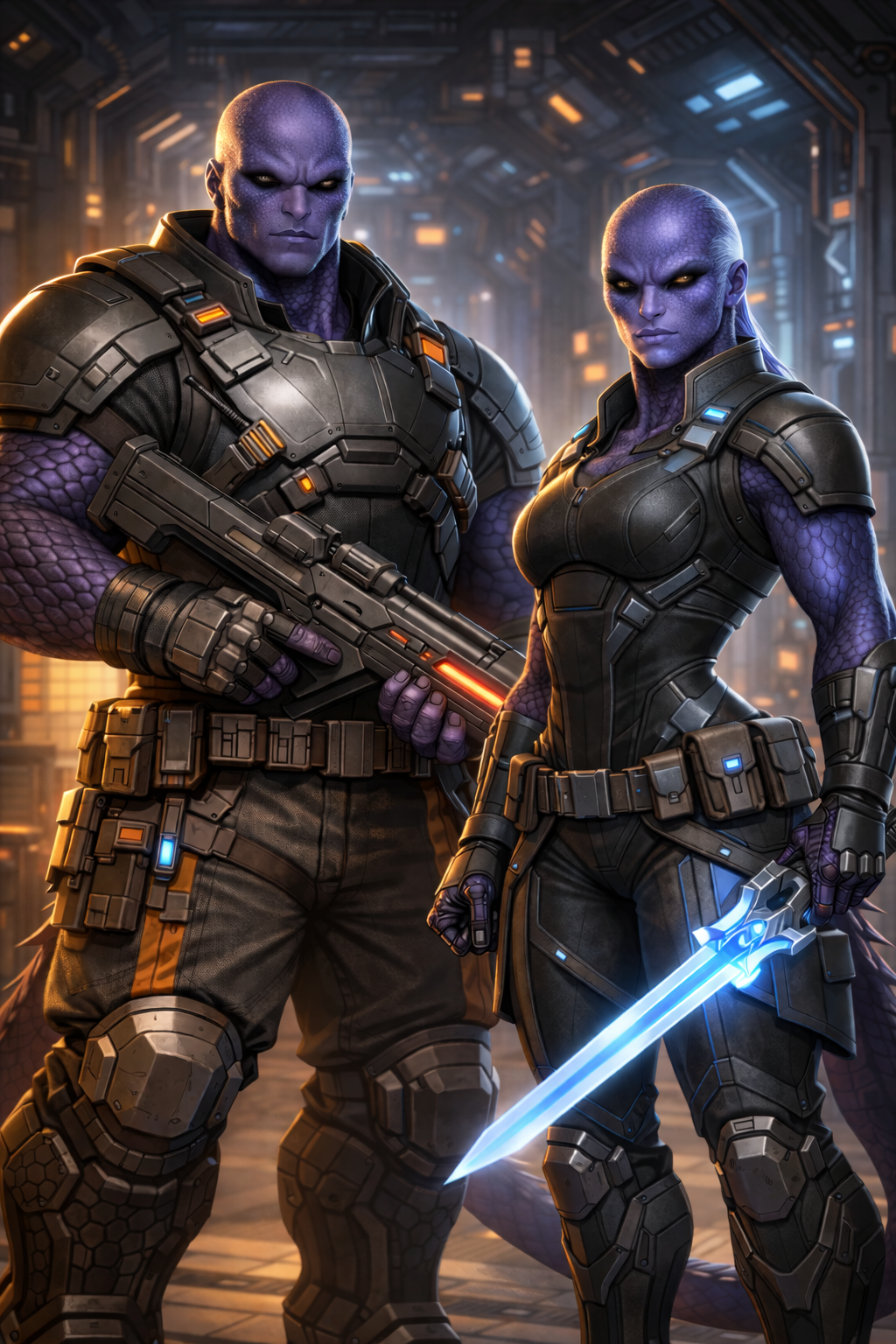
Dendi are engineered warforms: tall, dense, and built for battlefield problem-solving. Their skin is deep purple with lighter sun-faded tones where exposure is common. Their faces are smooth and saurian, with lidless black eyes and narrow nasal slits instead of a true nose. They move with a deliberate stillness that reads as predatory calm to those who have never served beside one.
Most Dendi were created under Azaran rule for decisive action in harsh conditions: shock troops, guardians, and tactical specialists who could operate while injured, exhausted, or afraid. Many of them are free now. Some embraced a new life. Others are still learning what “choice” means when you were built for orders. They mature quickly, burn bright, and rarely live as long as other peoples.
Why Play a Dendi?
Play a Dendi if you want a character who is hard to finish off, stays focused under pressure, and carries the weight of being a weapon trying to become a person. Dendi excel as marines, bodyguards, bounty hunters, breachers, scouts, and mission-first professionals who are forced to confront what they want when the shooting stops.
Dendi Ancestry Abilities
Attribute Increase (+2)
Dendi are built for endurance and force of will. Increase Vigor by one die type, and increase one other attribute of your choice by one die type (to a maximum of d12).
Most Dendi raise Vigor and Strength or Vigor and Spirit, depending on whether they were bred for shock assault or protective duty.
Darkvision (+1)
Dendi ignore all Illumination penalties and up to 2 points of penalties from invisibility or similar effects within 10” (20 yards).
Camouflage (+2)
Dendi carry a genetic enhancement that lets them shift their coloration to match the surrounding environment. If they are wearing a Dendi battle suit, the suit is built to echo that adaptation. While this camouflage is active, Dendi gain +2 to Stealth. That bonus becomes +4 while motionless. This does not conceal body heat or suppress sound.
Sleep Reduction (+1)
Dendi are engineered for war and require less sleep than most species.
Ancestral Enemy (−2)
Dendi suffer a –2 penalty to Persuasion rolls when dealing with their rivals and may become hostile with little provocation.
Dependency (-2)
Dendi are genetically reliant on Xaylan Blue, a phosphorescent blue compound mixed with water and injected into the body. It is one of the reasons healthy Dendi often show brighter purple coloration. Without it, they grow pale and begin to fail.
A Dendi requires Xaylan Blue every 24 hours. For each day without it, the character suffers one level of Fatigue until Incapacitated. The next day, they perish. The Azaranians designed this dependency to keep the Dendi from turning against them. The Dendi have since learned to produce the compound themselves.
Dendi in the Commonwealth Galaxy
Origins: Dendi were designed for war. Even those born free tend to inherit a culture of utility, readiness, and tactical thinking. Many were raised in systems that treated them as assets. Those who escaped, were purchased, or were liberated often carry complicated feelings about their creators and their former masters.
Temperament: Dendi trend toward mission-focus. They are not emotionless, but they are selective. Many Dendi are slow to trust and faster to commit once they do. They can be fiercely protective of a crew, especially if the crew becomes their first real chosen family.
In Civilian Space: Dendi commonly find work where physical risk is high and moral clarity is low: security contracts, high-threat salvage, frontier law enforcement, dangerous escort runs, and deniable operations. In the Commonwealth, reactions vary from sympathy to suspicion. In the Outer Rim, what matters is whether you can do the job.
Common Roles: Marine, bodyguard, breacher, bounty hunter, boarding specialist, escort captain, tactical advisor, reluctant hero.
Names and Language
Dendi names are often short and functional, suited for comms and command. Many Dendi adopt “free names” after leaving Azaran control, choosing names tied to personal milestones, places of refuge, or people who helped them survive.
Dendi typically speak English and Azaranian, plus one additional language reflecting their service history or chosen community.
Drakneri
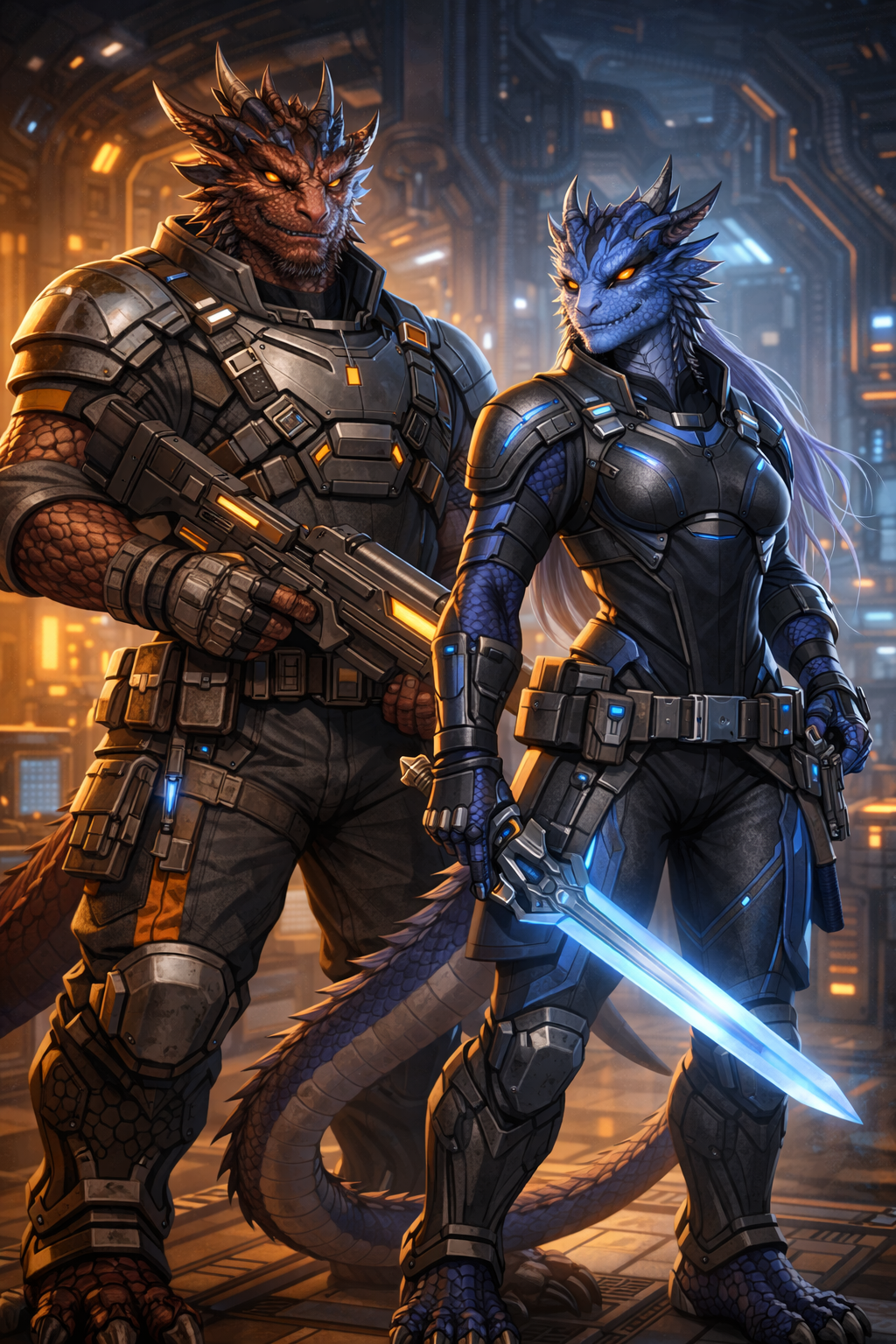
Drakneri resemble the dragonborn of old fantasy, but grounded in a hard sci-fi lineage. They are tall, heavy, scale-covered humanoids with clawed hands, blunt horns or crests, and voices that carry like distant thunder. Their culture treats status, obligation, and ownership as serious business. A Drakneri does not “own” something casually: contracts are promises made real, and breaking them is not merely rude, it is destabilizing.
Modern Drakneri are most famously tied to Freedom’s Gate in the Outer Rim, a sovereign stronghold where they guard secrets with layered protocol, airtight agreements, and decisive force. They hoard technology like the dragons of legend, but their treasure is not gold. It is data, prototypes, relics, and the leverage that comes from being the only one who can make a thing work.
Why Play a Drakneri?
Play a Drakneri if you want a character who feels physically imposing, socially weighty, and politically dangerous. Drakneri PCs fit naturally as negotiators, enforcers, diplomats, ship officers, “civilized” pirates, or tech-archivists with a personal code and a long memory.
Drakneri Ancestry Abilities
Breath Weapon (+2)
Drakneri can exhale destructive energy as a trained biological weapon.
- Make an Athletics roll as a limited action to use the breath weapon.
- It uses the Cone Template, may be Evaded, and causes 2d6 damage (3d6 with a raise on the Athletics roll).
- On a Critical Failure, the Drakneri suffers Fatigue (representing strain, overheating, or muscular shock).
- Choose a breath type appropriate to the character’s lineage: fire, cold, acid, electricity, or another energy type approved by the Gamemaster.
Darkvision (+1)
Drakneri ignore all Illumination penalties and up to 2 points of penalties from invisibility or similar effects within 10” (20 yards).
Repugnant (−1)
Drakneri can be unsettling to other cultures. Their presence is heavy, their scent and body language are alien, and their social customs can feel like a threat even when they are being polite.
Reactions are always Unfriendly, or rolled on 1d6 instead of 2d6 if determined randomly. A roll of 1 is treated as Hostile, and the target becomes physically Distracted.
Drakneri in the Commonwealth Galaxy
Culture: Drakneri culture is built on obligation, hierarchy, and the careful exchange of favors. Many Drakneri keep meticulous records of debt and duty, sometimes for generations. To a Drakneri, a contract is not merely legal paper. It is social reality.
Freedom’s Gate: Their most famous polity is Freedom’s Gate, where Drakneri safeguard the Star Stone and a deep archive of technology and Astra research. Outsiders often call it paranoia. Drakneri call it survival.
On Mixed Crews: Drakneri integrate well into crews where roles are clear and competence is respected. They clash in environments where rules are informal or routinely ignored. A Drakneri can be a terrifying ally and a dangerous enemy, because they tend to treat betrayal as a lesson that must be taught, not a grievance to be forgiven.
Common Roles: Negotiator, ship officer, security chief, bounty hunter, corporate liaison, relic custodian, Astra scholar, “respectable” pirate captain.
Names and Language
Drakneri names are often formal, with honorifics that mark lineage, achievement, or contract status. Many adopt shorter trade-names when operating outside their enclaves.
Drakneri typically speak English and Draconic, plus one additional language reflecting their alliances or area of operation.
Enox
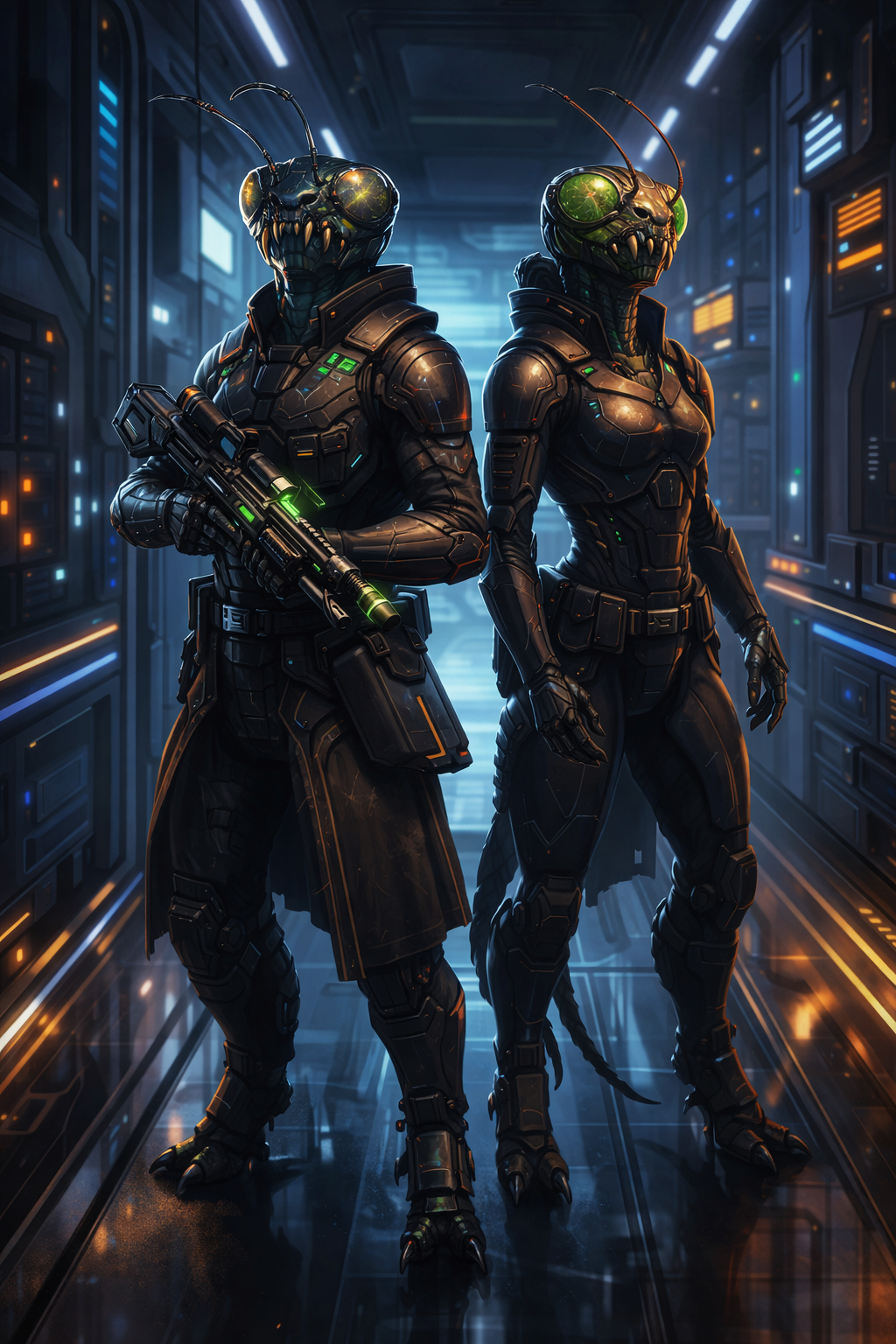
Enox are nocturnal-leaning insectoid humanoids with multifaceted eyes and flexible antennae adapted for advanced sensory processing. Both male and female Enox feature short forehead antennae that “taste” the air and read subtle vibrations, giving them an uncanny awareness of movement, scent, and changing conditions. Their societies trend competitive and combative, producing individuals who respect competence, quick thinking, and decisive action.
Enox physiology favors climbing, tracking, and low-light hunting. In the Outer Rim they are prized as scouts, saboteurs, survivalists, and bounty hunters, especially in places where darkness, wreckage, and vertical terrain would stop other species cold.
Why Play an Enox?
Play an Enox if you want a wiry, fast, sensory-driven character who thrives in darkness and complex terrain. Enox make excellent scouts, infiltrators, trackers, close-in skirmishers, and anyone who wants to feel at home in vents, gantries, ruins, and the unlit edges of a station.
Enox Ancestry Abilities
Attribute Increase (+2)
Enox are built for speed, precision, and predatory awareness. Increase Agility by one die type, and increase one other attribute of your choice by one die type (to a maximum of d12).
Heightened Senses (+1)
Enox sensory processing is highly refined. The hero gains +2 to Notice rolls based on hearing.
360-DEGREE VISION (+1)
The compound eyes of the Enox grant them an unhindered field of vision. Ignore 1 point of Gang Up bonus.
Acid Biology (1)
Enox blood and/or viscera are highly acidic. When one suffers a Wound, everyone within a Small Blast Template must roll Evasion or suffer 2d6 damage. If the being takes two or more Wounds from the attack, increase the damage to 3d6. The species is immune to acid and acid-based attacks.
Cold-Blooded (−3)
Enox metabolism is sensitive to low temperatures. After spending more than ten minutes in temperatures below 60°F (18°C), Enox subtract 1 from Agility, Strength, and Vigor rolls. The penalty ends after spending more than ten minutes in warmer temperatures.
Enox in the Commonwealth Galaxy
Culture: Enox cultures often treat status as something earned through action. Even friendly conversation can feel like sparring. Enox tend to admire competence and follow-through more than titles or lineage.
Antennae Signaling: Enox can communicate subtle cues to other Enox using antennae posture and micro-vibration patterns. It’s not a full spoken language at range, but it can convey intent, warning, and emotion quickly between Enox who know what to look for. Outsiders usually notice only that Enox “read each other” faster than anyone else.
On Mixed Crews: Enox thrive when a crew moves with purpose and keeps procedure tight. They struggle with indecision and environments that punish mobility, especially cold holds, ice worlds, or poorly heated stations. Many Enox become devoted ship people because maintenance spaces, ladders, gantries, and access shafts feel like natural terrain.
Common Roles: Scout, saboteur, bounty hunter, wilderness tracker, infiltration specialist, shipboard rigger, skirmisher.
Names and Language
Enox names often use clipped syllables and sharp consonants, designed for quiet exchange in the dark. Many Enox adopt trade-names when working off-world and reserve full names for clan or home contexts.
Enox typically speak English and Enox, plus one additional language reflecting their region or crew.
Geroth

"A Geroth who cannot keep the Measured Hand is not fit to walk among the stars."
Geroth are renowned across the Commonwealth galaxy for a peculiar contradiction: they are often refined, polite, and academically inclined, yet feared for a strength that can turn ordinary mistakes into catastrophes. Their homeworld, Geroth Prime, is curated beauty and opalescent architecture, a place where art, scholarship, and contribution are cultural currencies. It is also a world of exceptional mass and density. Every Geroth is born into gravity that demands control.
Off-world, that adaptation becomes dangerous. A careless grip can crush a tool handle. A frustrated tug can shear a latch. In low gravity, the line between “firm” and “disaster” is thin. The three small horizontal bone spines across a Geroth forehead are the usual giveaway, and once people notice them, they tend to stand a little farther back.
Why Play a Geroth?
Play a Geroth if you want a character built around restraint, responsibility, and consequence. Geroth can save lives with strength they refuse to use casually. They are scholars and artists first, trained to move gently in a galaxy that would happily turn them into weapons. Their stories thrive on moral pressure: when do you hold back, when do you intervene, and what does it cost to break your people’s most sacred promise?
Geroth Ancestry Abilities
Geroth are defined by what they refuse to do.
Major Hindrance: Pacifist (Major)
Geroth abhor unnecessary violence. A Geroth fights only when there is no other choice, and will not permanently harm sapient, living creatures under any circumstances except the narrow exemptions defined by their Vow (see below). They may use nonlethal methods in defense of themselves or others.
This is not weakness. It is doctrine, training, and identity.
Major Hindrance: Vow (Major)
The Vow of the Measured Hand
Every Geroth who leaves Geroth Prime takes the Vow, without exception.
The Vow is not “do no harm.” It is more precise, and more terrifying:
-
You will not use your strength as leverage, threat, or solution.
-
You will not use your strength to take what you cannot obtain by consent, craft, or lawful authority.
-
You will not kill with your strength.
-
You will not become the galaxy’s weapon.
Geroth do not take this lightly because the galaxy does not take them lightly. Empires and corporations would happily draft them into war, use them for raids, or point them at locked doors and call it heroism. Geroth society refuses that path.
Training Before Departure:
Before any Geroth is permitted to travel widely off-world, they undergo rigorous restraint training aboard the station above Geroth Prime, the Geroth Academy of Science. The Academy’s “small touch” disciplines are as core as mathematics and ethics:
-
Controlled movement under low gravity
-
Micro-force practice using brittle instruments and delicate mechanisms
-
Conflict de-escalation under stress
-
Nonlethal restraint techniques and safe holds
-
Ethical scenarios and oath-binding examinations
Graduation is not a ceremony. It is certification that the Geroth can exist among lighter bones without becoming a disaster.
Enforcement and Consequences:
Breaking the Vow is a serious violation of Geroth law. Killing with strength can lead to life imprisonment on Geroth Prime, followed by rehabilitation training. There are narrow exceptions:
-
Defending others against another Geroth using their strength
-
Facing an enemy assessed as an equal threat to a Geroth, where restraint would certainly result in loss of innocent life
Even in these exceptions, the act must be reported and judged.
A Geroth who breaks the Vow is expected to self-report and return home as soon as they can. Refusal is treated as a crisis.
If word spreads that a Geroth has become a renegade, Geroth society dispatches a retrieval team trained and authorized to use strength to bring them home for trial. The galaxy learns quickly that the Geroth do not negotiate with their own oaths.
Geroth Signature Ability
Gravity-Born Surge (Geroth Only)
A Geroth carries strength that can be unleashed, but doing so violates the Vow’s spirit unless used under the narrow conditions above. This is a last resort.
Activation: When you spend a Benny, you may activate Gravity-Born Surge. Increases Strength by six steps (d4 to d6 is one step, and each +1 past d12 counts as one step).
Benny Lock: You cannot gain Bennies from Jokers, Edges, roleplay awards, or table refreshes while it is active.” You can still spend what you already have.
Deactivation and Reactivation: You may end Gravity-Born Surge at any time. Once inactive, it can be activated again later by spending a Benny.
Vow Shock: If you kill someone while Gravity-Born Surge is active, you are Shaken afterward. If you break your Vow by using your strength in a way Geroth doctrine forbids, you are Distracted for 1 round after the effect ends as the impact of what you did sets in.
Renegade Clause: If a player character repeatedly breaks the Vow and refuses to self-report or stop, the consequences become part of the campaign reality. They will be hunted by Geroth retrieval teams across the galaxy. If they kill with their strength and continue to refuse accountability, they will eventually be caught and removed from play. The Geroth are extremely serious about this.
Geroth in the Commonwealth Galaxy
Culture: Geroth societies prize education, artistry, and academic achievement. Reputation is earned through contribution: a theorem proved, a sculpture completed, an evacuation organized without panic, a treaty drafted with precision.
Reputation: In the wider galaxy, Geroth strength is a legend and a stereotype. Some assume every Geroth is a living weapon. Others underestimate them because they do not look bulky. Both assumptions cause trouble. Veteran Geroth learn to keep hands open, movements slow, and frustration contained.
On Mixed Crews: Geroth often become steady anchors for crews under stress. They handle hard labor without complaint, but they refuse to be treated as a battering ram. Most crews learn to respect that line, or learn the hard way.
Common Roles: Scientist, engineer, diplomat, medic, rescue specialist, artifact handler, negotiator, ethics officer, security coordinator who prefers restraints and evacuation routes over gunfire.
Names and Language
Geroth names tend to be elegant and formal, often with lyrical cadence or family honor structures. Many adopt shorter trade-names while working the Outer Rim.
Geroth typically speak English and Geroth, plus one additional language reflecting their education or crew background.
Human

Humans are the dominant species from Earth, now the political heart of the Commonwealth of Worlds. They are everywhere: Core arcologies, colony worlds, station warrens, and Outer Rim dustports. What humans lack in extreme biological specialization, they make up for with adaptability, ambition, and a remarkable ability to build community in places that try to kill them.
In Astrabound, “Human” includes several widely recognized upbringings. Choose one of the following human lineages.
Earthborn Human
Earthborn grow up closest to Commonwealth stability: infrastructure, education, and social systems that usually work. They are versatile, persuasive, and confident in ways that can read as inspiring or infuriating depending on where you stand.
Why Play an Earthborn?
Play an Earthborn if you want maximum flexibility and a character who can fit into almost any role with the right Edge and the right attitude.
Earthborn Ancestry Abilities
Adaptable (+2)
Earthborn begin play with any Novice Edge of their choosing. They must meet its Requirements as usual.
Languages
You speak English and two additional languages of your choice.
Voidborn Human
Voidborn are born on stations, ships, and belt habitats. They learn early that gravity is a setting, air is a resource, and a crew is a lifeline. They tend to be comfortable in tight spaces, dim corridors, and environments where movement is three-dimensional.
Why Play a Voidborn?
Play a Voidborn if you want a human who excels in the dark and moves with practiced confidence in microgravity and shipboard chaos.
Voidborn Ancestry Abilities
Darkvision (+1)
Voidborn spend so much of their lives in station corridors, maintenance shafts, and the open dark that they adapt to low-light conditions. Voidborn ignore all Illumination penalties and up to 2 points of penalties from invisibility or similar effects within 10” (20 yards).
Skill Bonus: Athletics (+1)
Voidborn spend their lives in zero-g, microgravity, and artificial gravity. They train to keep control of their bodies in all of them. Voidborn Humans gain +1 to Athletics rolls.
Languages
You speak English and two additional languages of your choice.
CorpBorn Human
CorpBorn are raised in corporate states, company towns, and contract cultures where law is written in fine print and enforced by security teams with logos. They grow up fluent in negotiation, leverage, and reading what people really want.
Why Play a CorpBorn?
Play a CorpBorn if you want a human built for deals, influence, and social pressure, with complications that follow you like paperwork.
CorpBorn Ancestry Abilities
Skill Bonus: Persuasion (+2)
CorpBorn gain +2 to Persuasion rolls.
Languages
You speak English and two additional languages of your choice.
Colonyborn Human
Colonyborn are raised on worlds built by human hands, often far from Earth’s comfort and far from corporate polish. Their cultures prize competence and resilience. Many Colonyborn have local militia traditions, because the frontier rarely offers free protection.
Why Play a Colonyborn?
Play a Colonyborn if you want a practical, rugged human with strong physical instincts and the toughness to keep functioning when conditions turn ugly.
Colonyborn Ancestry Abilities
Skill Bonus: Athletics (+1)
Colonyborn gain +1 to Athletics rolls.
Environmental Resistance (+1)
Choose Heat or Cold. You gain +4 to resist that environmental effect, and reduce damage from that source by 4.
Languages
You speak English and two additional languages of your choice.
Kethni

Kethni are blue-skinned people of cold worlds with ice-white hair and a reputation forged in hardship. Their cultures prize loyalty, honor, and courage expressed through action rather than ceremony. They are the kind of people who remember who stood the watch with them, who kept a promise when it was costly, and who broke under pressure.
Kethni physiology is adapted to harsh climates and long campaigns. They bleed silver-based blood, and their bodies run hot enough to endure environments that would freeze most species into statues. Many Kethni traditions still carry the echoes of old military orders and ritualized duels, where restraint and discipline matter as much as winning.
Why Play a Kethni?
Play a Kethni if you want a stalwart warrior, ship officer, or protector who is hard to break and harder to intimidate. Kethni shine as guardians, leaders, boarding specialists, and “last one standing” archetypes who don’t quit when the situation turns desperate.
Kethni Ancestry Abilities
Environmental Resistance (Cold) (+1)
Kethni gain +4 to resist cold environmental effects, and reduce damage from cold by 4.
Hardy (+2)
Kethni are hard to put down. A second Shaken result in combat does not cause a Wound.
Ancestral Enemy: Lorendi (−1)
Kethni have a long-standing cultural rivalry with the Lorendi. They suffer a −2 penalty to Persuasion rolls when dealing with Lorendi and may become hostile with little provocation.
This doesn’t mean every Kethni hates every Lorendi. It means the history between them is old, complicated, and easy to trigger in the wrong circumstances.
Kethni in the Commonwealth Galaxy
Culture: Kethni cultures tend to be direct and emotionally honest, but disciplined. Passion is not a lack of control, it is fuel for duty. Kethni respect competence, courage, and promises kept when it would be easier to walk away.
Honor and Duels: Many Kethni maintain ritualized honor-duels. These are controlled violence with rules, witnesses, and consequences, used to prevent grudges from becoming feuds. In the Outer Rim, the tradition often survives as a practical tool: one duel to avoid a dozen ambushes.
The Lorendi Rivalry: Kethni and Lorendi history varies by region, but the broad themes are consistent: clashing doctrines, competing alliances, and old slights that became songs and then became “truth.” In mixed crews, this rivalry often shows up as sharp banter, distrust of motives, and the need to prove reliability through action.
Common Roles: Ship officer, security lead, marine, boarding specialist, bodyguard, expedition protector, squad leader, steadfast diplomat.
Names and Language
Kethni names often include sharp consonants and strong syllables, well-suited for being shouted through wind or over comms. Many also carry lineage markers or honor-titles earned through service.
Kethni typically speak English and Kethni, plus one additional language reflecting their postings or alliances.
Kitsune

Kitsune are charismatic, foxlike beings whose cultural myths became biology. Clever, alluring, and often unsettlingly old-souled, Kitsune cultivate multiple “faces” across their lives. For them, identity is not a single mask you remove at home, it is a wardrobe you learn to wear with intention. Their traditions blur the line between truth and performance, and many Kitsune consider deception an art form rather than a vice.
In Commonwealth space, Kitsune are beloved as performers and distrusted as infiltrators. In the Outer Rim, they are both. A Kitsune can be the warmest friend in the room and the reason the door was unlocked five minutes ago.
Why Play a Kitsune?
Play a Kitsune if you want a social infiltrator, charming trickster, spy, or performer. Kitsune excel at persuasion, deception, misdirection, and living three steps ahead of the conversation.
Kitsune Ancestry Abilities
Shapeshift (+4)
As a limited action, a Kitsune may assume the appearance of another being within 2 points of Size.
-
To duplicate a specific individual, the Kitsune must touch the target and make an opposed Smarts roll.
-
With success, the Kitsune looks like the target.
-
With a raise, the Kitsune also gains surface details such as voice, fingerprints, retinal patterns, and similar identifiers.
This is disguise, not a new stat block. You do not gain the target’s Edges, skills, or special abilities.
Low Light Vision (+1)
Kitsune ignore penalties for Dim or Dark illumination (but not Pitch Darkness).
Skill Bonus: Persuasion (+1)
Kitsune gain +1 to Persuasion rolls.
Attribute Penalty: Strength (−2)
Kitsune are lithe and agile, but not built for raw power. They suffer −1 Strength (this affects Strength-linked rolls and damage as usual).
Hindrance (Major): Secretive (Identity) (−2)
Kitsune identity customs run deep, and secrecy is often survival.
You have a persistent complication tied to maintaining a persona or protecting your true identity. Work with the Gamemaster to choose the form it takes in the campaign (examples include: being hunted in certain ports, having a rival who can expose you, or obligations to a Kitsune network that enforces taboos).
This should create recurring problems and interesting choices, not simply punish the character.
Kitsune in the Commonwealth Galaxy
Society: Kitsune often live among other species, sometimes openly, more often passing in curated forms and revealing their natural shape only to those they trust. Kitsune culture tends to be accepting of fluid identity and judges people by deeds and legacy rather than appearance.
The Taboo: It is deeply taboo among Kitsune to “out” another Kitsune who is passing. Kitsune develop subtle signals and coded phrases to recognize one another without breaking the taboo. Many Kitsune can also “sense” another Kitsune socially, an instinct born from shared cues and lived experience.
Tails and Mastery: Kitsune legends speak of additional tails gained through exceptional deeds. Whether literal, symbolic, or Astra-adjacent depends on the region. In Astrabound, this is best represented through character growth, reputation, and Edges rather than as a default ancestry mechanic.
Common Roles: Spy, con artist, diplomat, performer, fixer, intelligence asset, social engineer, the crew’s “face.”
Names and Language
Kitsune usually adopt names that fit within the society they were born and raised, or match a favored persona. Those who travel openly as Kitsune often take traditional names or vivid nicknames like Cybermoon, Enmity, Kabura, Shizu, Tomomi, or Verve.
Kitsune typically speak English and Kitsune, plus one additional language of their choice.
Krynn
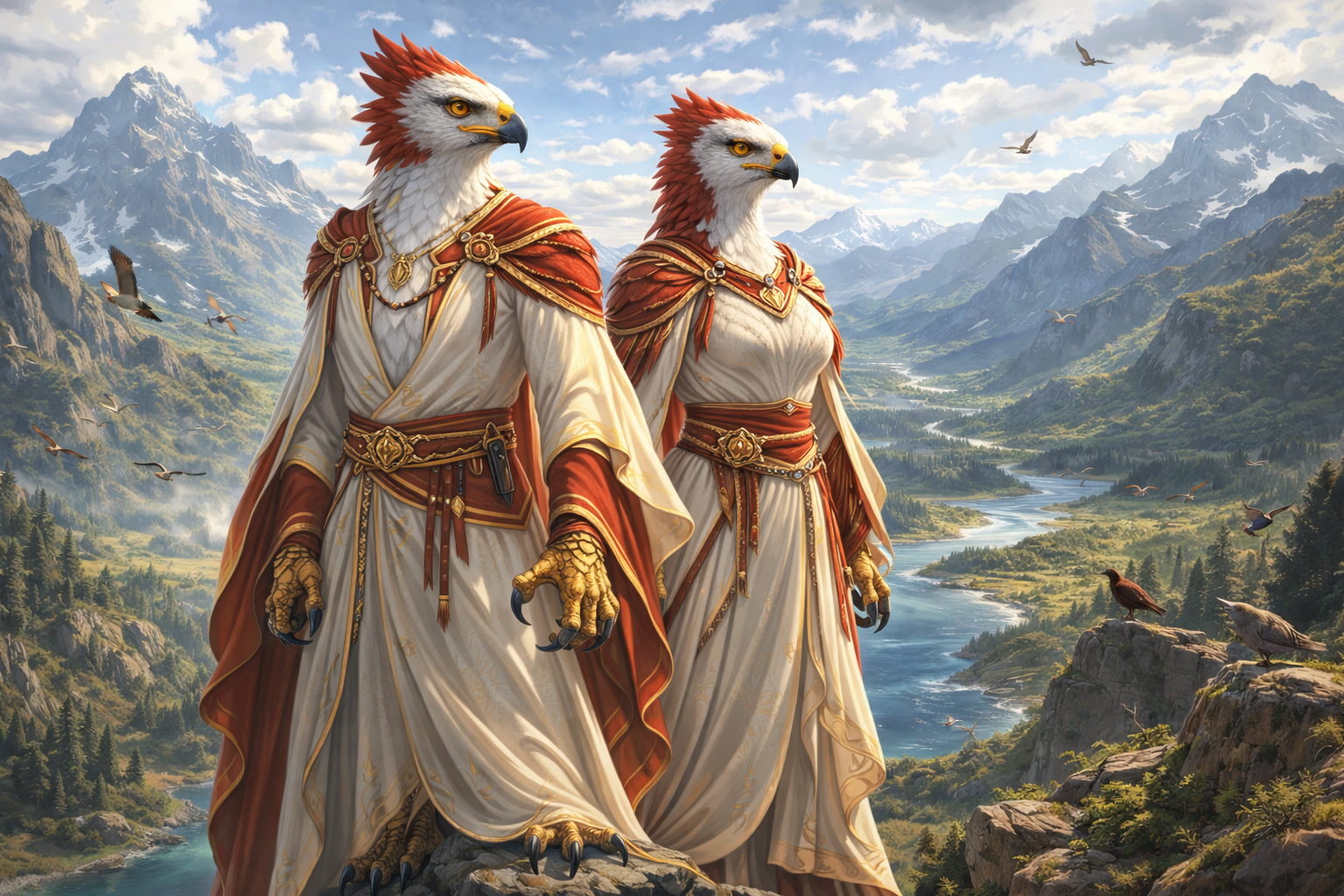
The Krynn are a newly discovered species of a hawklike origin. Their plumage is distinctive, most commonly patterned in white and red. Many males display additional yellow feathering, while many females present only white and red. Their faces end in a hooked beak, and their hands terminate in talon-like digits built for grip, precision, and sudden violence.
Krynn society is careful and quiet. They watch, listen, remember, and speak only when the words matter. To other species, they can seem distant or unreadable. To those who learn their rhythms, they are loyal, incisive, and frighteningly perceptive. In the Outer Rim, Krynn often become investigators, scouts, hunters, and information brokers, thriving in the spaces where secrets decide outcomes.
Why Play a Krynn?
Play a Krynn if you want a subtle operator with strong instincts for people and problems: an investigator, diplomatic fixer, scout, or hunter who thrives when hidden motives and quiet truths matter.
Krynn Ancestry Abilities
Claws (+2)
Krynn talons are natural weapons that cause Str + d4 damage (see Natural Weapons).
Krynn are effectively “always armed” in close combat for story purposes. Their talons can’t be confiscated at a checkpoint.
Skill Bonus: Persuasion (+1)
Krynn gain +1 to Persuasion rolls.
Skill Bonus: Notice (+1)
Krynn gain +1 to Notice rolls.
Attribute Penalty: Vigor (−2)
Krynn have lighter physiology and lower raw endurance than most. They suffer −1 Vigor (this affects Vigor-linked rolls, Soak, and related checks as normal).
Krynn in the Commonwealth Galaxy
Social Intuition: Krynn have a reputation for reading rooms well. Whether this is cultural training, subtle body-language awareness, or simply patience varies by individual. What’s consistent is that Krynn tend to notice what others rush past.
Quiet Diplomacy: Krynn prefer clean outcomes over loud victories. They value truth, but they also value timing. A Krynn might sit silently through ten minutes of argument and then end it with one sentence that makes everyone recalibrate.
Hunters and Watchers: Krynn traditions often emphasize observation, patience, and decisive action. They don’t flinch from violence, but they rarely waste it.
Common Roles: Investigator, scout, wilderness hunter, diplomat, negotiator, intelligence broker, shipboard security with a soft voice and sharp hands.
Names and Language
Krynn names are often short, with clear syllables that carry well over distance. Many adopt trade-names when operating off-world.
Krynn typically speak English and Krynn, plus one additional language of their choice.
Lorendi

Lorendi are tall, lean humanoids with gray skin, violet eyes, and pointed ears. They tend to present as calm and contained, but they are not passive. Lorendi cultures prize restraint, subtlety, and long-term thinking. In interstellar society they are often encountered as diplomats, physicians, researchers, and quiet power brokers, the kind who seem to know more than they say.
Lorendi live a long time. They reach physical maturity on a human timescale, but Lorendi adulthood is defined by experience and self-mastery. Many don’t claim an “adult name” until roughly a century of life, and elders can carry centuries of memory into a room without ever raising their voice.
Why Play a Lorendi?
Play a Lorendi if you want a poised, capable character who can pivot between social precision and practical competence. Lorendi fit well as envoys, investigators, covert operatives, medics, or scientists with an agenda.
Lorendi Ancestry Abilities
Darkvision (+1)
Lorendi ignore all Illumination penalties and up to 2 points of penalties from invisibility or similar effects within 10” (20 yards).
Sleep Reduction (+2)
Lorendi require very little rest. They do not sleep as most species do. Instead, they enter a waking meditative state that helps them order their thoughts. They remain aware during this meditation and do not suffer setbacks for skipping it.
Skill Bonus: Persuasion (+1)
Lorendi gain +1 to Persuasion rolls, representing social precision, cultural training, and a reputation for controlled credibility.
Environmental Weakness (Sunlight) (−1)
Lorendi suffer a −4 penalty to resist a specific environmental effect: direct sunlight.
In play, this most often applies to sight-dependent tasks, long exposure, and situations where harsh light is a meaningful obstacle (Gamemaster’s call). If sunlight is the basis of an attack or hazard, the penalty can function as a bonus to the effect’s severity or damage as appropriate.
Hindrance (Minor): Code of Restraint (−1)
Lorendi are raised to treat impulse as a liability. You have an ingrained reluctance to act rashly, escalate publicly, or break protocol without cause.
Lorendi in the Commonwealth Galaxy
Culture: Lorendi culture values patience, subtlety, and the long view. A Lorendi may spend months preparing a negotiation or investigating a problem that another species would rush headlong into. They are not slow, they are deliberate.
Reputation: Lorendi often carry an aura of quiet competence. In many ports, people assume a Lorendi knows what they’re doing, and that assumption can be as useful as a weapon. It also paints a target. In the Outer Rim, “quiet power” attracts predators.
The Kethni Rivalry: Lorendi and Kethni history is old, complex, and not always polite. In mixed crews this often manifests as clipped banter, mutual scrutiny, and grudging respect earned through action rather than words.
Common Roles: Diplomat, medic, researcher, intelligence handler, covert operative, investigator, strategist, “polite monster.”
Names and Language
Lorendi names often include soft consonants and careful cadence. Many Lorendi maintain multiple names across their long lives: a childhood name, an adult name, and one or more professional or covert identities.
Lorendi typically speak English, Lorendi, and one additional language of their choice.
Rakashan

Rakashans are lionlike humanoids: tall, confident, and built like apex predators wearing courtly manners as a second skin. Their presence can swing from regal to terrifying in a heartbeat. Rakashans stand well over most humans, commonly beyond 6 feet (1.8 meters) and sometimes reaching 7 feet (2.1 meters). Their bodies are covered in tawny fur, their hands end in sharp retractable claws, and their tails are long and expressive. The species is sexually dimorphic: males often grow thick manes ranging from gold to black, while females tend to have shorter fur.
Rakashan cultures often prize honor, pride, and earned authority. They respond poorly to imposed control they do not respect, and they take insult seriously. Many Rakashans are charismatic leaders or feared enforcers, and all Rakashans are capable of unleashing a thunderous roar that can turn a room quiet.
Why Play a Rakashan?
Play a Rakashan if you want a proud leader, intimidating protector, hunter, or duelist. Rakashans excel as front-liners, decisive captains, and powerful social forces in tense negotiations.
Rakashan Ancestry Abilities
Attribute Increase: Agility (+2)
Rakashans increase Agility by one die type during character creation. This also increases maximum Agility by one step.
Claws (+2)
Rakashan claws are natural weapons that cause Str + d4 damage (see Natural Weapons).
Retractable claws are part of Rakashan body language. A Rakashan can “bare claws” without striking, and everyone understands the warning.
Low Light Vision (+1)
Rakashans ignore penalties for Dim or Dark illumination (but not Pitch Darkness).
Hindrance (Minor): Bloodthirsty (−1)
Rakashans can be cruel to their enemies, and many cultures glorify dominance in victory.
This is a Minor Hindrance representing difficulty taking prisoners, resisting provocation, or accepting surrender without some form of “payment.” Define what it looks like with the GM (duels demanded, harsh terms, intimidation rituals, etc.).
Skill Penalty: Athletics (Swimming) (−1)
Rakashans shun water and are poor swimmers.
They suffer −2 to Athletics rolls when swimming, and each inch of movement in water costs 3” of Pace.
Ancestral Enemy: Resarian (−1)
Rakashan society rose at the expense of the Resarians. Rakashans suffer −2 to Persuasion rolls when dealing with Resarians and may become hostile with little provocation.
Rakashan in the Commonwealth Galaxy
Culture: Rakashans respect strength, but more than that, they respect competence and courage. Titles matter only if they are backed by action. Many Rakashan traditions treat negotiation as a form of contest: who holds their ground, who speaks cleanly, who yields with dignity.
Authority: Rakashans rarely accept imposed authority unless it is earned or contractually clear. A Rakashan who chooses to serve under a captain does so deliberately, and expects the captain to act like one.
The Resarian Grudge: The old history between Rakashans and Resarians is still alive in stories, insult-codes, and inherited suspicion. Individual Rakashans can rise above it, but the default cultural friction is real.
Common Roles: Duelist, marine, security lead, expedition hunter, ship captain, intimidating negotiator, bodyguard, pride-driven hero.
Names and Language
Rakashan names often carry strong vowel sounds and honor markers. Many Rakashans also earn titles through deeds: “Shield of,” “Claw of,” “Voice of,” or similar cultural epithets.
Rakashans typically speak English and Rakashan, plus one additional language depending on region and service history.
Resarian
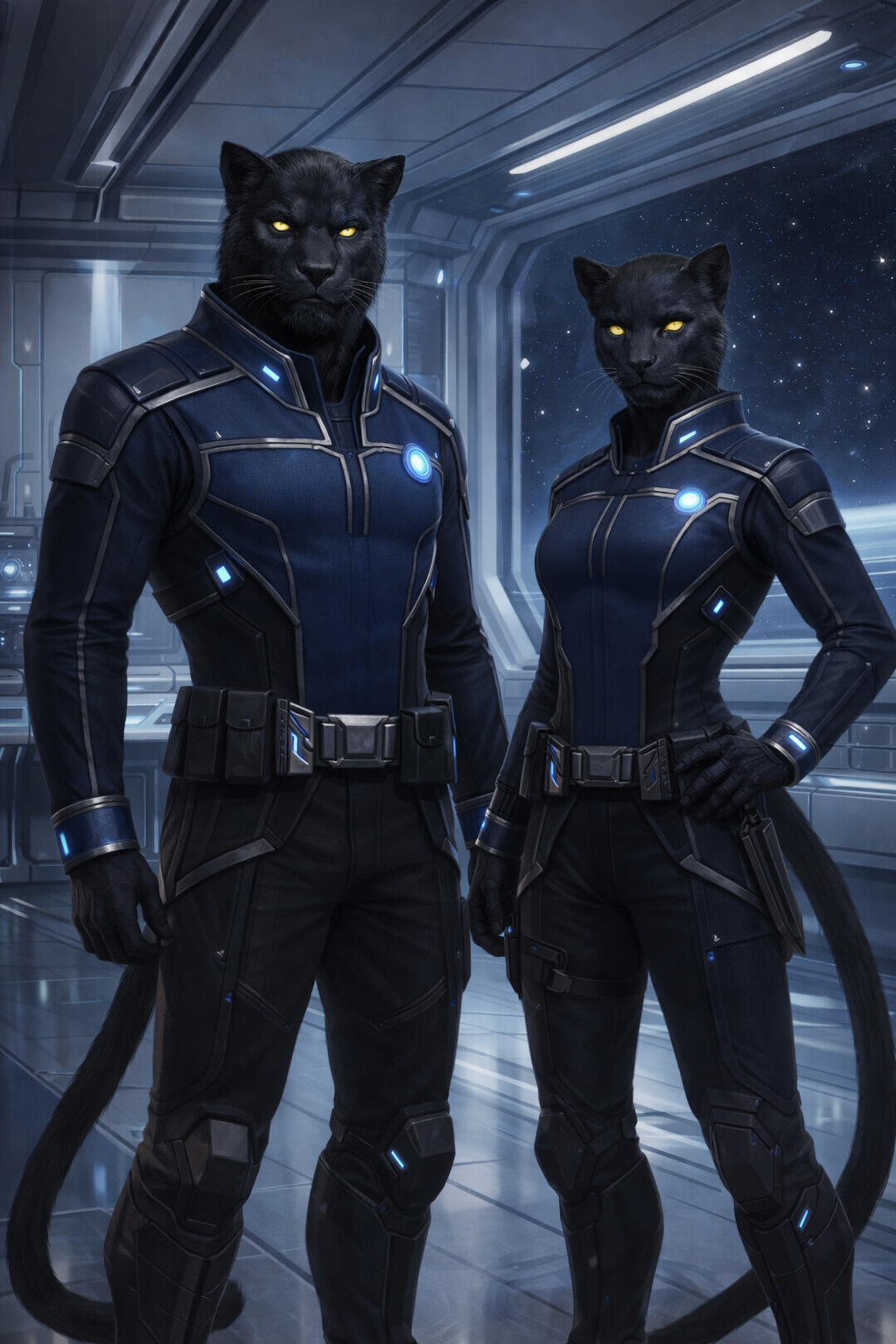
Resarians are panther-like humanoids: sleek, quiet, and predatory in motion. Many outsiders assume they are “just Rakashans with different fur,” but Resarians tend to be more patient, more precise, and far less theatrical. Where Rakashans project authority, Resarians project control. Their cultures often emphasize discipline, territory, and reputation earned through competence rather than volume.
Resarians move like they were built for the dark: low center of gravity, smooth weight shifts, and the kind of stillness that makes other people nervous. In the Outer Rim they’re prized as scouts, infiltrators, reconnaissance marines, and pilots who like to fly close to the terrain and leave no room for error.
Why Play a Resarian?
Play a Resarian if you want a fast, capable hunter type who can pivot between stealth, athletic action, and sharp tactical thinking. Resarians make great scouts, trackers, infiltrators, recon marines, and “low and mean” pilots.
Resarian Ancestry Abilities
Pace (+2)
Resarians increase their Pace by +2, and their running die increases one die type.
Claws (+2)
Resarian claws are natural weapons that cause Str + d4 damage (see Natural Weapons).
Low Light Vision (+1)
Resarians ignore penalties for Dim or Dark illumination (but not Pitch Darkness).
Ancestral Enemy: Rakashan (−1)
Resarians and Rakashans share old history and sharper grudges. Resarians suffer −2 to Persuasion rolls when dealing with Rakashans and may become hostile with little provocation.
Skill Penalty: Persuasion (−2)
Resarians are not naturally inclined toward open warmth or easy charm. They suffer a −1 penalty to Persuasion, and this penalty is considered commonly used, so it is valued at −2.
This does not mean Resarians are rude. It means they tend to communicate with restraint, and many cultures read that restraint as coldness.
Resarian in the Commonwealth Galaxy
Culture: Resarians value discipline and competence. Many Resarian traditions treat reputation as something earned through consistency: you do what you said you would do, you keep your territory clean, you don’t waste words.
The Rakashan Rivalry: Resarians and Rakashans are cousins with old wounds. Sometimes it manifests as open hostility. More often it shows up as tight smiles, careful insults, and a need to prove who is more capable under pressure.
On Mixed Crews: Resarians integrate well into teams that respect procedure, silence, and precision. They struggle with crews that rely on loud improvisation or “vibes” over planning. Once a Resarian trusts a crew, they are famously steady.
Common Roles: Scout, recon marine, tracker, infiltrator, bounty hunter, pilot, security specialist, quiet leader.
Names and Language
Resarian names often have clipped consonants and smooth vowel runs, meant to be spoken low and fast. Many Resarians adopt short call-signs in service.
Resarians typically speak English and Resarian, plus one additional language depending on posting and trade routes.
Sovreki
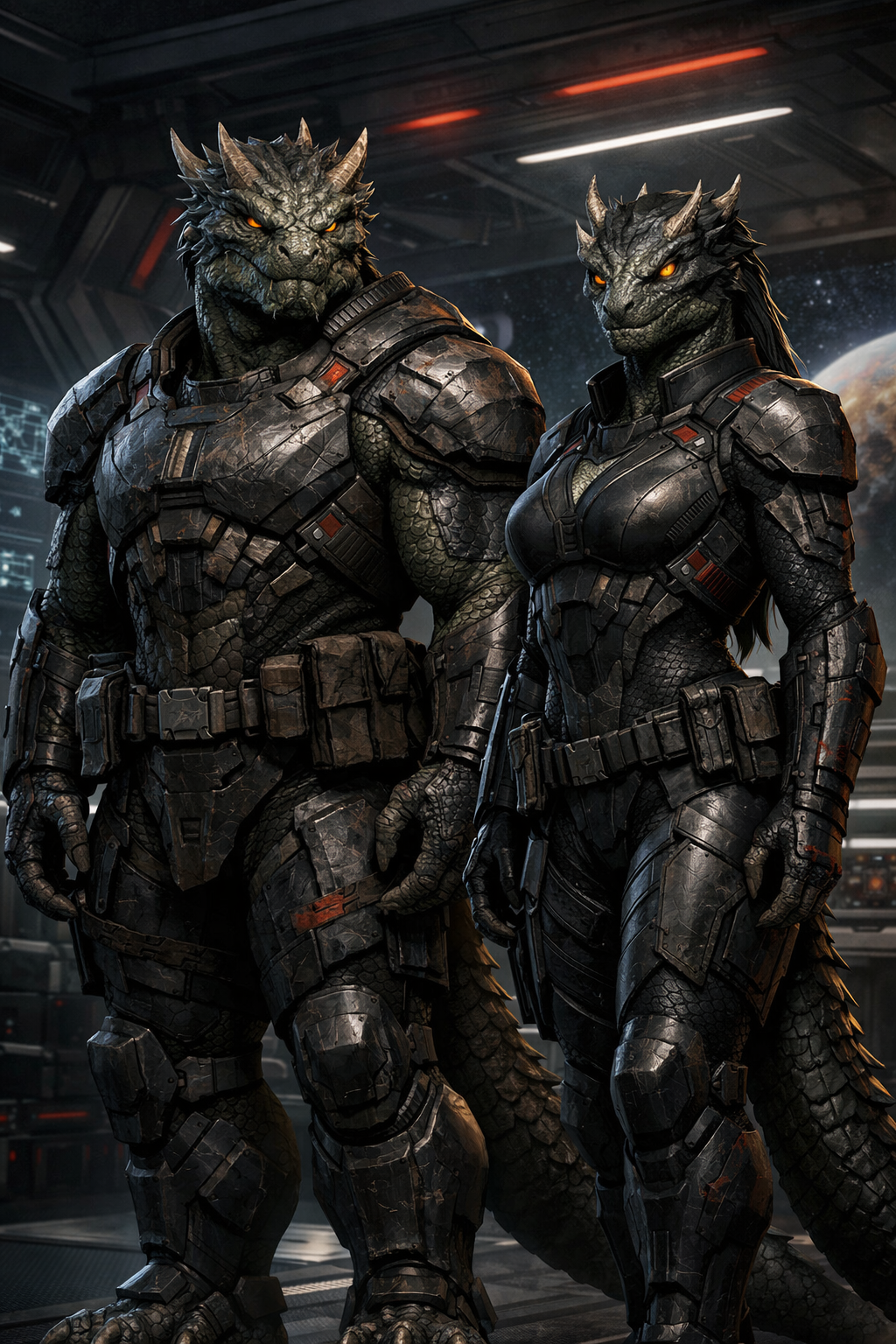
Heavily muscled and covered with thick scales and short, sharp horns, the reptilian Sovreki are exactly as predatory as they appear. They once commanded a formidable empire that stretched to near the Core Worlds from the Outer Rim, but their story is not only conquest. It is also scarcity, discipline, and the long shadow of an authoritarian era that taught an entire people to survive through hierarchy, vigilance, and control.
A dearth of resources and economic strain pushed Sovrek toward militarized governance. Expansion became policy, conquest became logistics, and intrigue became a cultural skill. Over time, infighting and internal fractures hollowed the empire, forcing fleets home. Then the Azaran Empire crushed what remained of Sovreki military power, reducing them to a shadow of their former reach.
In the modern era, Sovreki are often vilified and distrusted for what their old government did. Many resent it. Many accept it. Some weaponize it. Sovreki culture prizes mental discipline and obedience to strict hierarchies, and they carry a reputation for arrogance, cruelty, and smug superiority, even when the individual in front of you is simply trying to rebuild a life.
Sovreki keep secrets the way others keep tools. Suspicion is treated as wisdom, and uncovering secrets is regarded as a practical craft. Their sayings are notorious across the Rim:
-
“Everyone is guilty of something. The only question is what.”
-
“If you don’t want me knowing, hide it better.”
-
“All my stories are true, especially the lies.”
Why Play a Sovreki?
Play a Sovreki if you want a durable, survival-capable ally who feels genuinely non-human in outlook. Sovreki make excellent explorers, marsh fighters, scouts, grim diplomats, intelligence operatives, and security specialists who don’t flinch when conditions turn lethal.
Sovreki Ancestry Abilities
Armor (+2)
Sovreki have thick, scaly plating that grants Armor +2.
Bite (+1)
Sovreki fangs are natural weapons that cause Str + d4 damage (see Natural Weapons).
Edge: Alertness (+2)
All Sovreki have the Alertness Edge, representing predator awareness and threat-sense.
Environmental Weakness (Cold) (−1)
Sovreki are poorly suited for frigid conditions. They suffer a −4 penalty to resist cold environmental effects. If an attack is based on cold, this penalty acts as a bonus to damage/effect severity as appropriate.
Hindrance (Minor): Outsider (−1)
Most species distrust Sovreki. Their customs, predatory presence, and the shadow of their old conquests make others wary.
Sovreki suffer −2 to Persuasion rolls with all but other Sovreki.
Ancestral Enemy: Azaranian (−1)
Sovreki history includes humiliation at Azaran hands. Sovreki suffer −2 to Persuasion rolls when dealing with Azaranians and may become hostile with little provocation.
Sovreki in the Commonwealth Galaxy
Culture: Sovreki culture prizes discipline, endurance, and competence. Many Sovreki are taught that order prevents collapse, and that weakness in leadership kills more people than cruelty does. This mindset can read as cold, but it produces individuals who remain functional when others panic.
Intrigue as Craft: Sovreki often treat secrets as currency and suspicion as wisdom. They respect careful observation, patience, and the ability to see through comfortable lies. A Sovreki negotiator may feel like a predator not because they’re violent, but because they’re listening.
Reputation and Resentment: The empire’s actions still stain Sovreki today. In many ports, a Sovreki must prove they are not an occupier, a security agent, or an extortionist before they can be treated as a person. Some Sovreki take this as an insult. Others treat it as the cost of history. A few lean into fear, because fear is cheaper than trust.
The Azaran Scar: The Azaran defeat remains a cultural wound. Sovreki reactions range from vengeance to shame to cold strategic obsession. Even Sovreki who despise the old regime often carry the determination to ensure their people are never controlled that way again.
Common Roles: Scout, explorer, survival specialist, marine, security lead, intelligence operative, intimidating negotiator, wilderness guide, “hard choices” officer.
Names and Language
Sovreki names often include sibilant consonants and hard stops, suited to their speech patterns. Many also carry clan identifiers or earned titles, especially among those who served in old imperial structures or modern mercenary cadres.
Sovreki typically speak English and Sovreki, plus one additional language based on service history.
Tarav

Tarav are an intelligent fungal species that resemble walking toadstools in humanoid form. Their flesh is bloated and spongy, varying in color from deep purple to slate gray. Their wide feet have vestigial toes, and their pudgy hands have two stubby fingers with a thumb on either side, built more for careful handling than fine toolwork.
Tarav do not possess a spoken language. They communicate via telepathy, projecting meaning, emotion, and intent directly into the minds of nearby sapients. When multiple Tarav are present, their thoughts braid together into a quiet group consciousness. Outsiders often describe the experience as standing near a calm chorus they cannot quite hear.
No one knows how the Tarav came to be. They appear in records as fully formed, already coherent, already strange, and already difficult to misunderstand.
Why Play a Tarav?
Play a Tarav if you want a quiet negotiator, a telepath, or a truly alien species. Tarav excel as diplomats, mediators, investigators, ship counselors, and unnervingly calm operators who can turn conflict into conversation without ever raising their voice.
Tarav Ancestry Abilities
Telepathy (+1)
Tarav can communicate mentally with any sapient lifeform within 12” (24 yards) regardless of language.
Bloodless (+1)
Tarav automatically stabilize whenever they would Bleed Out without needing to roll. Rending weapons deal no extra damage to them.
Hardy (+2)
A second Shaken result in combat does not cause a Wound.
No Vital Organs (+1)
Tarav organs are diffuse and redundant. Called Shots do no additional damage against them.
Environmental Weakness (Heat/Fire) (−1)
Tarav suffer a −4 penalty to resist heat environmental effects. If an attack is based on heat or fire, this penalty acts as a bonus to damage/effect severity as appropriate.
Cannot Speak (−1)
Tarav have no vocal cords and cannot form speech as most species understand it. They can communicate naturally with their own kind, and with others via Telepathy. They can still hear and understand spoken languages and may communicate through electronic devices if desired.
Alien Form (−1)
Tarav size and shape are incompatible with most standard equipment and vehicles.
-
They can only wear customized armor.
-
They subtract −1 from Trait rolls when using non-customized equipment and vehicles.
-
Items can be customized to work for the character for +100% of the base cost (Gamemaster’s call).
Tarav in the Commonwealth Galaxy
Group Consciousness: Tarav are individuals, but proximity creates a shared mental “weather.” When multiple Tarav are together, they become calmer, more coordinated, and harder to surprise. Outsiders may interpret this as eerie unity, but to Tarav it is simply community.
Diplomacy and Truth: Tarav don’t speak, and that changes conflict. They cannot be drowned out or shouted over. Their telepathy also changes how lies feel: deception is still possible, but the emotional texture of intent is harder to fully mask. Many Tarav become negotiators or counselors because they can make tense rooms quieter just by being present.
Fire Fear: Tarav are not cowards, but they treat open flame the way sailors treat vacuum exposure: with respect. Tarav crews tend to be obsessive about fire suppression, insulation checks, and thermal hazards.
Alien Practicalities: Tarav bodies don’t fit standard armor harnesses, vac-suit seals, or cockpit ergonomics without modification. On the frontier, this is a constant source of expense, delay, and improvisation.
Common Roles: Diplomat, negotiator, counselor, investigator, ship systems monitor, xenobiologist, calm “face” in tense rooms.
Names and Language
Tarav names are often translated concepts rather than spoken sounds: Soft-Foot, Still-Bloom, Ash-Memory, Low-Drum, Quiet Witness. Many adopt a spoken “trade name” for the convenience of non-telepaths, even if they never actually say it.
Tarav understand spoken languages, but do not speak them. They communicate via Telepathy, text, or devices.
Vendi

Vendi are an aquatic species known across the rims as skilled swimmers, steady professionals, and unnervingly calm negotiators. Their heads resemble stingrays, with mouths bracketed by cephalic lobes that flex subtly as they speak or taste the air. Their skin ranges through blue, pink, and green hues, naturally patterned like underwater camouflage. In motion, a Vendi looks almost weightless, even on land, as if they’re always moving through a denser medium.
Vendi culture tends to prize patience, precision, and measured words. Many outsiders describe them as serene. Vendi often describe themselves as unrushed. On a starship or in a crisis room, that difference matters.
Why Play a Vendi?
Play a Vendi if you want a patient specialist: physician, investigator, scientist, artisan, or calm high-stakes negotiator who simply does not panic the way others do.
Vendi Ancestry Abilities
Aquatic (+2)
Vendi are native to the water.
-
They cannot drown in oxygenated liquid.
-
They move their full Pace when swimming.
Low Light Vision (+1)
Vendi ignore penalties for Dim or Dark illumination (but not Pitch Darkness).
Toughness (+1)
Life in the depths has made Vendi flesh resilient. Vendi gain +1 Toughness.
Dependency (Water Immersion) (−2)
Vendi must immerse themselves in water for one hour out of every 24.
Without the required immersion, the Vendi become Fatigued each day until Incapacitated. A day after Incapacitation from dehydration, they perish. Each hour spent immersed restores one level of Fatigue.
Vendi in the Commonwealth Galaxy
Culture: Vendi culture is often built around long view thinking: slow currents, deep systems, and the understanding that pressure changes everything. Many Vendi communities treat emotional control as professionalism, not repression. When a Vendi raises their voice, people pay attention.
Diplomacy: Vendi are often trusted as mediators because they don’t rush to fill silence. They let other people reveal themselves. This can read as compassion, or as predatory patience, depending on who is being negotiated with.
On Mixed Crews: Vendi make excellent shipboard specialists, but require logistics. Every crew with a Vendi learns the same lesson: hydration is not optional. Smart crews install immersion tanks, shower pods with proper volume, or make deals with ports that can provide access.
Common Roles: Diplomat, physician, xenobiologist, investigator, ship counselor, artisan, calm crisis lead.
Names and Language
Vendi names often sound fluid and layered, sometimes including tone-shifts or glottal clicks that translate poorly to human tongues. Many adopt short trade-names off-world.
Vendi typically speak English and Vendi, plus one additional language of their choice.
Yseri

“Every ship needs a rat.”
Yseri are small, ratlike humanoids with bright eyes, quick hands, and a survival instinct that borders on prophetic. Their communities thrive in the margins: station warrens, megacity service corridors, salvage fields, and anywhere the powerful don’t watch closely enough. Yseri don’t just survive neglect, they turn it into an advantage.
A Yseri with a toolkit is a miracle worker. They know which panel hides the bypass, which cable is safe to splice, and which noise in the wall means you have thirty minutes before something catastrophic happens. They are often dismissed as scavengers or pests until the ship loses power, the air turns thin, and the “rat” is the only one who can fix it.
Why Play a Yseri?
Play a Yseri if you want a scrappy survivor: thief, slicer, mechanic, scout, or underestimated hero who wins with cleverness and grit. Yseri shine in campaigns full of ships, stations, improvised tech, and problems solved with ingenuity.
Yseri Ancestry Abilities
Attribute Increase: Spirit (+2)
Yseri increase Spirit by one die type during character creation. This also increases maximum Spirit by one step.
Yseri don’t panic. They adapt. When the ship groans and everyone else starts shouting, a Yseri gets stubborn.
Skill: Repair d6 (+2)
Yseri begin with Repair at d6. The skill’s maximum increases to d12+1.
Yseri don’t just “know machines,” they know the ways machines fail.
Size −1 (−1)
Yseri are smaller than average, reducing their Size and Toughness by 1.
Reduced Pace (−1)
Yseri have short legs and compact frames. Reduce Pace by 1 and reduce the running die by one die type.
Yseri in the Commonwealth Galaxy
Culture: Yseri communities prize usefulness, loyalty, and the ability to vanish when trouble arrives. They tell stories about “the big folk” the way spacers tell stories about storms: inevitable, dangerous, and best navigated with planning.
Reputation: In clean ports, Yseri are searched more. In corporate space, they’re treated like labor. In the Outer Rim, they’re respected because everyone eventually learns the motto is true.
On Mixed Crews: Yseri tend to bond fast with crews who treat them as equals. They don’t forgive being treated as disposable. A Yseri who feels genuinely valued becomes a ride-or-die problem solver.
Common Roles: Mechanic, slicer, scavenger-tech, thief, scout, saboteur, ship’s “fixer,” underestimated hero.
Names and Language
Yseri names are often short, sharp, and easy to shout down a corridor: Rix, Nessa, Kavo, Tarn, Vee, Skit, Morrow, Patch, Bolt. Many also use nicknames earned from jobs or disasters survived.
Yseri typically speak English and Yseri, plus one additional language of their choice.
Zerai
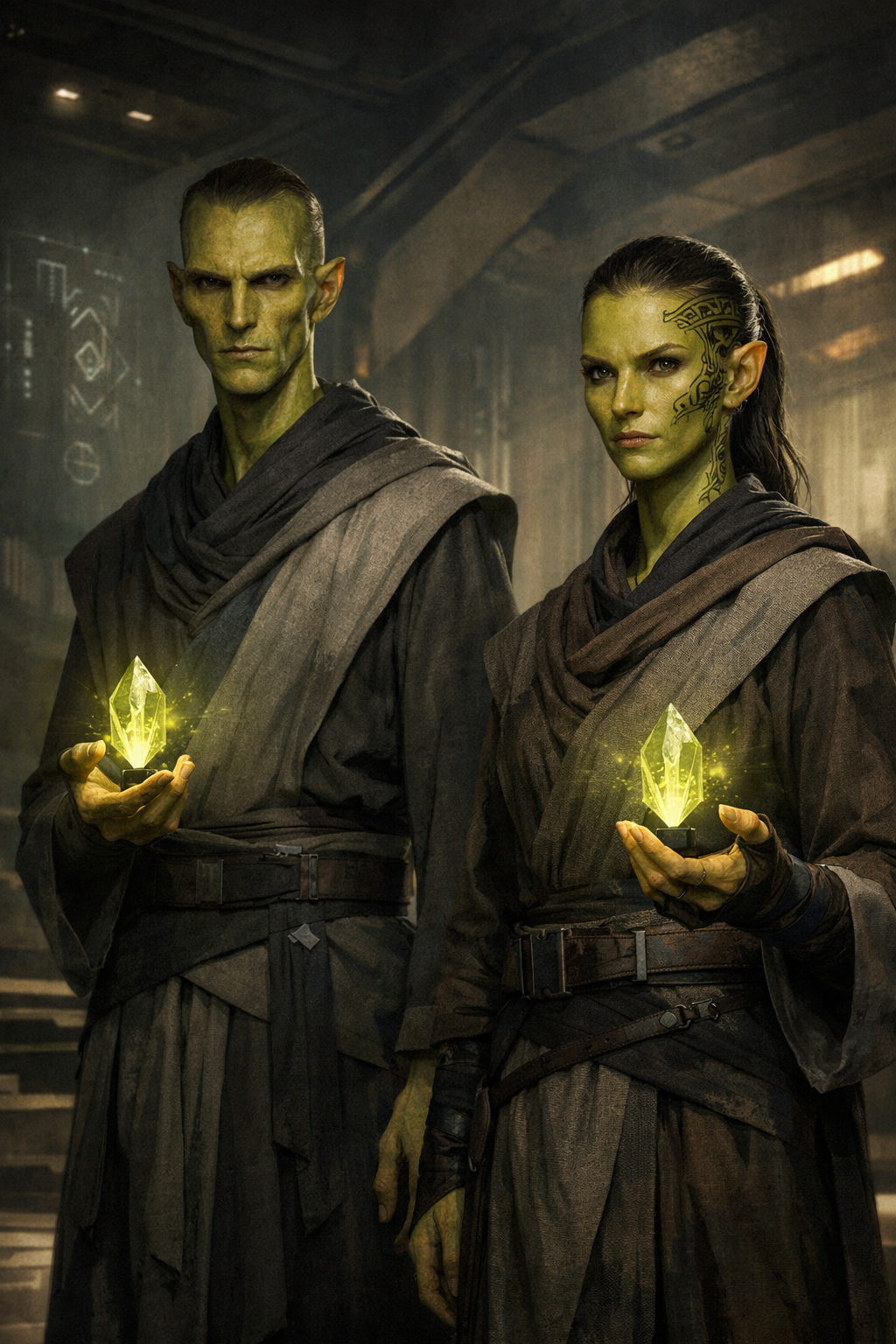
Zerai are lanky, toughened people shaped by ancient oppression and hard-won discipline. Their ancestors survived the Illithari not by outmuscling them, but by learning how to endure, how to refuse, and how to push back inside the mind. What began as survival under psychic domination became tradition: austere training, controlled emotion, and Astra practice refined into a philosophy as much as a weapon.
Once splintered into scattered lineages and schools, the Zerai have reunited as a single people with strong philosophical traditions. They are often calm in ways that unsettle others. It is not passivity. It is control.
Why Play a Zerai?
Play a Zerai if you want a disciplined warrior-monk, psychic duelist, or calm specialist who can endure pressure and push back mentally. Zerai fit naturally into Astra-focused storylines and campaigns where restraint, willpower, and inner strength matter as much as firepower.
Zerai Ancestry Abilities
Edge: Astra Gifted (+2)
All Zerai begin with the Astra Gifted Edge.
-
This represents an innate capacity to work Astra
-
Zerai typically learn early control practices and meditative discipline that make Astra use look effortless, even when it is not.
Telepathy (+1)
Zerai can communicate mentally with any sapient lifeform within 12” (24 yards) regardless of language.
Astra Resistance (+1)
Zerai gain +4 to resist Astra, and reduce any damage or severity from that source by 4 as appropriate.
Hindrance (Minor): Vow of Discipline (−1)
Zerai are taught that impulse is a weakness and that control is survival. You have a code of discipline that complicates life on the frontier: you avoid intoxication, cruelty, reckless escalation, or needless emotional outbursts (choose the specific expression with the GM).
This is a Minor Hindrance and should create meaningful choices rather than remove agency.
Hindrance (Minor): Marked (Illithari Legacy) (−1)
Zerai carry a history that makes people uneasy. Some fear what you can do. Others resent what was done to you. A few assume you are dangerous by default.
This is a Minor Hindrance representing suspicion, prejudice, or unwanted attention in certain ports, factions, or cultures (Gamemaster’s call).
Zerai in the Commonwealth Galaxy
Philosophy: Zerai traditions vary, but most share a central belief: freedom begins inside the mind. Many Zerai schools teach breathing disciplines, focus forms, and meditative practice as daily essentials, not spiritual luxuries.
Astra Practice: Zerai commonly treat Astra use as craft and responsibility. They are less likely to “show off” and more likely to view flashy power as sloppy. A Zerai who uses Astra openly is either very confident or very desperate.
Reputation: Some cultures respect Zerai as calm professionals. Others fear them as “psionic survivors,” assuming hidden influence and dangerous capability. Zerai learn to live with being watched.
Common Roles: Warrior-monk, duelist, bodyguard, counselor, Astra specialist, investigator, crisis negotiator, disciplined scout.
Names and Language
Zerai names often include soft syllables and controlled cadence, sometimes paired with school identifiers or honor titles. Many adopt short trade-names when traveling the Outer Rim.
Zerai typically speak English and one additional language of their choice.
Making Ancestries
Game Masters and players who want to make their own ancestries, engineered lineages, or cultural archetypes can use the system below. Astrabound uses this method so species feel distinct at the table without turning character creation into a spreadsheet.
Our ancestries are designed with the following rules:
-
Start with 2 points of positive ancestral abilities. These are “free” and represent the baseline biological or foundational traits of the ancestry.
-
Any additional positive abilities must be balanced by negatives so the ancestry totals back to Net 0. A +2 ability, for example, may be balanced by a single −2 ability or two −1 abilities.
-
If you want an ability that isn’t on the list, assign it a value by comparing it to similar abilities. If it feels stronger than a listed ability, price it higher. If it feels narrower or more situational, price it lower.
Names: Don’t be afraid to rename abilities to match Astrabound’s tone and culture. If your void-clan “just has Riding at d6,” that’s fine, but it often reads better as something like Born to the Tether or Railrunner Blood. The goal is flavorful, playable ancestries that the whole table can remember, not a pile of generic bonuses.
| VALUE | ABILITY |
|---|---|
| 1 | 360-Degree Vision (1): Bulbous or faceted eyes, independent eyestalks, or another unusual arrangement give the species an unhindered field of vision that lets them ignore 1 point of Gang Up bonus. |
| 1 | Acid Biology (1): The beings' blood and/or viscera are highly acidic. When one suffers a Wound, everyone within a Small Blast Template must roll Evasion or suffer 2d6 damage. If the being takes two or more Wounds from the attack, increase the damage to 3d6. The species is immune to acid and acid-based attacks. |
| 2 | Adaptable (1): The ancestry has great variation among its people and cultures. Characters start with a free Novice Edge of their choice (and must meet all the Edge's Requirements). |
| 3 | Additional Action (1): The being has additional appendages, enhanced reflexes, or exceptional eye-hand coordination. He may ignore 2 points of Multi-Action penalties each turn. |
| 4/5 | Additional Action Option B (1): The species is quick, mentally or physically, for 4 points, allowing them to reduce Multi-Action penalties by 2 if all the actions are physical or mental. For 5 points, they can ignore 2 points of Multi-Action penalties for either type of action. |
| −1 | Alien Form (1): The beings' size and shape are incompatible with most equipment and vehicles used in the setting. They can only wear customized armor and subtract 1 from Trait rolls when using non-customized equipment and vehicles. Items can be customized for 100% of the base cost. If the creature is Big as well, use only that ability. |
| 1/2 | Aquatic/Semi-Aquatic (1): For one point the character is semi-aquatic and can hold his breath for 15 minutes before checking for drowning. For two, he's native to the water. He cannot drown in oxygenated liquid and moves his full Pace when swimming. |
| 1 | Armor (3): The species has a thick hide or is encrusted in solid material like scaly plating or even rock. This grants Armor +2 each time it's taken. |
| −1/–2/−4 | Atmospheric Dependency (1): The species requires a rare atmosphere to survive. Any other atmosphere is hazardous, requiring a Vigor roll every hour to avoid a Fatigue level that can lead to death. This check is made every minute for –2 points, or every round for –4 points. Breathable air at standard pressure allows the being to recover one Fatigue level every 10 minutes. |
| −2/–3 | Attribute Penalty (Once per Attribute): One attribute (but not its linked skills) suffers a –1 penalty. For 3 points, it suffers a –2 penalty. If Strength, this applies to damage as well. |
| 2 | Attribute Increase (U): During character creation, the species increases a particular attribute (Agility, Smarts, Spirit, Strength, or Vigor) one die type. This increases the Trait's maximum by one as well. |
| −2 | Big (1): The race is particularly large in a world where most others aren't. He subtracts 2 from Trait rolls when using equipment that wasn't specifically designed for his race and cannot wear their armor or clothing. Equipment, food, and clothing cost double the listed price. |
| 1/2/3 | Bite (1): The species has fangs that cause Str+d4 damage and may be used on grappled foes. Increase the bite to d6 for +1 point, and/or AP 2 for +1 point. See Natural Weapons in Savage Worlds. |
| 1 | Bite Option B (1): The species has fangs that cause Strength+d4 damage. See Natural Weapons. |
| 1 | Bloodless (1): Members of the species automatically stabilize whenever they would Bleed Out without needing to roll. Rending weapons deal no extra damage to them. |
| 2 | Breath Weapon (1): The species can breathe fire, cold, acid, or other energy by making an Athletics roll as a limited action. This uses the Cone Template, may be Evaded, and causes 2d6 damage (3d6 with a raise). A Critical Failure causes Fatigue. Other breath weapon types may have additional effects and increase the cost by the Power Point modifier appropriately. |
| 1 | Burrowing (1): The species can burrow into loose earth and move through it at half normal Pace. He cannot normally be attacked while burrowing, and can attempt to surprise opponents with an opposed Stealth vs. Notice roll. If successful, the burrower adds +2 to attack and damage rolls that round, or +4 with a raise (he has The Drop. |
| 1/2 | Camouflage (1): The being's skin or exoskeleton allows her to effortlessly blend in with her natural surroundings. For 1 point, pick a terrain type. For 2 points, she can change color to match any natural surrounding. While camouflaged, she adds +2 to Stealth (+4 while completely motionless). The bonus is halved if half or more of her skin is covered by clothing, and she gets no bonus if completely covered. |
| −1 | Can't Heal (1): The species has no capacity for natural healing or self-repair, but may otherwise be healed normally. |
| −1 | Cannot Speak (1): The species has no vocal cords or cannot form the sounds made by most other races. He can communicate with members of his own ancestry naturally. Other ancestries may learn to understand him if they take the proper Language skill. The species can hear and understand other typical languages and may communicate via electronic devices. |
| 2/3/4 | Claws (1): The being has claws that cause Str+d4 damage. One more point may be spent to increase their damage to Strength+d6, and/or another to add AP 2. See Natural Weapons. |
| −3 | Cold-Blooded (1): The species subtracts 1 from Agility, Strength, and Vigor rolls after spending more than ten minutes in temperatures below 60° Fahrenheit (18° Celsius). The being recovers after spending more than ten minutes in a warmer temperature. |
| 1 | Communal (1): The being is part of a hive mind or highly integrated social construct. He gains a +2 bonus to Spirit rolls when others of the same species are present within 12" (24 yards). |
| 8 | Construct (1): Constructs are artificial beings made of inorganic material. They add +2 to recover from being Shaken, ignore one level of Wound modifiers, don't breathe, and are immune to disease and poison. Wounds must be mended via the Repair skill. Each attempt takes one hour per current Wound level and ignores the "Golden Hour." Many Constructs have the Dependency negative ancestral ability. |
| 1 | Darkvision (1): The species can see in the dark a short distance, ignoring all Illumination penalties and up to 2 points of penalties from invisibility or similar powers within 10" (20 yards). |
| −2 | Dependency (1): The being must consume or have contact with some sort of relatively common substance for an hour out of every 24. Without the required contact, a character becomes Fatigued each day until Incapacitated. A day after that, they perish. Each hour spent recovering with the appropriate substance restores a level of Fatigue. |
| 2/4/6 | Diminutive (1): The cost to create a Diminutive being is 2 points for Small Scale, 4 for Very Small, or 6 for Tiny. Small creatures (Size −2) have a max Strength of d8 and subtract 2 from Toughness and damage rolls. Very Small (Size −3) subtract 3. Tiny (Size −4) subtract 4. Gear weighs and costs proportionally less at each scale. |
| 2 | Doesn't Breathe (1): The species does not breathe. Individuals aren't affected by inhaled toxins, can't drown, and don't suffocate in a vacuum. (They may still freeze, however.) |
| 1 | Echolocation (1): The character can "see" by emitting sound and receiving its echo. As long as he can emit and receive sound, he may ignore all Illumination penalties and up to 4 points of blindness, invisibility, or other sight-based penalties within 10" (20 yards). |
| 2+X | Edge (U): All members of this species have the same innate Edge chosen from those available in the setting. Unlike Adaptable, this ability ignores Requirements except other Edges. Each Rank beyond Novice costs an additional point to a maximum of Heroic Rank (5). |
| 4 | Energy Form (1): The being's body is made of energy. It has no vital organs and ignores Called Shots and takes no damage from falling, collisions, or physical weapons and projectiles. The being can fit through all but filtered openings as if they were Difficult Ground. It can't wear armor, use weapons, or manipulate matter unless it wears a containment suit. |
| 1 | Environmental Resistance (U): The species receives a +4 bonus to resist a single negative environmental effect, such as heat, cold, lack of air, radiation, etc. Damage from that source is also reduced by 4. |
| −1 | Environmental Weakness (U): The species suffers a –4 penalty to resist a particular environmental effect, such as heat, cold, etc. If the being suffers an attack based on that form, the penalty acts as a bonus to damage. |
| 2 | Extra Limbs (2): The creature has an additional set of arms. The limbs may be used for sustained actions, holding a flashlight, or grappling, leaving other limbs free. They can also wield two different two-handed weapons, add +1 Gang Up bonus in melee, and add +1 to Athletics rolls. |
| 2/4/6 | Flight (1): The species can fly at Pace 6 (or 12 for 4 points) and "run" for extra movement. For 6 points, the being can fly at Pace 24 and may "run" for 2d6″ of additional movement. Maneuvering uses the Athletics skill. Wings can be targeted or fouled (a Bound or Entangled character cannot fly). |
| −1 | Frail (2): The creature is less durable than most. Reduce its Toughness by 1. |
| 2/3 | Gelatinous (1): The species has an amorphous, almost liquid body with no vital organs. Members take only half-damage from falling or collisions and Called Shots do no extra damage. For 3 points the creature can make an Athletics roll to ooze through grates or large openings like Difficult Ground. Cracks take 1d6 rounds to seep through, leaving the hero Vulnerable until she reforms. |
| 2 | Hardy (1): A second Shaken result in combat does not cause a Wound. |
| 1 | Heightened Senses (3): The character gains one of the following each time taken: 1) Eagle Eyes: Read fine print up to a mile distant; reduces Range penalties by 1. 2) Hearing: Hear a whisper up to a mile away; +2 to Notice rolls based on hearing. 3) Smell: +2 to Survival rolls made to track if the target had a scent and the trail is no more than a day old. |
| −1/–2 | Hindrance (U): The being has an inherent Minor Hindrance for 1 point, or a Major Hindrance for 2. This doesn't affect the ability to choose other Hindrances during character creation. |
| 1/2 | Horns (1): The being has a horn or horns that cause Str+d4 damage (or Str+d6 for 2 points). See Natural Weapons. |
| 2 | Husk (1): The being inhabits another body (the "husk"), either taken, purchased, or recovered. The neural connection ignores 1 point of Wound penalties. If not destroyed by the husk's death, it can inhabit a new host body within 24 hours. The new host has the same statistics. |
| 1 | Immune to Poison or Disease (2): The species is immune to poison or disease (your choice). It may be taken twice for both effects. |
| 1 | Infravision (1): The creature "sees" heat, either through eyes or other sensory organs. This halves Illumination penalties when attacking warm targets (including invisible beings). |
| 2 | Interface (1): The beings can link directly to electronic devices, adding +2 to Electronics and Hacking rolls when using a device they're able to connect to. |
| 4/8 | Invisibility (1): The beings are translucent (–2 to see or attack) for 4 points or entirely invisible (–4 to see or attack) for 8. Carrying gear reduces the penalty by 2 points, and wearing clothing or body armor reduces it by 4. |
| 2 | Leaper (1): The character can jump twice as far as listed under Movement. In addition, he adds +4 to damage when leaping as part of a Wild Attack instead of the usual +2. |
| 1 | Low Light Vision (1): The being ignores penalties for Dim or Dark illumination (but not Pitch Darkness). |
| 1 | Mods (1): The species has three robotic Mod slots, plus or minus their Size. Each installed Mod must still be purchased normally. |
| −4 | No Manipulators (1): The species lacks hands or digits. They can't use any equipment that wasn't specifically designed for their species. Clothing and armor may be placed on them but they can't dress or undress without help. |
| 1 | No Vital Organs (1): These species have hidden, extremely tough, or redundant vital organs. Called Shots do no extra damage against them. |
| 2 | Pace (2): The character's Pace is increased by +2 and his running die is increased a die type. |
| 1 | Parry (3): The creature's natural Parry is increased by +1. This may be due to a prehensile tail, extra limbs, enhanced reflexes, or even latent psi-sense. |
| 1/3 | Poisonous Touch (1): With a successful Touch Attack, bite, or claw, the victim must roll Vigor or suffer the effects of Mild Poison. For 3 points the poison can be upgraded to Knockout, Lethal, or Paralyzing instead, but each use causes the hero Fatigue. The character may always choose whether or not to use her poison touch. |
| 1/3F | Poisonous Touch Option B (1): When the character hits a foe with an unarmed attack, the target must make a Vigor roll or suffer Mild Poison. Change the poison to Knockout for +1, Lethal for +3, or Paralyzing for +2. For +2 points, the character can spit or project her poison up to 6" away via an Athletics roll. A concentrated dose forces a −2 penalty to the Vigor roll but causes the hero Fatigue. |
| −1 | Poor Parry (3): These beings are poor melee defenders; –1 Parry. |
| 2/1 | Power (U): The species has an innate ability that functions like a power. For 2 points, she has Arcane Background (Gifted) and a power reflecting her unusual ability. Each additional power costs 1 point. It does not increase Power Points. |
| 1 | Reach (3): Long limbs, tentacles, etc. grant the creature Reach +1 (add +1 each time it's taken after the first). |
| −1 | Reduced Core Skills (5): This species starts with one less core skill. The skill may be gained normally but does not start at a d4. This may be taken once per core skill affected. |
| −1/–2 | Reduced Pace (1): For –1 point, reduce Pace by 1 and the running die a die type. For –2 points, reduce Pace another 2 points and subtract 2 from Athletics and rolls to resist Athletics where movement and mobility are integral. |
| 2/3 | Regeneration (1): The being heals damage quickly, making a natural healing roll once per day. For 3 points, permanent injuries may be recovered once all other Wounds are regenerated, treating each injury as an additional Wound for recovery purposes. |
| −1 | Repugnant (1): The species has an odor, appearance, or habits that disgusts most other cultures. Reactions are always either Unfriendly or rolled on 1d6 instead of 2d6. A roll of 1 is treated as Hostile, and the unfortunate being becomes physically ill. |
| 6 | Robot (1): The being is a mechanical and electronic entity. Robots don't breathe, are immune to disease and poisons, ignore decompression and background radiation. They have Robotic Mod slots based on their Size and can't make natural healing rolls — they must be Repaired rather than Healed and ignore the Golden Hour for Wounds. |
| −2 | Separation Disorder (1): Members of the species require others of their kind in close proximity to function unhindered. They subtract 2 from Spirit rolls when no other beings of the same species are within line of sight. |
| 4 | Shapeshift (1): As a limited action, the species can assume the appearance of another being within 2 points of Size. To duplicate a specific individual, the shapeshifter must touch the target and make an opposed Smarts roll. With a raise, he also gains surface memories, voice, fingerprints, retinal patterns, etc. |
| −1/–2 | Sickly (1): Members suffer a –2 penalty to any Vigor roll made to resist or recover from disease. For –2 points, the character must roll Vigor any time she suffers a Wound — if failed, she becomes infected with a Debilitating Disease. |
| 1/2 | Size +1 (3): The creature is larger than normal. Each point of Size adds directly to Toughness and increases maximum Strength one step. Large species may have difficulty using equipment designed for more traditional humanoids. |
| −1 | Size –1 (1): The entity is smaller than average, reducing its Size and Toughness by 1. |
| 1/2 | Skill (1/skill): The character starts with a d4 in a skill inherent to her race or culture. For 2 points (or 1 if already a core skill), it starts at d6 and the skill's maximum increases to d12+1. |
| 1/2 | Skill Bonus (Once per Skill): Biological factors give the race a +1/+2 bonus when using a particular skill. A race that emits pheromones, for example, might have a +1 bonus to Persuasion. |
| −1/–2 | Skill Penalty (Once per Skill): The species suffers a –1 penalty to a very commonly used skill. If the skill is less common or only comes up in certain situations, the penalty is −2. For 2 points, the penalty is −2/−4 instead. |
| 1 | Sleep Reduction (2): The being needs half the normal amount of sleep as humans. If taken a second time, the being never sleeps. |
| 3 | Spacer (1): The beings can survive in space without artificial means. They have the Doesn't Breathe ability and ignore the effects of decompression and background radiation. This doesn't confer any other environmental resistances. |
| 1 | Stable (1): The species has multiple legs, a serpentine body, or strange limbs that operate like a tracked vehicle. They ignore the penalty for Difficult Ground. |
| 2 | Stun (1): When the character hits a foe with an unarmed attack, the target must make a Vigor roll or be Stunned. The attacker may focus his ability for a level of Fatigue, causing the target to subtract 2 from her Vigor roll. |
| 2+X | Super Powers (1): The ancestry has truly extraordinary abilities taken from the Savage Worlds Super Powers Companion. The cost is 2 for Arcane Background (Super Powers) plus the actual cost of the power selected (X). Gamemaster permission required. |
| 1 | Telepathy (1): The species can communicate mentally with any sapient lifeform within 12" (24 yards) regardless of language. |
| 2/4 | Tentacles (2): The being has tentacles that add +2 to grappling rolls. For 4 points, characters of this ancestry gain two tentacle actions. |
| 1 | Toughness (3): The character has hardened skin, scales, or extremely dense tissue that increases his base Toughness by +1. |
| 8 | Undead (1): The being is undead or has a physiology similar enough to call them so. They have +2 Toughness, +2 to recover from being Shaken, take no additional damage from Called Shots, ignore 1 point of Wound penalties, don't breathe, and are immune to disease and poison. |
| −1 | Ancestral Enemy (U): This species dislikes another species relatively common to the setting. They suffer a –2 penalty to Persuasion rolls when dealing with their rivals and may become hostile with little provocation. This may only be taken once per race. |
| 1 | Wall Walker (1): The species may walk on vertical surfaces normally, or inverted surfaces at half Pace. |